
Francisco Ruiz, Toledo, Spain.
The Ruiz family was renowned in the Spanish arms industry, particularly in the production of ceremonial swords, and we hear of its members as early as the mid-16th century. Francisco Ruiz was most likely the son of Sebastian Ruiz, a "rapier maker" at the court of Emperor Maximilian II. The latter is mentioned in court records as early as 1565 with a monthly salary of 5 florins; however, he likely had already been in Maximilian's service for many years. In 1570, he was paid 20 florins "for special reasons and by favor." Sebastian crafted not only sword blades but also ornate and embossed hilts, scabbards, and belt accessories. In 1570, he left the imperial service, returned to Spain, and on July 27, in recognition of his many years of service, received 40 florins as travel expenses. The Ruiz surname is not uncommon in Spain, and we encounter it again among goldsmiths and doradors. Julián Ruiz worked in Toledo around 1524, and Jerónimo in Granada. Juan, also from Andalusia, was nicknamed Vandolino. He is believed to have been from Córdoba and a student of Enrico d'Arfe. Documents relating to him date back to 1533. Juan de Arfe, in his "Various Estimations," calls him the first goldsmith in Spain. Around 1590, the goldsmiths Diego Ruiz and Juan Ruiz worked in Toledo around the same time as Francisco.
A study of Francisco's work reveals that it differs significantly from Spanish national styles and is based on German ones. Several researchers, most recently Robert, have already made this observation but have been unable to explain it.
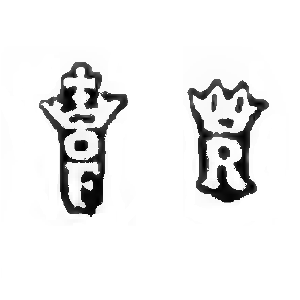
According to excerpts from Palomina's Jubilee Collection of the Royal Armory, Francisco also had a brother, Antonio, who initially worked as a blacksmith in Toledo and later in Madrid, and bore a mark almost identical to that of our master: a crowned F. A blade (981) by this Antonio is in the castle of Ambras in Tyrol, and a second is in a sabre, a single-edged short sword (544), in the Royal Armory of Madrid. The mark on this blade is struck six times. Francisco, who was called "el viejo" (the elder) to distinguish him from his son of the same name, undoubtedly received his early education in Germany. He was born around 1560 and worked until about 1620. Unfortunately, we do not see examples of his work in the Royal Armory of Madrid. The master is well represented in the Royal Museum in Brussels by three blades, the hilts of which can also likely be attributed to him. One rapier (VIII. 77) has a hexagonal blade and bears the inscription "Francisco Ruiz in Toledo." The second (VIII. 79), with a square blade, bears the master's mark, as well as the Toledo mark and the master's name, as shown nearby. The third (VIII. 86) is also hexagonal and bears only the master's name. The shapes are similar to the blades from Solingen. In the Royal Historical Museum in Dresden, we find his oldest hallmark on a rapier blade, next to a hallmark and name, which shows that the maker originally also used a crowned R.
In the Artillery Museum in Paris, we see three more works by the master: a rapier from the late 16th century (J. 178) with the inscription "de Francisco in Toledo"; a second (J. 244) with the name "Francisco Ruiz" on the blade, from the early 17th century, which Robert, based on the inscription, considers a German imitation; and finally, a rapier with a single-edged weapon (J. 364) from the early 17th century, with a beautiful hilt of etched and blackened iron and the name "Ruiz en Toledo" on the blade. Such rapiers with firing mechanisms are always of Brescia or German origin, and this work once again demonstrates that the master worked outside of Spain. The blades of our master's son, also named Ruiz, are almost exclusively urban rapiers with sharp fullers but weak tangs. They bear the same name as his father's blades, sometimes also his F mark, as well as another mark struck in gold.
His works can be found in the Imperial Arms Collection in Vienna (804), in the royal collection in Copenhagen (B. 233, 288), and in the royal armory in Stockholm (56a), on the sword of King Frederick I, and finally in the royal armory in Berlin. At the same time as the younger Francisco, another, lesser, Juan, was working in Toledo. The Palomina bears his mark.
Around the turn of the 16th century, in the inventory of the treasury of King Philip III, we find Francisco Ruiz, along with Antonio Alba, as guarda joyas, or treasurer. The name Ruiz was indeed quite common, "but it is not surprising that our master, being a rapier maker and gilder of armour, later entered the service of the king."
Source: Meister der Waffenschmiedekunst vom XIV. bis ins XVIII. Jahrhundert, Wendelin Boeheim, 1897, Berlin, 183
Weapons of the great master you can see: