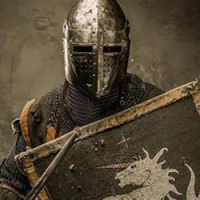

The medieval knight's dagger was a faithful companion to the sword, a reliable "second blade" that saved lives in close combat when the main sword broke, got stuck in armor, or proved too long for close combat. For a knight, a dagger was not just a weapon, but a last line of defense and a symbol of readiness to fight to the end.
From a fighting knife to a knight's dagger.
In the Early Middle Ages (11th–13th centuries), knights carried simple fighting knives—seax or scramasax—short, wide blades inherited from Germanic traditions. By the 14th century, with the development of plate armor, a specialized knight's dagger emerged.
The most famous types are:
Basilard—a dagger with a characteristic H-shaped crossguard and often a wide blade. Popular in Italy and Switzerland.
The rondel dagger is the most classic knightly dagger of the 14th and 15th centuries. It has a narrow, three- or four-sided blade with round discs (rondels) at the top and bottom of the handle. It was ideal for piercing chainmail and armor joints.
The ballock dagger (or kidney dagger) has characteristic "egg-shaped" protrusions at the base of the handle, reminiscent of a man's testicles. It was popular in England and the Netherlands.
The estoc or misericorde is a very narrow, unsharpened thrusting dagger, intended solely for finishing off a fallen knight through gaps in armor (from the French miséricorde, meaning "mercy").
The dagger was usually worn on the right side of the belt or behind the shin, allowing for quick access with the left hand when the right was occupied with a sword or shield.
Design and Craftsmanship.
Knightly daggers were made of high-quality steel. The blade was often diamond-shaped or triangular in cross-section—this provided maximum rigidity with minimal weight and excellent piercing ability through chainmail. The handle was made of wood, bone, horn, or metal, wrapped in leather or wire.
Particular attention was paid to balance: the dagger had to fit comfortably in the hand, even when wearing a gauntlet. Many daggers were decorated with engravings, coats of arms, or religious symbols—the knight believed that the dagger protected not only the body but also the soul.
In battle: the knight's final argument.
In a close melee, when a knight fell from his horse or found himself on the ground in heavy armor, the dagger became his primary weapon. It could be used to:
Deliver powerful thrusts to the visor, armpits, groin, or joints of armor.
Cut the straps of an opponent's armor.
To finish off a wounded enemy (hence the name "misericordia"—merciful blow).
Experienced warriors used a dagger in combination with a sword: they would grasp the enemy's weapon or shield with their left hand and strike with their right. In duels and tournaments, the dagger was often used in a "half-sword" style—holding the sword by the blade and using it as a hammer, while the dagger was used for precise thrusts.
A symbol of status and knightly honor.
The dagger was not only a practical weapon but also a source of pride. Wealthy knights commissioned daggers from the best craftsmen, engraved with mottos or images of saints. In some cases, the dagger was given as a token of special favor or used in knighting ceremonies.
In the late Middle Ages, the dagger sometimes became a symbol of mercy: a knight could grant a defeated man a "misericordia"—a swift and relatively merciful end.
The legacy of the medieval dagger.
Today, original knightly daggers are rare museum pieces, striking in the quality of their steel and precision of fit even after 600 years. Reenactors and historical fencers actively use exact replicas of rondels, basilards, and ballock daggers, attesting to their incredible effectiveness in close combat.
The medieval knight's dagger embodies practicality, cruelty, and nobility all at once. When a knight in full armor drew his dagger, he knew the battle had entered its final, most personal phase. This small blade embodied the essence of chivalry—the willingness to fight to the last breath, even when the sword is useless.
This weapon still reminds us: true strength often lies not in something large and heavy, but in something short, sharp, and always ready for action.