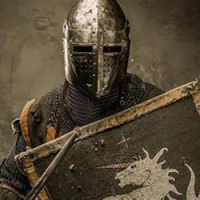

The war hammer is a weapon that embodied the very essence of the late Middle Ages: when a slender sword could no longer pierce the thick steel of a plate, a knight would take up a hammer and transform combat into a metalsmith's forge. Short, heavy, and merciless, it didn't chop or pierce, but crushed. One precise blow and a breastplate would dent, a helmet would crack, and the bones beneath the armor would snap like dry twigs.
Evolution: From a Simple Hammer to a Knightly Weapon.
In the Early Middle Ages, knights sometimes used ordinary blacksmith's hammers or axes. But the war hammer's true heyday came in the 14th and 15th centuries—the era of full plate armor. It was then that the classic form emerged:
The short hammer (one-handed war hammer) was used for foot and mounted combat, with a handle length of 40–70 cm.
The long hammer (two-handed or horseman's hammer) was up to 1.2–1.5 meters long, and was more often used on foot.
The hammer head had two sides:
A flat or slightly convex hammer face was used for crushing.
A sharp beak or spike was used for punching holes in armor, armpits, visors, or joints.
Sometimes a spike or even a small hatchet was added to the butt. In the late Gothic period, hammers became true works of art: engraved, gilded, and decorated with heraldic symbols.
Construction: destructive engineering.
The handle was made of durable wood (ash, oak, walnut), often covered with metal or reinforced with leather to withstand blows from enemy weapons. The head was forged from high-carbon steel: the hammer was forged to transmit maximum energy, and the beak was thin but incredibly strong to penetrate steel.
The hammer typically weighed 1–2 kg. This allowed for rapid, repeated strikes even while wearing heavy gauntlets. Some luxurious examples had a handle wrapped in silver or gold wire and engraved with the knight's motto.
In combat: "hammer on armor."
The knight's hammer was an ideal weapon against a fully armored opponent. It did not attempt to cut armor, but rather deformed it. A blow from the hammer could stun, break a collarbone, or rib. The beak penetrated joints, pierced a helmet, or lodged itself in the metal, allowing the enemy to be pulled to the ground.
The hammer was especially effective in dismounted combat during the Hundred Years' War, the Wars of the Roses, and the Italian campaigns. Experienced knights used it in combination with a dagger: first, they knocked down their opponent with a powerful blow, then finished him off by striking him through a gap in his armor.
A symbol of status and practicality.
Unlike the "noble" sword, the hammer wasn't considered a particularly chivalrous weapon in the early centuries. But by the 15th century, everything had changed: even kings and dukes commissioned luxurious hammers from the best armorers in Milan, Augsburg, and Nuremberg. It became the sign of a practical warrior, prepared for real war, not just tournaments.
Some hammers served a purely ceremonial function, but most were practical instruments of death.
The Legacy of the Knight's Hammer.
Today, original medieval war hammers are kept in museums (the Metropolitan, the Tower of London, the Dresden Armory) and impress with the quality of their forging. Historical fencing reenactors actively use replicas and confirm that the hammer remains one of the most effective weapons against plate armor.
The knight's hammer is a symbol of a transitional era. When chivalry met the reality of heavy armor, the grace of the sword gave way to the brutal yet honest power of the hammer. Each blow echoes the clang of metal and the cracking of bones—the voice of the late Middle Ages, when victory went not to the most beautiful swordsman, but to the one capable of shattering an opponent.
This weapon reminds one of a simple truth: sometimes, to preserve honor, one simply needs to take the hammer and strike so hard that the enemy never rises again.