








Abstract.
The image of the medieval knight has become firmly embedded in modern culture: a warrior encased in heavy plate armor—supposedly hoisted onto his horse by a crane, unable to get back up after a fall, and virtually incapable of movement. However, a significant portion of these notions emerged long after the Middle Ages—in 19th-century literature, popular culture, cinema, and historical reenactments. Contemporary study of surviving armor, written sources, and experimental archaeology allows for a substantial correction of this image. This article examines the most common myths about knights, their origins, and how they align with historical evidence.
Introduction.
The medieval knight is one of the most recognizable figures in European history. In the popular imagination, he appears simultaneously as a warrior, an aristocrat, a participant in tournaments, and a hero of romantic tales. Yet, the modern image of the knight is a kind of historical "collage." It blends authentic information about the medieval warrior class with literary ideals of courtliness, later historical reconstructions, and numerous cinematic clichés. Myths are particularly prevalent regarding armor. To the modern mind, medieval plate armor is often perceived as a heavy metal shell that rendered the wearer almost completely immobile. In reality, experts in arms and armor have long pointed out that a well-crafted suit of field armor was a sophisticated engineering system, designed not only for protection but also to allow for freedom of movement. The Metropolitan Museum of Art in New York has even dedicated a specific educational resource to this topic, cataloging the most common misconceptions about arms and armor.
Myth №1. A knight in full armor could barely move.
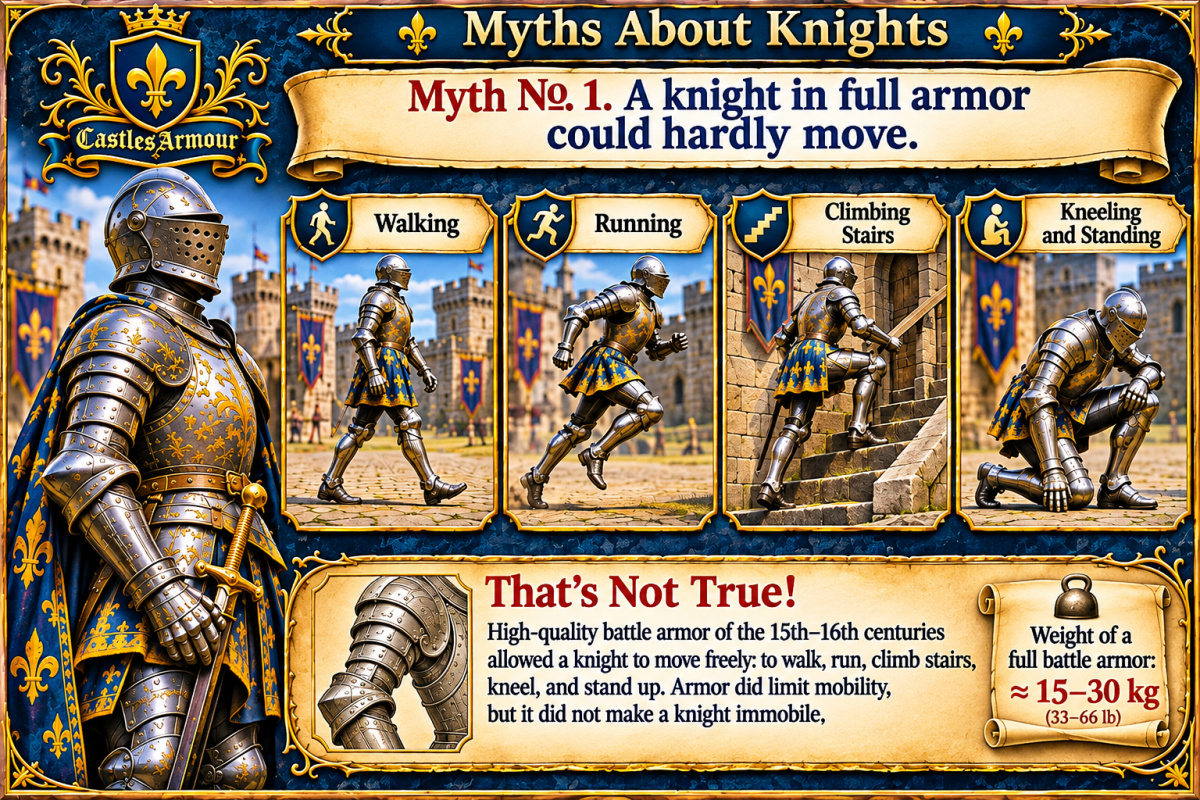
This is one of the most persistent stereotypes. In films, a knight is often portrayed as someone who struggles to take a step, cannot bend, quickly loses his balance, and effectively turns into an immobile metal structure. Historical evidence suggests otherwise. A full suit of field armor from the 15th–16th centuries typically weighed around 20–25 kg (44–55 lbs), though the exact weight varied depending on the type, purpose, size, and period of manufacture. The Metropolitan Museum of Art cites this specific range for a typical suit of field armor. What mattered most was not just the amount of metal, but how that weight was distributed. Armor consisted of many individual components. The plates were connected by hinges, rivets, straps, and other flexible joints. This allowed the elbow to bend, the knee to flex and extend, and the shoulder area to retain a significant range of motion. Modern experiments using reconstructed armor have shown that a person can walk, run, sit on the ground, and stand back up while wearing a well-made suit of plate armor. However, this does not mean the armor was light. Experimental studies have shown that moving in armor required significantly more energy; the energy expenditure for walking or running was roughly double that of moving without armor. In short: a knight was not immobile, but the physical exertion required was much higher.
Myth №2. If a knight fell, he could not get back up on his own.
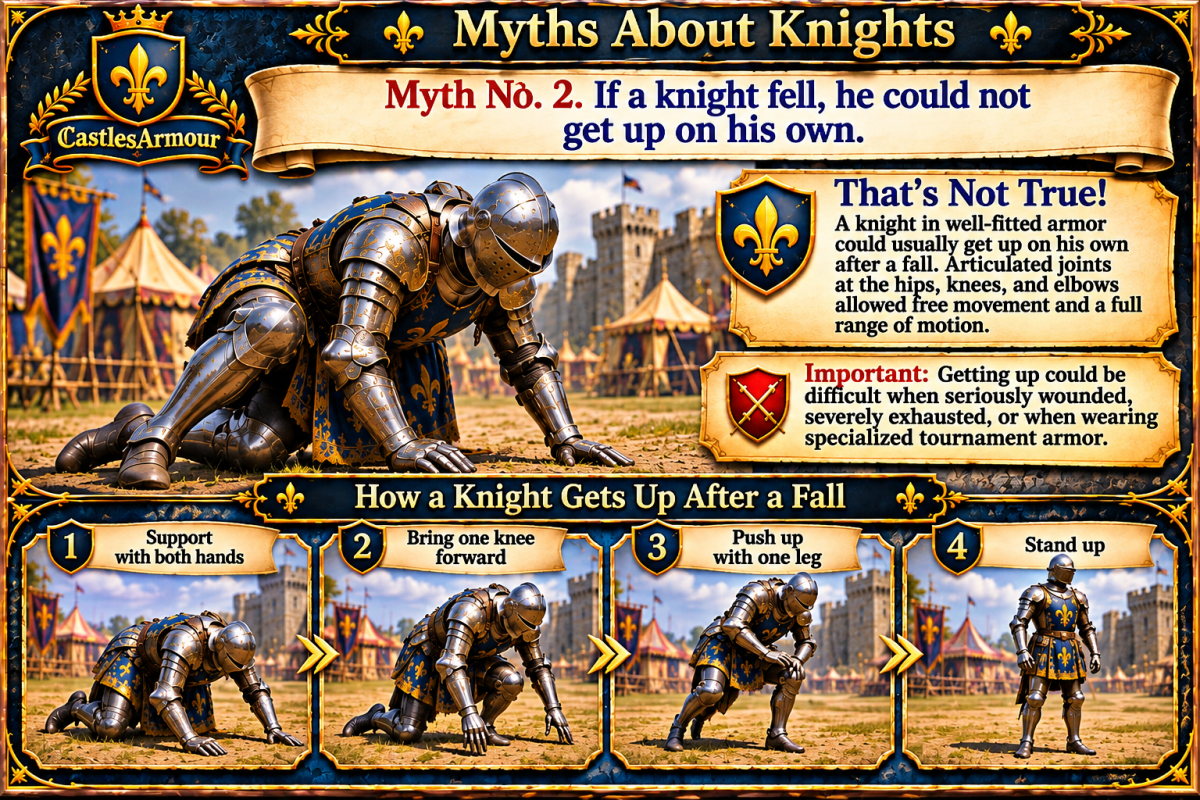
This scenario is frequently depicted in popular films and historical reenactments. The idea is that once a person in plate armor ended up on the ground, they became virtually helpless. However, the design of the armor contradicts this. The mobility of a suit of plate armor allowed a person to bend their knees, elbows, and hip joints. There are depictions of medieval warriors in various postures, and written accounts describe the physical exercises performed by heavily armored combatants. A particularly notable example is the French knight Jean II le Meingre, better known as Boucicaut. Historical sources describe his extraordinary physical fitness. Modern experiments reconstructing his training regimen have shown that many movements—which might seem impossible to perform while wearing armor today—were, in fact, entirely feasible. Consequently, a fall could indeed be dangerous—but not because the knight would become trapped, helpless, inside a metal shell.
Myth №3. Knights were hoisted onto their horses using a crane.
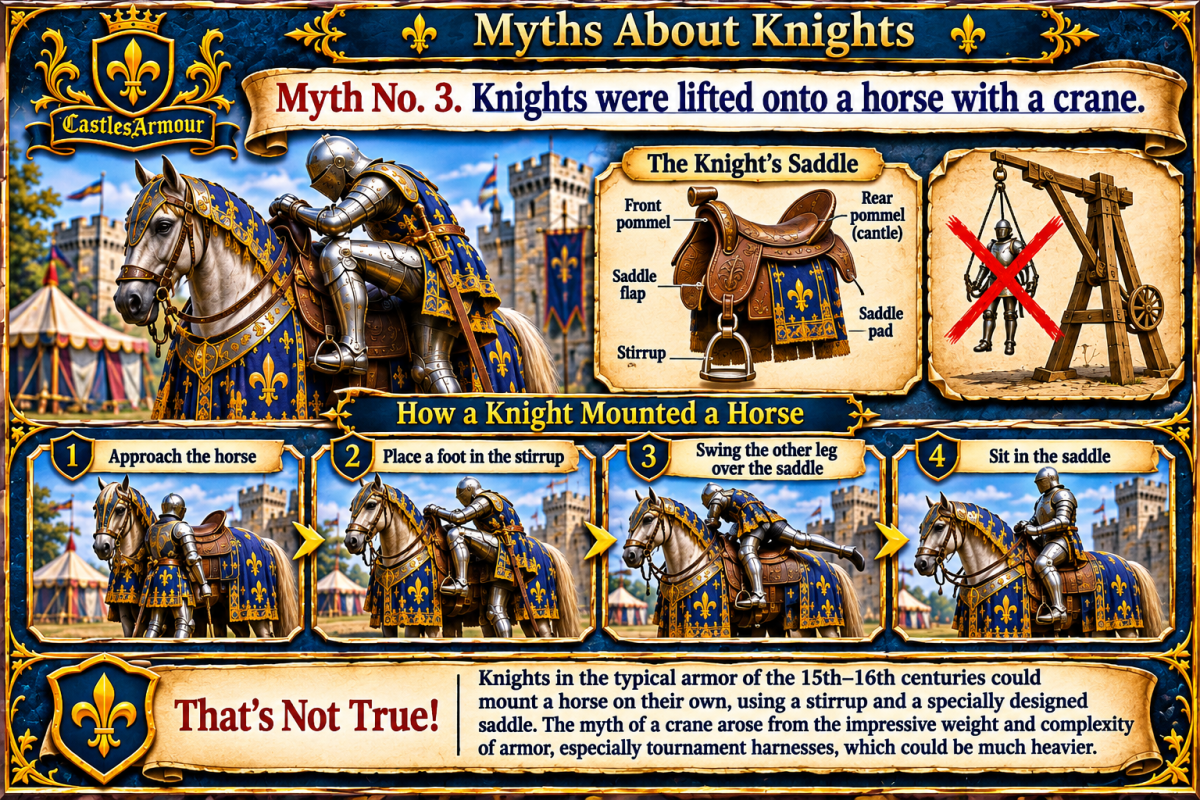
This is perhaps the most famous myth regarding the medieval knight. In paintings—and especially in popular culture—one occasionally encounters scenes where a heavily armored knight is supposedly lifted into the saddle by means of a mechanical device. In reality, this was unnecessary for standard combat armor. The Metropolitan Museum of Art explicitly labels the notion that knights were hoisted into the saddle by a crane as historical fiction. Furthermore, research by Robert Woosnam-Savage of the Royal Armouries specifically examines the origins of this myth. He demonstrates that the idea of needing a mechanical aid to lift a knight onto his horse is a later misconception that has become widespread in popular culture. Admittedly, for certain types of tournaments, specialized equipment, mounting steps, or the assistance of a squire might have been used. Tournament armor could be specially reinforced and differed significantly from the armor worn on the battlefield. But making this a rule for all knights would be a mistake.
Myth № 4. All medieval knights wore the same type of heavy plate armor.
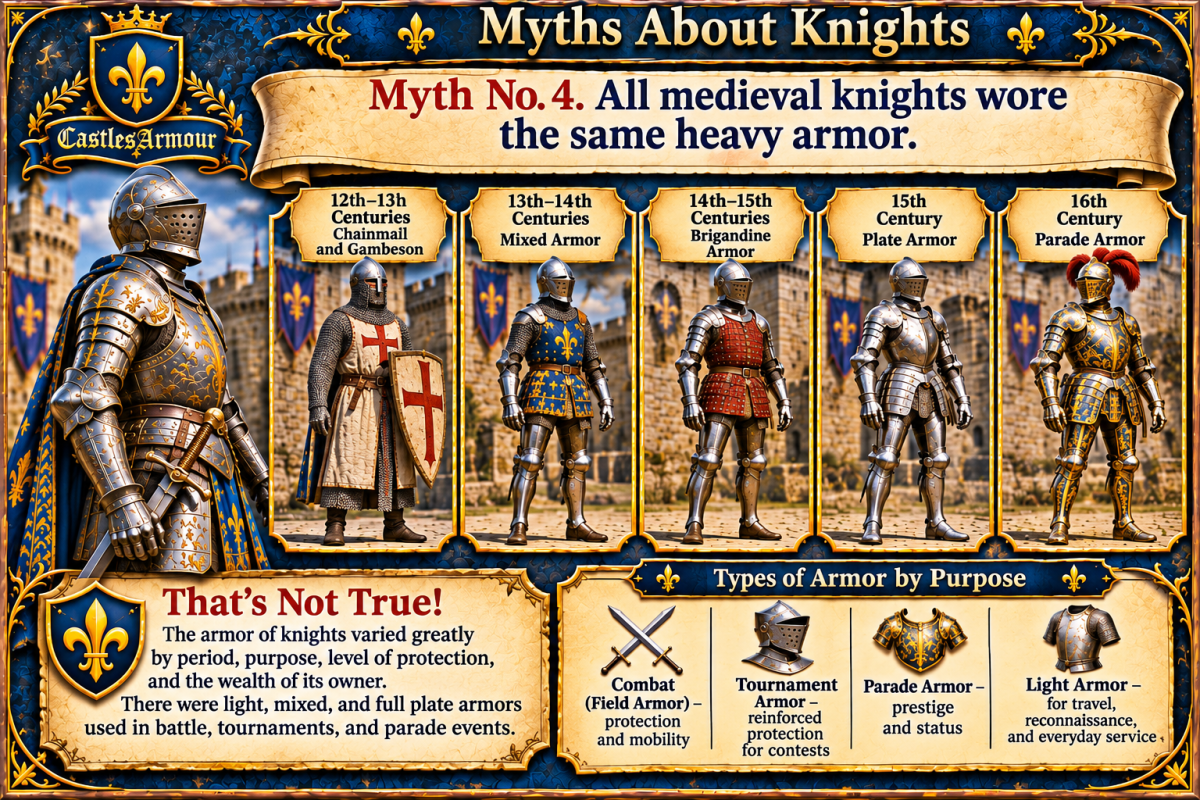
The Middle Ages spanned nearly a thousand years; therefore, it is impossible to speak of "medieval armor" as a single, unchanging type of equipment. A knight’s gear in the 11th century could differ significantly from that of a 14th-century knight, which in turn would be quite different from the Italian or German armor seen in the late 15th century. In the early Middle Ages, chainmail was of great importance. Gradually, additional metal elements began to appear over this mail protection. The 14th and 15th centuries saw the intensive development of plate armor. Research by the Royal Armouries points to significant shifts in personal military equipment during the mid-14th century, as plate components began to be added to traditional chainmail. By the 15th century, European armorers had developed sophisticated systems of plate protection that successfully balanced defense with mobility. Consequently, an 11th-century knight and a knight from 1480 represent, in terms of their equipment, two distinct historical types of warriors.
Myth №5. Armor provided a knight with complete protection.
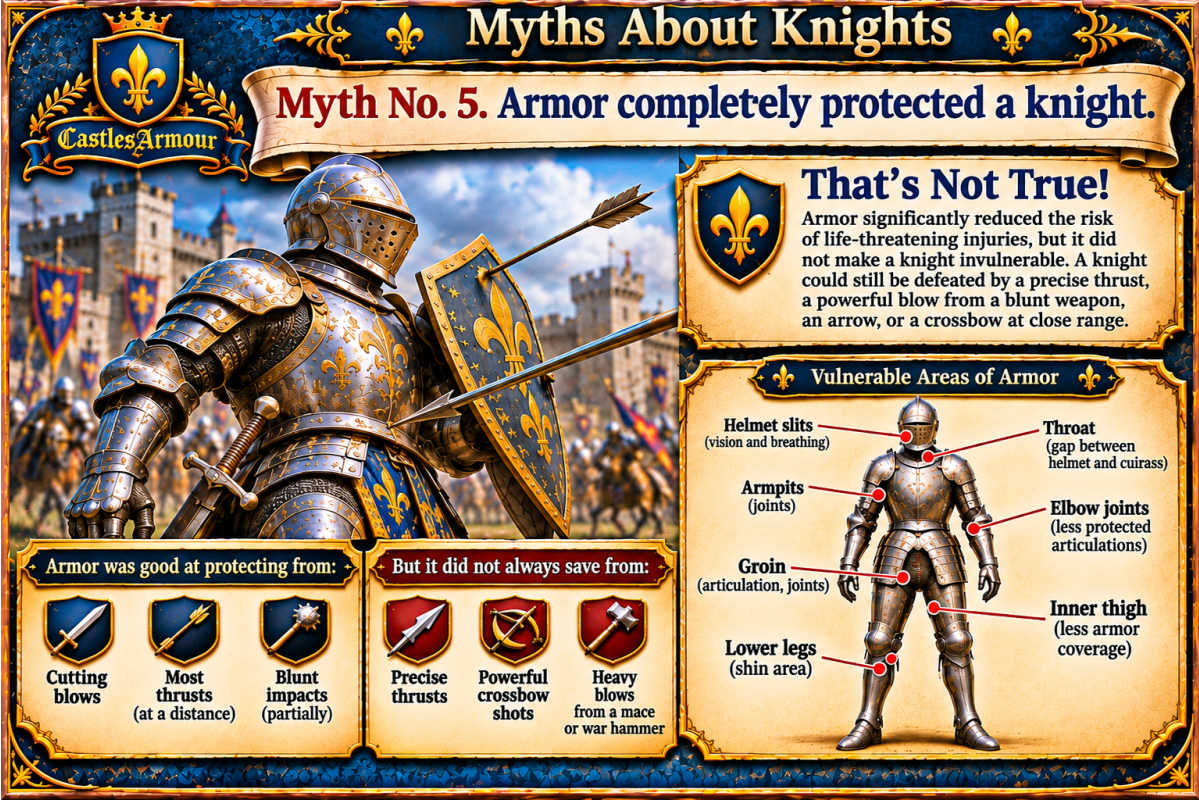
While plate armor was an exceptionally effective form of defense, it did not render a person invulnerable—a crucial distinction. The design of the metal plates helped deflect blows and mitigate their impact; however, a powerful strike could still transmit a significant amount of kinetic energy to the wearer’s body. Furthermore, there were vulnerable areas, including: joints; the armpits; the inner elbow; the back of the knee; certain parts of the neck; the face; and the gaps between individual pieces of armor. The Metropolitan Museum of Art emphasizes that no type of medieval armor guaranteed absolute invulnerability. This is precisely why the development of weapons and armor occurred in parallel.
Myth №6. Swords could easily pierce knightly plate armor.
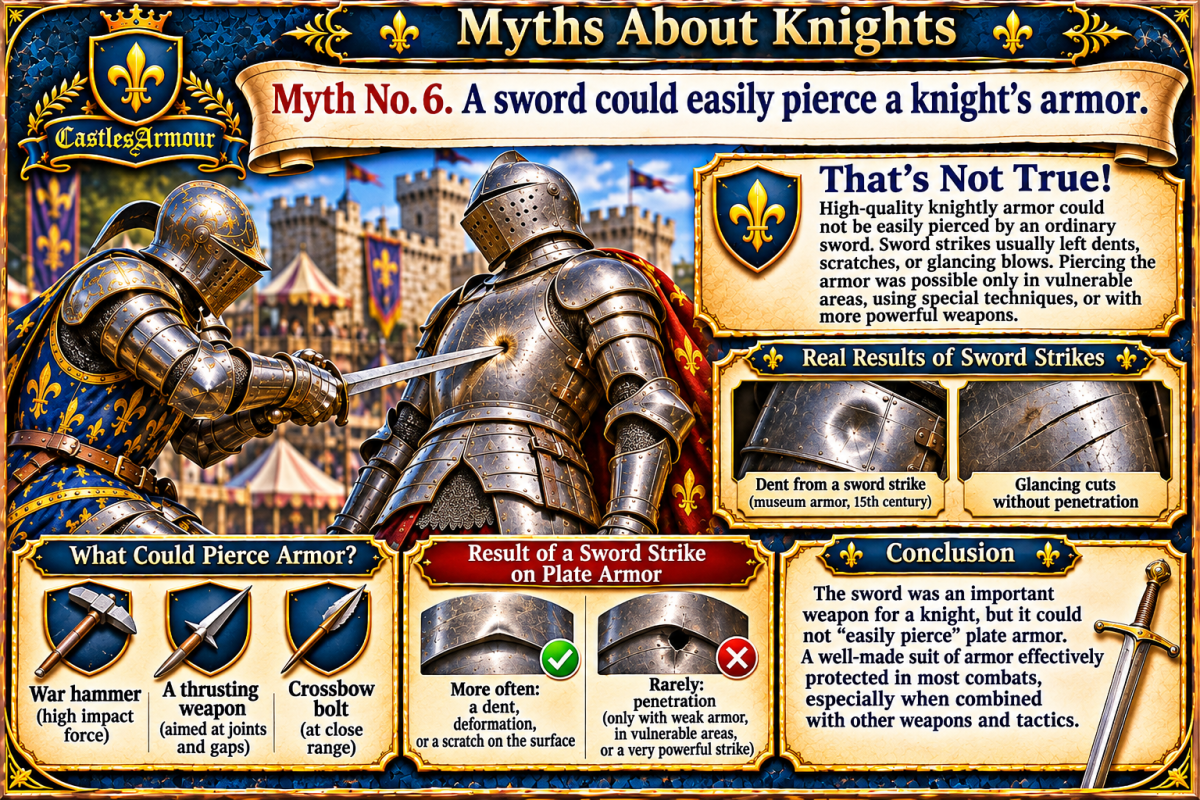
Modern cinema often depicts swords slicing effortlessly through metal armor. In actual combat, the situation was far more complex. Plate armor was specifically designed with a shape intended to deflect blows. A standard slashing strike from a sword against a well-crafted steel plate would by no means guarantee a penetration. This does not mean that the sword became useless. On the contrary, combat techniques would shift depending on the opponent and the armor they wore. When facing heavy armor, the importance of the following increased: thrusting attacks (using the point); daggers; war hammers; maces; specialized grappling techniques; strikes aimed at vulnerable areas. The Metropolitan Museum of Art notes that the evolution of plate armor altered the balance between offense and defense, leading to the proliferation of specialized weaponry.
Myth №7. Knights were exclusively mounted warriors.
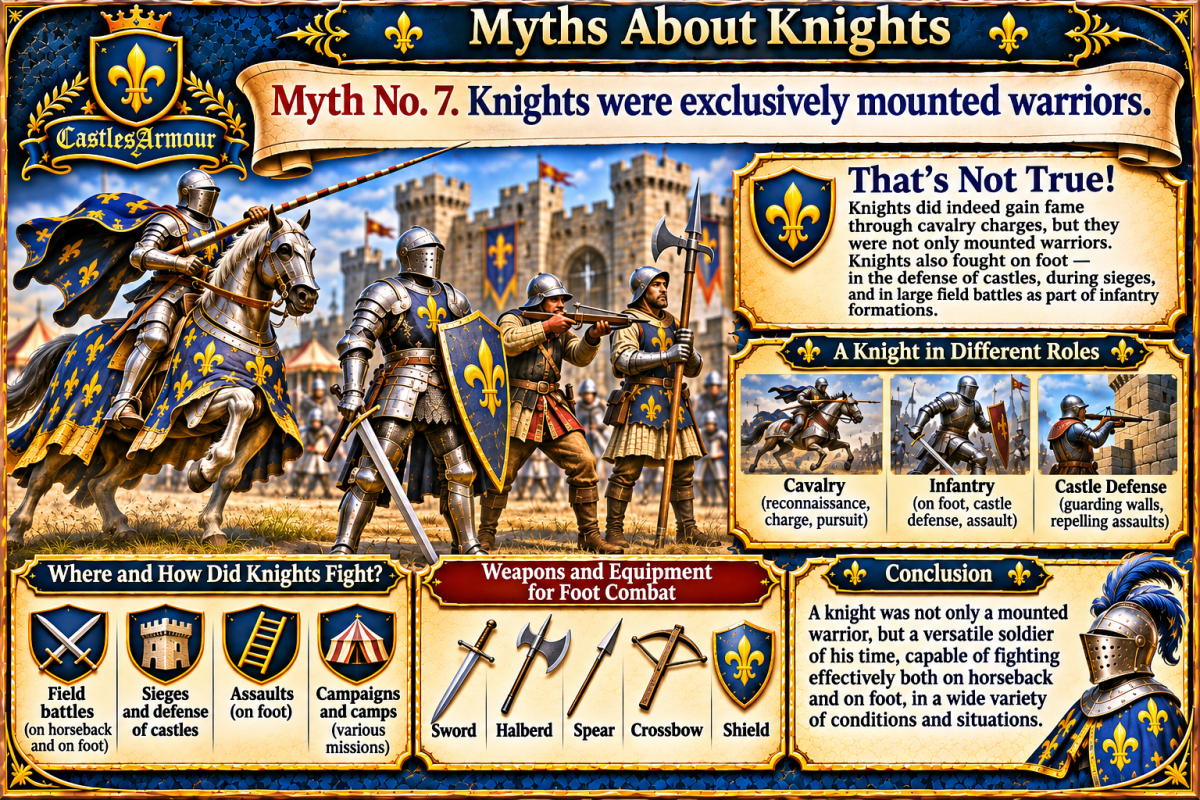
The term "knight" is often automatically associated with a man on horseback. While mounted combat was indeed a crucial component of knightly military culture, medieval armies were not composed solely of knights. They also included: infantry; archers; crossbowmen; spearmen; squires; mercenaries; urban militias; engineers; servants and baggage train personnel. The Metropolitan Museum of Art emphasizes that the mere possession of armor does not necessarily mean the wearer was a knight; various types of combatants and members of urban militias also wore armor. Therefore, it is historically more accurate to speak of a "man-at-arms" if the status of the individual owner is unknown.
Myth №8. Anyone in armor was a knight.
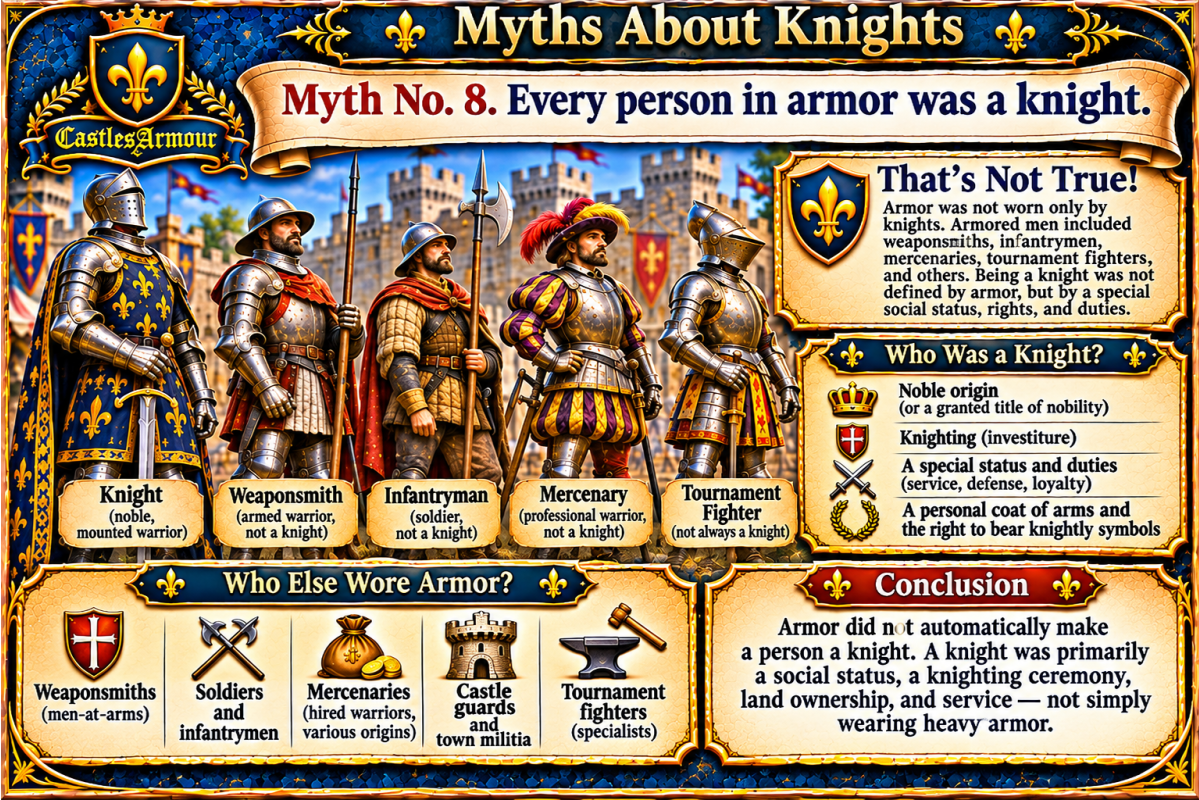
This is an extension of the previous misconception. Medieval society had a complex social structure. A knight was not simply a person with a sword and a suit of armor. Knighthood was a socio-military category tied to a specific status, set of duties, and culture. Furthermore, armor could be worn by: knights; nobles; professional soldiers; mercenaries; town militia; squires; members of other military categories. Moreover, the cost and quality of protective gear varied significantly. The Metropolitan Museum of Art notes that not every suit of armor was a lavish creation by a court armorer; there was also mass-produced, relatively affordable equipment available.
Myth №9. Knightly armor was incredibly expensive and accessible only to kings.
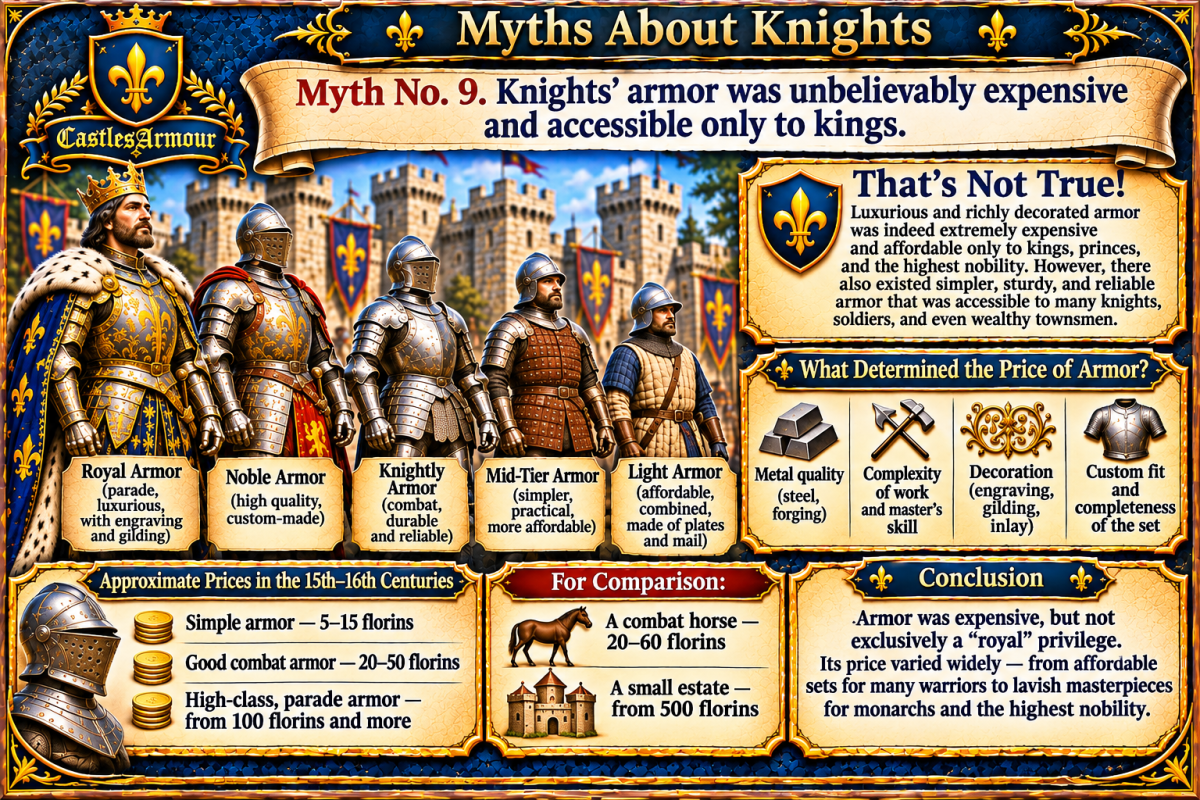
A qualification is necessary here. High-quality, custom-made armor could indeed cost a fortune. Renowned workshops in Germany and Italy produced pieces that were both functional military equipment and works of art. However, simpler forms of protection also existed. Urban workshops produced armor of varying quality, and warriors could purchase individual pieces rather than a full suit. The Metropolitan Museum of Art points out that armor of different grades was sold at markets, fairs, and in town workshops. Therefore, it is more accurate to speak of a wide price range rather than a single, fixed cost for a suit of knightly armor.
Myth №10. A knight always fought in full armor.
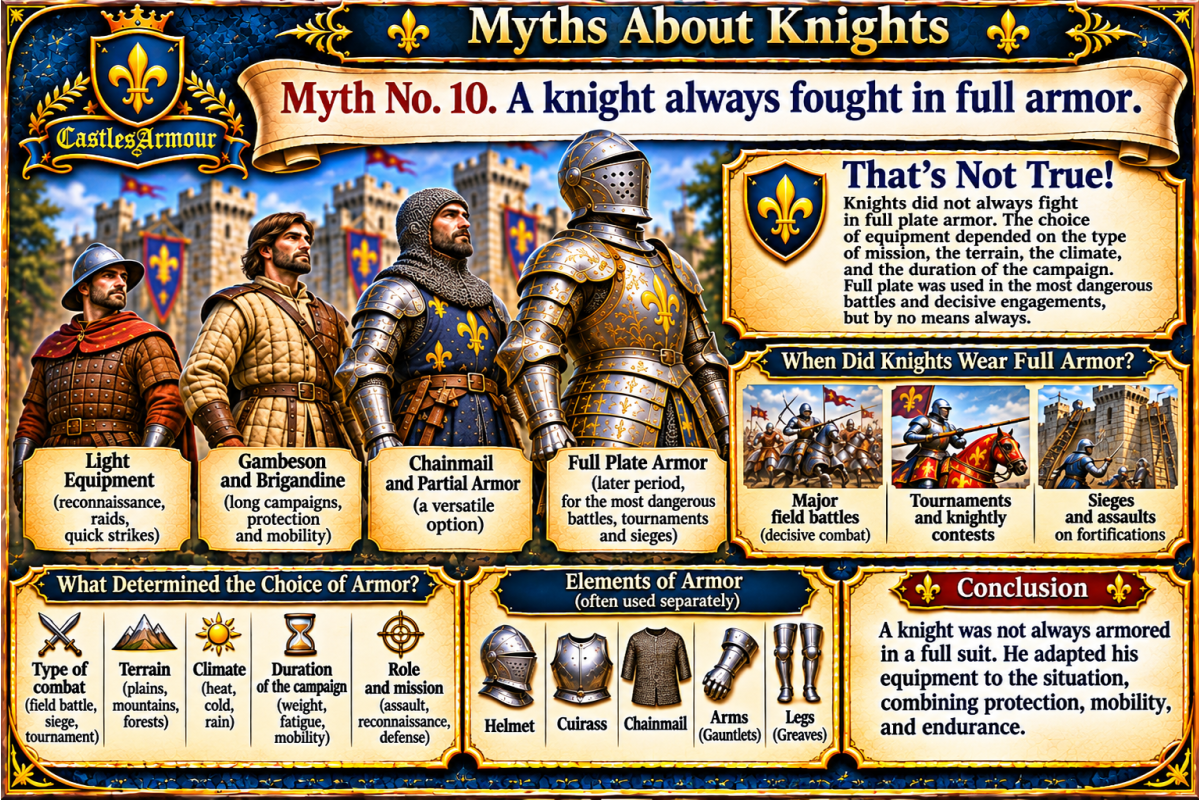
In practice, a warrior’s equipment depended on: the time period; the region; the nature of the conflict; social status; financial means; the specific military objective. ...type of battle. There was no single, universal suit of armor. Field armor, tournament armor, and ceremonial (parade) armor could differ significantly. It is especially important not to confuse tournament armor with combat armor. Tournaments fostered the development of specialized suits designed for specific types of contests. Some of these were, in fact, considerably heavier and more specialized than standard field equipment.
Myth №11. A knight was a virtually invincible warrior.
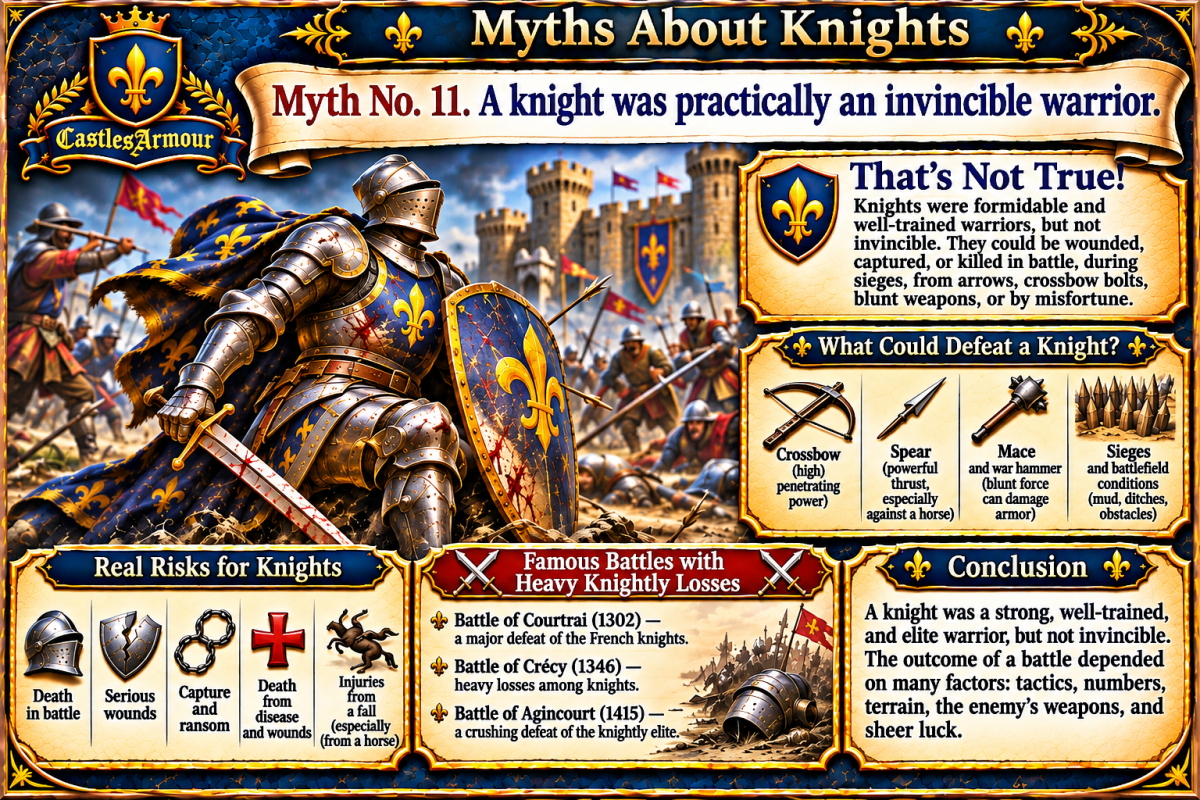
While chivalric culture did indeed cultivate an ideal of the brave, strong, and noble warrior, the historical knight remained a human being. He could: suffer an injury; be taken prisoner; die; fall ill; lose his horse; become surrounded; find himself in a disadvantageous position. Moreover, the outcome of a battle did not depend solely on individual skill. Factors of great importance included: troop numbers, discipline, command, terrain, logistics, the condition of the horses, the quality of weaponry, and tactics. Therefore, the legendary image of "one knight against an entire army" should be viewed primarily as a literary motif.
Myth №12. Medieval people did not know how to create comfortable armor.
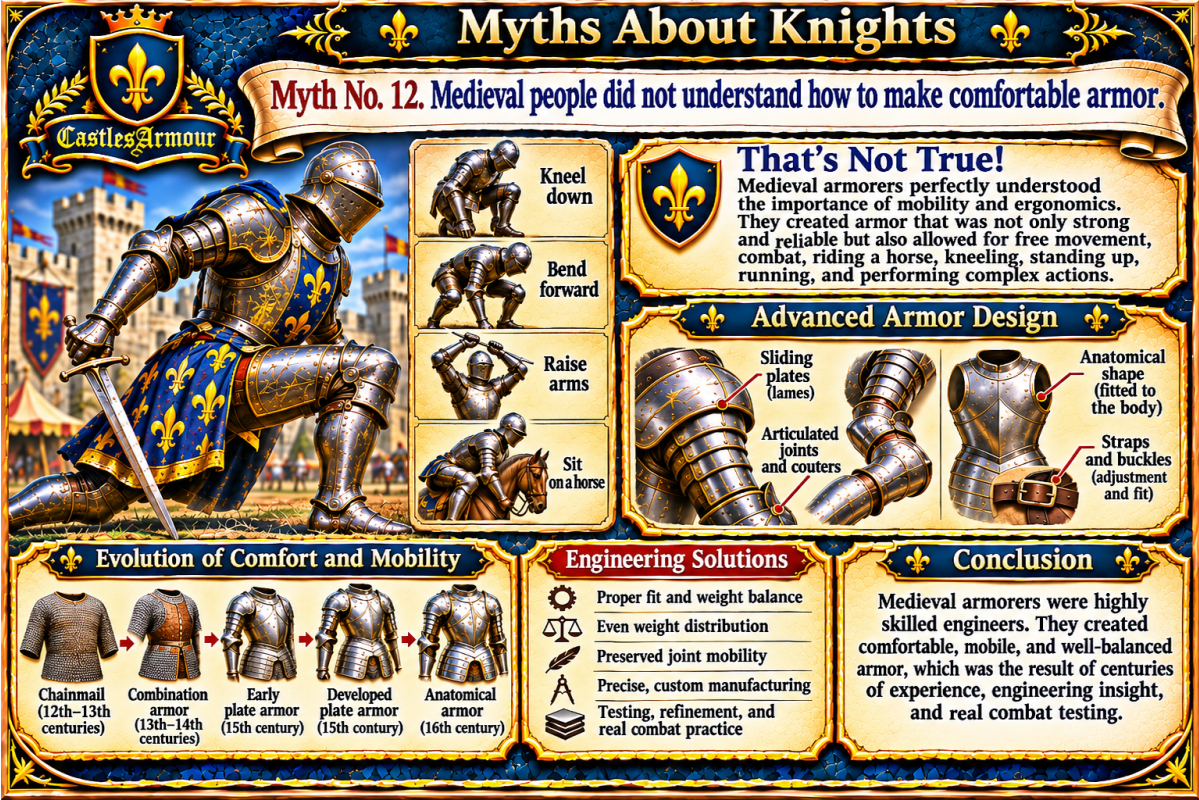
This myth is particularly interesting. To a modern observer, it might seem as though medieval armorers simply kept adding metal to the human body. In reality, the evolution of armor represented a complex engineering challenge. An armorer had to take into account: anatomy; the range of motion of the joints; the direction of potential blows; weight distribution; ventilation; the attachment of individual components; the ability to mount a horse; the interaction between the armor and the weapons. the specific characteristics of the individual owner. Good armor was not merely a "metal suit," but rather a system of articulated protective elements.
Myth №13. It was impossible to run while wearing full armor.
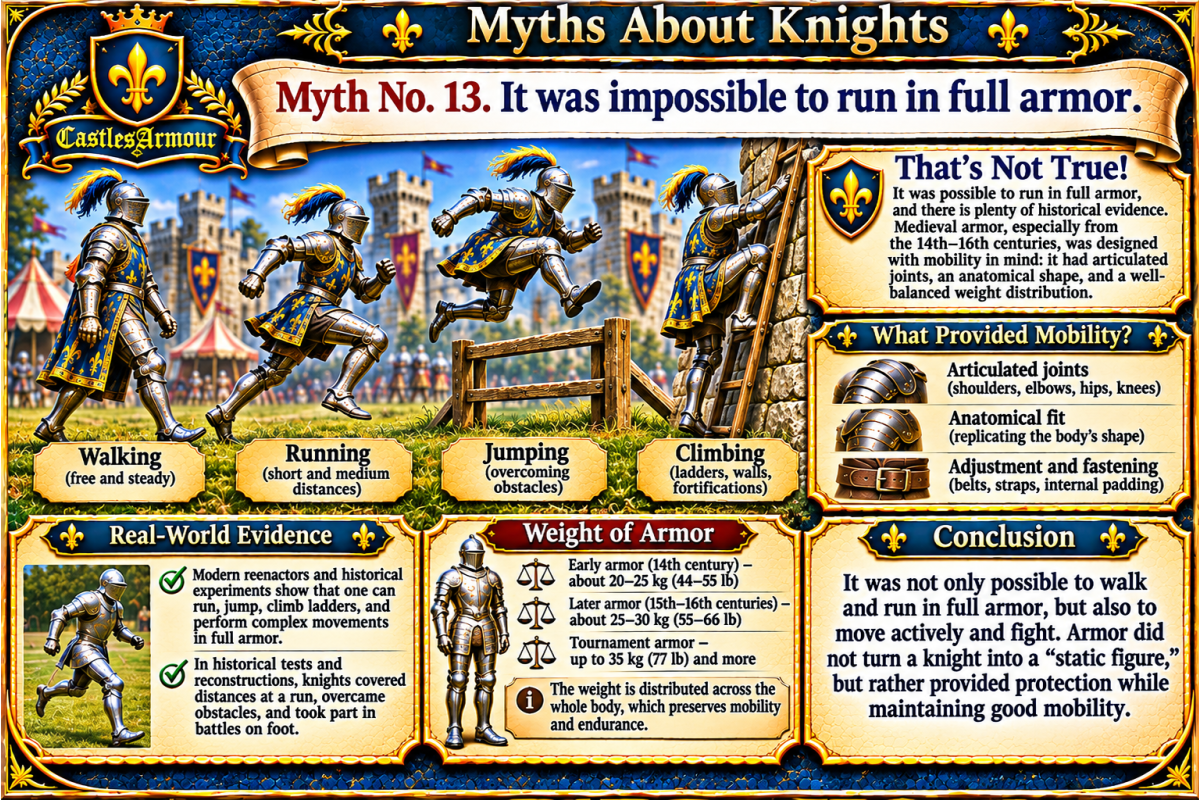
This claim requires a very careful formulation. Running in armor was possible, but significantly more strenuous than running without it. Experimental studies have shown a substantial increase in the energy cost of movement. One study found that the energy expenditure for walking in armor was approximately 2.1–2.3 times higher, and for running, about 1.9 times higher, than it would be without the additional load. Consequently: A knight could move quickly, but wearing armor placed significant demands on his physical fitness. And this, arguably, is far more interesting than the Hollywood image of a clumsy, lumbering warrior.
Myth №14. Knights did not care about hygiene.
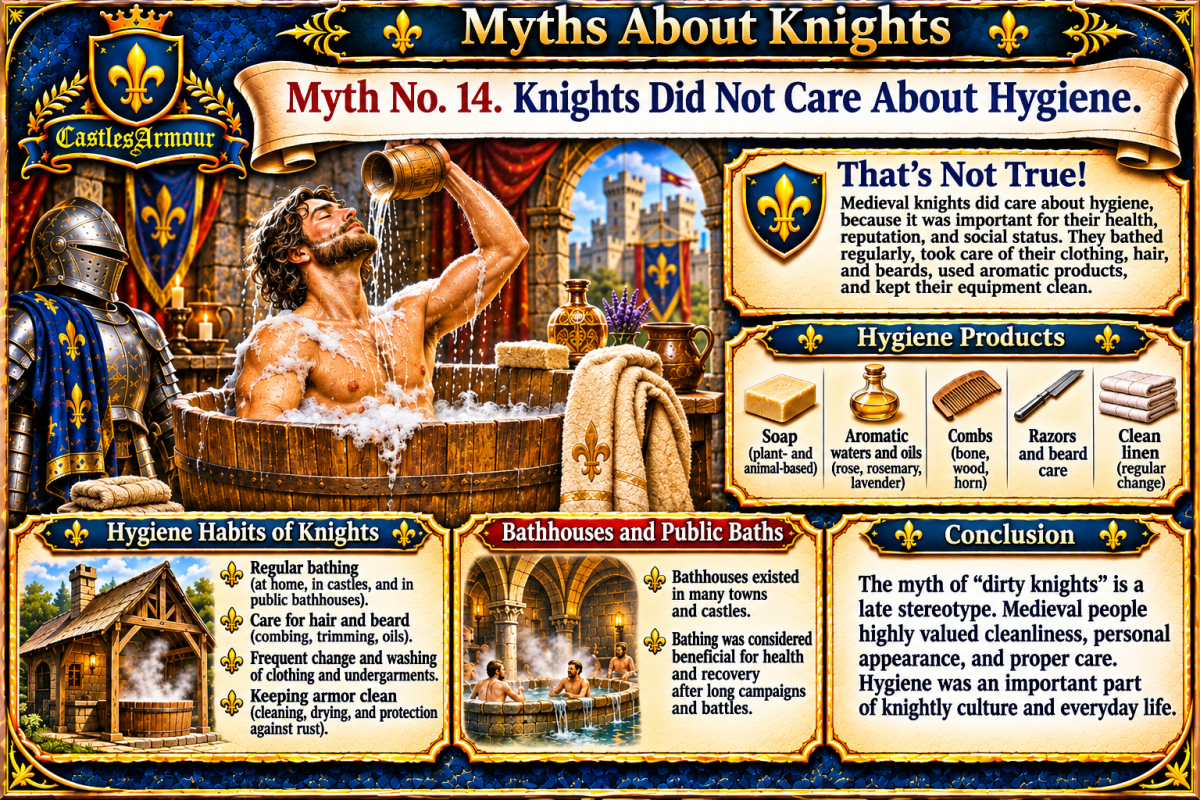
The notion of the Middle Ages as an era in which people never bathed is an oversimplification. The subject of medieval hygiene is far more complex. There existed: public bathhouses; bathing; washing; changing clothes; various body-care practices. That said, concepts of cleanliness differed from those of today, and access to water and bathhouses depended on one’s location and social status. Therefore, the claim that "knights never bathed" is historically untenable. The history of medieval hygiene requires an examination of specific sources and regions, rather than broad, universal generalizations. For instance, academic literature specifically explores how bathing was perceived and depicted in Middle English literature.
Myth №15. All knights were noble and gallant.
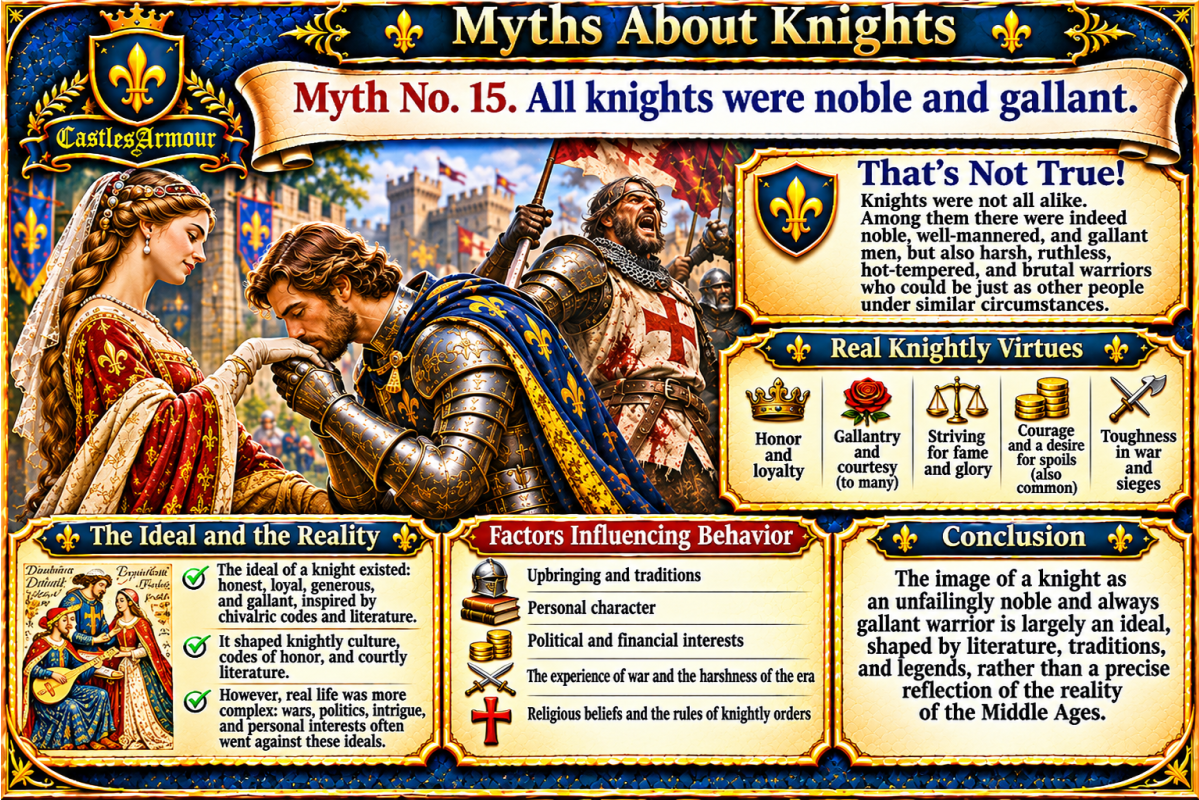
This is not a myth about weaponry, but rather one concerning the character of a knight. Literature from the Middle Ages and subsequent eras created an ideal: brave + noble + loyal + magnanimous + a defender of ladies. Real-life knights, however, were human beings, possessing all the qualities inherent to humanity. They were capable of displaying: courage; generosity; loyalty; cruelty; greed; political calculation; ambition; religious fanaticism; compassion. While chivalric culture did indeed establish certain norms of conduct, these norms and actual behavior were not one and the same.
Why did myths about knights emerge?
Most of these myths stem from several sources:
1. Medieval literature Romances featuring King Arthur, Lancelot, and other heroes shaped an idealized image of knighthood.
2. 19th-century Romanticism European culture in the 19th century took a keen interest in the Middle Ages. It was during this period that many romanticized notions about castles, knights, and tournaments took root.
3. Historical reconstructions Some early reconstructions were based on an inadequate study of surviving artifacts.
4. Cinema Film transformed complex historical processes into visual symbols that were easily understood by audiences.
5. The repetition of the same errors This is particularly evident in the case of the "crane" myth (the idea that knights needed a crane to mount their horses).
The Metropolitan Museum of Art notes that this narrative continued to be circulated well into the 20th century, even though experts had long since pointed out its inaccuracy.
What do we actually know about the medieval knight?
If we strip away the romantic veneer, we are left with a far more compelling figure. A knight was a professionally trained warrior for whom physical conditioning, mastery of weaponry, horsemanship, and the ability to operate as part of a military unit were of paramount importance. His armor was the product of centuries of technological evolution. His weaponry evolved in tandem with the defensive gear of his adversaries. His horse was a vital component of his military system. His social status was defined not merely by his arms, but by his lineage, his service, his relationship with his liege lord, his wealth, and his cultural standing. And, most importantly, a knight was no superhero. He was a human being upon whom society placed exceptionally high demands.
Conclusion.
Myths about medieval knights are interesting not only because they allow us to debunk common misconceptions; they also reveal the extent to which modern culture can reshape historical reality. The knight we see on screen is often a product of romantic literature, painting, theater, and cinema. The historical knight was far more complex. He could move independently while wearing armor, mount a horse without the aid of a crane, fall down and get back up, and engage in combat both on horseback and on foot. This does not mean it was easy, however: wearing armor required physical strength, endurance, and specialized training. Modern research confirms a key point: medieval armor was not a symbol of helplessness, but rather the product of highly advanced military technology for its time. This is precisely why studying actual knightly equipment allows us to view the Middle Ages in an entirely different light—not as an era of clumsy warriors in heavy iron suits, but as a period of intense development in military technology, metallurgy, horsemanship, and martial culture.