



King Henry VIII (1491–1547) played a key role in the history of knightly armor, becoming one of the leading patrons and innovators in this field in 16th-century England. He not only actively participated in tournaments but also laid the foundation for the English school of armormaking.
Foundation of the Greenwich Armory.
He founded the Royal Almain Armory or Greenwich Armory in 1515 (sometimes 1511–1520) at Placentia Palace in Greenwich, London. Its goal was to produce high-quality English-style plate armor for the king, court, and allies, thereby eliminating dependence on foreign craftsmen.
Key details:
The workshop attracted foreign armorers (mainly Germans, Italians, and Flemish). Germans dominated the industry for much of the 16th century. Early masters: Among the first were John Blewbury (the English royal armourer), Martin van Royne, and especially Erasmus Kyrkenar (c. 1495–1567), one of the most influential masters, under whose leadership the workshop reached a high level (he became Master Workman around the 1530s).
Their peak of prosperity came during the reign of Jacob Halder (1576–1607/1608) – during the reign of Elizabeth I. Greenwich armour became recognizable by its style: rich engraving, gilding (often based on designs by Hans Holbein the Younger), and functionality for tournaments and the battlefield.
Personal armour of Henry VIII.
Henry was an avid tournament fighter in his youth and commissioned numerous garnitures (suits of armour). Surviving examples reflect his changing figure:
Early armor (c. 1515–1520): For a slender, athletic king (height about 185 cm, waist ~88 cm). Examples include the armor for foot combat at the Field of the Cloth of Gold (1520). One of them has a "tonlet" (steel skirt).
Middle period (1520–1530s): More massive, with an emphasis on tournaments.
Armor Garniture, Probably of King Henry VIII of England (reigned 1509–47), dated 1527, British - 19.131.1a–r, t–w, .2a–f, l
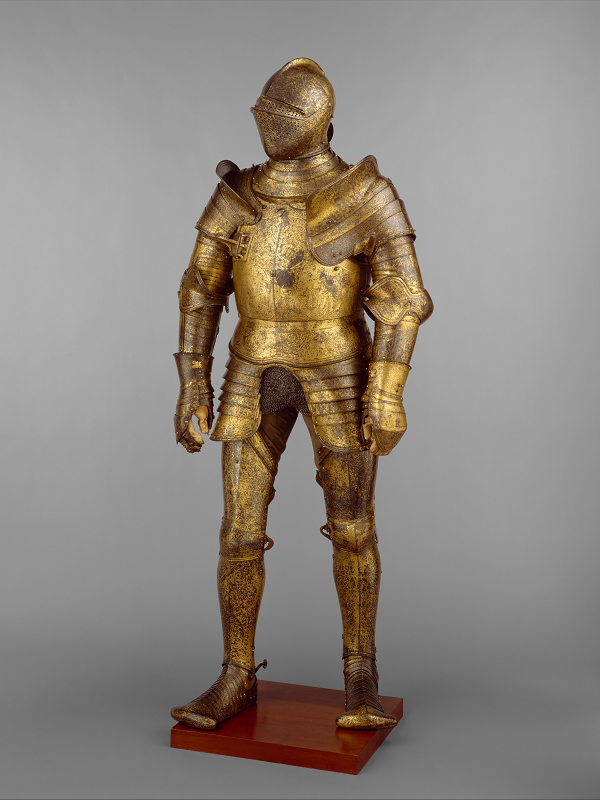
Late armor (c. 1540–1544): For a greatly enlarged king (waist up to 130+ cm). The famous field armor in the Metropolitan Museum (New York) is wide and heavy, and was used in the 1544 campaign in France despite gout and other illnesses.
Field Armor of King Henry VIII of England (reigned 1509–47), ca. 1544, Italian, Milan or Brescia - 32.130.7a–l


Many suits of armor had functional elements (movable joints) and decorative ones (large kopis as a symbol of masculinity).
Armour garniture of Henry VIII for the field and tilt, probably about 1540, Erasmus Kyrkenar, Greenwich, England - RCIN 72834 Windsor Castle.


Historical significance.
Political and prestige aspects: Armor was a tool of diplomacy and propaganda. Henry gifted it to allies and rivals, demonstrating England's wealth and power.
Technological contribution: The workshop operated until the mid-17th century and raised English armormaking to a European level.
Symbol of an era: His armor is a striking example of the transition from medieval chivalry to Renaissance military art, which combined practicality and luxury. Today, it is housed in the Royal Armouries (Leeds, Tower of London), Windsor Castle, the Wallace Collection, The Metropolitan Museum, and other collections.
Henry VIII transformed England from an importer of armor into a country with its own prestigious school, which influenced the entire European tradition of the 16th century. His collection and workshop are one of the most striking episodes in the history of knightly armament and the pinnacle of English Tudor arms art.