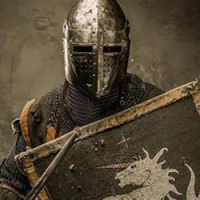






Chainmail (fr: Cotte de mailles, de: Kettenrüstung, it: Cotta di maglia[)) is the legendary "second skin" of the medieval warrior, accompanying knights from the early campaigns of the Vikings and Normans to the rise of full plate armor. Flexible, reliable, and remarkably durable, it became one of the most recognizable symbols of the knightly era.
What is chainmail?
Chainmail (hauberk or chainmail) is a protective shirt woven from thousands of small metal rings. Each ring was connected to four adjacent ones, forming a strong yet flexible mesh. Classic European chainmail of the 11th–13th centuries typically reached the knees, had long sleeves, and was often complemented by a coif hood that protected the head and neck. A good suit of chainmail weighed between 8 and 15 kg, depending on its size, wire thickness, and weave type. It was worn over a quilted underarmor (gambeson), which cushioned blows and prevented chafing.
How chainmail was made.
Making chainmail was a true art and required immense patience. The craftsman first drew iron or steel wire, cut it into pieces, bent it into rings, and joined them in two ways:
Butted mail—simple rings simply joined at the ends (a cheap and quick option, more common among ordinary soldiers).
Riveted mail—rings were riveted or welded, which made the weave significantly stronger. The best chainmail was completely riveted.
A single hauberk could contain between 15,000 and 40,000 rings. Crafting took weeks, sometimes even months, of hand labor. Therefore, high-quality chainmail was expensive and passed down through generations.
The Evolution of Chainmail.
11th-12th centuries — a long hauberk with a coif, often worn over an underarmor. This is the type of chainmail we see on the Bayeux Tapestry.
13th century — shorter versions (haubergeons) and reinforcements in the form of additional plates on the chest or shoulders appear.
14th-15th centuries — chainmail gradually gives way to plate armor, but remains an important element: it was inserted into vulnerable areas (armpits, folds), and was also used as a standalone armor for light cavalry and infantry.
Chainmail provided excellent protection against slashing blows from a sword or axe—the rings absorbed and distributed the energy. However, thrusting blows from spears or arrows could penetrate it, so a thick gambeson was always worn underneath.
In battle: flexibility and reliability.
Chainmail gave warriors a significant advantage: mobility. It allowed them to gallop freely, run, bend, and deliver powerful blows. It didn't restrict movement as much as later plate armor.
During the Crusades and the battles of the Hundred Years' War, thousands of soldiers relied on chainmail. It protected them from numerous wounds, but required constant maintenance: after battle, it was cleaned of rust with sand and vinegar and oiled.
The Legacy of Chainmail.
Even after the advent of full plate armor, chainmail didn't disappear completely. It continued to be used as additional protection, as well as in lighter suits for mercenaries and infantry. Today, authentic chainmail is the pride of reenactors and collectors.
Chainmail is a symbol of an entire era. It embodies the tenacity of medieval craftsmen, who, from simple iron rings, created protection capable of saving lives in fierce battle. Flexible, durable, and beautiful in its functionality, it remains one of the most elegant designs in the history of military armor.
When you see a knight in gleaming chainmail, remember: beneath those thousands of rings beat the heart of a warrior who believed that steel and valor could withstand any enemy.