Introduction.
The death of a knight in medieval Europe was not merely a private tragedy for his family. It could also be a religious, social, and political event.
Knights occupied a distinctive position within medieval aristocratic society, and their burials reflected several aspects of medieval life simultaneously: Christian beliefs about death, family status, military identity, social rank, and the desire to preserve the memory of the deceased.
Burial customs varied considerably according to period, region, religious tradition, social status, and the financial resources of the family.
The funeral of a powerful feudal lord could be very different from that of a lesser knight.
Particularly important were the burials of aristocratic warriors in churches and monasteries. Above their graves, families could commission stone monuments known as effigies, depicting the deceased in armor.
These monuments are among the most valuable sources for the study of medieval military culture because they provide visual evidence for armor, shields, swords, spurs, heraldry, and other aspects of aristocratic identity.
Christian Concepts of Death.
Medieval European society was deeply Christian, and death was therefore understood primarily in religious terms.
For a Christian, earthly life was temporary, while death represented a passage toward judgment and the possibility of salvation.
Important preparations for death included:
confession;
communion;
prayer;
reconciliation;
forgiveness;
making arrangements for property;
preparing a will.
For a knight, these religious ideas could be combined with the concept of the Christian warrior.
The ideal knight was expected to combine military courage with religious faith and moral responsibility.
The Final Hours of a Knight.
If a knight died after battle, a tournament, or a military campaign, preparing the body for burial could be difficult.
If death occurred at home or in a castle, relatives, servants, and a priest might be present.
The priest could administer the appropriate religious rites.
The preparation of the dying person was an important part of medieval Christian culture.
Medieval religious literature repeatedly emphasized the importance of achieving a good Christian death.
Washing and Preparing the Body.
After death, the body was prepared for burial.
It could be washed and dressed in appropriate clothing.
For an aristocrat, the clothing might reflect his social position.
Depending on circumstances, the deceased could be dressed in:
ordinary clothing;
ceremonial clothing;
ecclesiastical garments;
monastic clothing;
specially prepared burial garments.
Practices varied according to region, period, personal wishes, and family traditions.
Was a Knight Buried in His Armor?
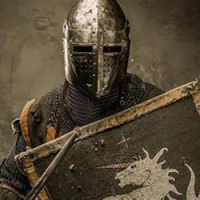
The modern image of a medieval knight being buried fully equipped in his battlefield armor is largely exaggerated.
Armor was expensive military property and normally remained within the possession of the family, heirs, or household.
Consequently, a complete suit of armor was not routinely placed inside the grave.
Instead, the deceased's identity as a warrior was frequently expressed symbolically through:
a sword;
a shield;
spurs;
heraldry;
an effigy;
an epitaph.
In some cases, individual military objects could be associated with burial practices, but there was no universal rule requiring a knight to be buried in his armor.
The Sword as a Symbol of Knighthood.
The sword had a special position in medieval culture.
It was more than a weapon.
The sword could symbolize:
knightly dignity;
military honor;
authority;
protection;
Christian warfare;
membership in the warrior aristocracy.
For this reason, the sword became one of the most important elements of knightly funerary imagery.
On many effigies, the sword lies alongside the body.
Its presence immediately identifies the deceased as a warrior.
The Shield and Coat of Arms.
The shield was equally important.
It could display the coat of arms of the deceased.
Heraldic imagery could identify:
family origin;
dynastic relationships;
social rank;
political allegiance.
The tomb monument therefore served not only as a memorial but also as a kind of genealogical record.
Spurs.
Spurs were important symbols of aristocratic and mounted status.
They represented the knight's relationship with the horse and the culture of mounted warfare.
On some effigies, spurs are carefully represented.
Such details are valuable to historians because they can provide evidence for changes in spur design over time.
Burial Inside a Church.
High-status knights could be buried inside churches.
Particularly prestigious locations included:
areas near the altar;
family chapels;
monastic churches;
chantry chapels;
family burial spaces.
However, church regulations and local customs could restrict burial inside sacred buildings.
Therefore, practices differed considerably across medieval Europe.
Monasteries as Burial Places.
Monasteries played an important role in aristocratic burial culture.
A knight or his family might support a monastery financially.
In return, the family could receive:
prayers for the deceased;
commemorative services;
burial rights;
a family chapel;
a permanent memorial.
Burial could therefore become part of a long-term relationship between an aristocratic family and a religious community.
The Funeral Procession.
The funeral of a noble warrior could involve a formal procession.
Participants might include:
relatives;
retainers;
vassals;
clergy;
monks;
servants;
members of the local aristocracy.
Prayer and liturgical singing were central elements of the ceremony.
For powerful aristocrats, the public and ceremonial dimension of the funeral could be considerable.
Candles and Torches.
Light played an important role in Christian funerary rituals.
Candles and torches could be used during prayers and processions.
They represented Christian hope and the light of Christ.
The number and quality of candles could depend on the wealth and status of the deceased.
The Coffin and Funeral Bier.
The deceased could be carried on a funeral bier covered with cloth before being placed in a coffin or sarcophagus.
Wealthy individuals might have elaborate textiles and decorative fittings.
Nevertheless, archaeological evidence demonstrates considerable diversity in medieval burial practices.
Not every knight received an elaborate aristocratic burial.
The Effigy: A Knight in Stone.
One of the most recognizable monuments of medieval knightly culture was the effigy — a sculpted representation of the deceased placed on a tomb.
A knight could be represented:
lying horizontally;
wearing armor;
holding or accompanied by a sword;
with a shield;
with crossed legs;
with hands in prayer.
An effigy was not necessarily a literal portrait.
It was a symbolic representation of the deceased.
The Knight in Armor on a Tomb.
The depiction of a knight in military equipment became particularly widespread between the thirteenth and fifteenth centuries.
For historians, these monuments are extremely valuable.
They can provide evidence for:
helmets;
mail;
plate defenses;
shields;
swords;
spurs;
belts and associated equipment.
However, an effigy should not automatically be interpreted as a precise representation of the deceased's actual armor.
The sculptor could depict an idealized image of a knight according to contemporary artistic conventions.
Cross-Legged Effigies: Myth and Reality.
One of the most famous motifs in English medieval funerary sculpture is the knight with crossed legs.
Later popular tradition sometimes claimed that crossed legs indicated participation in a Crusade.
Modern scholarship treats this interpretation with considerable caution.
Crossed legs cannot automatically be used as evidence that a particular person took part in a Crusade.
The iconography of medieval tombs is considerably more complex, and the same motif could have different meanings.
The Tomb Inscription.
An epitaph could contain:
the name of the deceased;
titles;
the date of death;
genealogy;
religious formulas;
requests for prayers;
statements about achievements.
Some inscriptions directly addressed the visitor.
They reminded the living of the transience of human existence and the inevitability of death.
Heraldry and Dynastic Identity.
Heraldry became one of the most important elements of aristocratic funerary art.
A monument could display:
the arms of the deceased;
the arms of his wife;
ancestral arms;
dynastic symbols;
chivalric order insignia.
The heraldic program could sometimes help historians reconstruct family relationships even when written documents have been lost.
Members of Military Orders.
Members of military-religious orders could have distinctive funerary traditions.
Knights Templar, Hospitallers, Teutonic Knights, and members of other military orders combined military and religious identities.
Their funerary imagery could include:
the order's cross;
religious symbols;
a sword;
a shield;
a coat of arms;
inscriptions.
Specific practices varied between different orders and historical periods.
Burial After Death in Battle.
When a knight died on a battlefield, circumstances could be very different.
After a major battle, it was impossible to provide elaborate individual funerals for every casualty.
The body might be:
left temporarily on the battlefield;
collected later;
buried with other dead;
transferred to relatives.
Conditions could be particularly difficult after sieges and large military engagements.
Returning the Body Home.
For an important nobleman, the family could make considerable efforts to recover the body.
This was significant not only emotionally but also religiously and socially.
Burial in a family church or monastery provided a permanent place for remembrance and prayer.
In some cases, the distance between the place of death and the final burial site could be considerable.
Burial of the Heart and Internal Organs.
Medieval Europe also knew practices of divided burial.
In certain circumstances, the body could be divided so that different parts were buried in different places.
The heart, for example, could be buried separately from the body.
This practice was particularly associated with some members of the highest levels of medieval society.
It allowed the deceased to remain symbolically connected to several important places.
Family Tombs.
Aristocratic families often created permanent spaces for remembrance.
These could include:
chapels;
crypts;
monasteries;
family burial churches;
monumental tombs.
Several generations could be buried in the same location.
The burial space thus became a visual history of the family.
Tombs as Political Statements.
A monumental tomb did more than express grief.
It could also demonstrate the social position of the family.
The size, location, material, heraldry, and artistic quality of a monument communicated an important message:
the deceased belonged to a particular family and occupied a particular position in society.
Funerary art was therefore an important part of aristocratic memory culture.
Christian and Military Symbolism.
Medieval culture did not necessarily perceive a contradiction between being a knight and being a Christian.
The ideal knight was expected to combine:
courage;
loyalty;
protection of the weak;
religious faith;
service to his legitimate lord;
adherence to Christian morality.
Consequently, a tomb could combine:
cross + sword + shield + prayer.
Together these symbols created the image of the Christian warrior.
What Archaeologists Find in Medieval Warrior Burials.
Archaeological investigations of medieval graves can reveal:
human remains;
clothing fragments;
footwear;
belt fittings;
spurs;
jewelry;
crosses;
coffin fragments;
occasional elements of weapons.
However, a richly furnished burial does not automatically prove that the individual was a knight.
Status must be established through a combination of archaeological, historical, anthropological, and contextual evidence.
What a Burial Can Tell Us About a Knight.
Modern research can combine:
archaeology;
osteology;
physical anthropology;
metallography;
DNA analysis;
isotope analysis;
epigraphy;
art history.
These methods can sometimes reveal:
age;
biological sex;
stature;
traumatic injuries;
some diseases;
patterns of physical activity;
aspects of diet;
geographic mobility or origin.
A grave can therefore provide information not only about how a person died, but also about how he lived.
Combat Injuries.
Knights could suffer serious injuries long before their deaths.
Skeletal remains may preserve evidence of:
fractures;
joint injuries;
healed wounds;
chronic skeletal changes;
repeated physical stress.
However, not every injury should automatically be interpreted as a battlefield wound.
Some injuries could have resulted from horse riding, hunting, accidents, or other physical activities.
Burials as Evidence for the Study of Armor.
Tomb monuments and archaeological remains complement each other.
Effigies provide visual evidence for:
the appearance of armor;
the arrangement of individual components;
helmets;
shields;
swords;
methods of wearing equipment.
Archaeological discoveries provide actual surviving objects.
Comparing the two types of evidence helps historians reconstruct the development of European armor.
Famous Knightly Tombs.
Some of the most important surviving medieval knightly effigies are found in England and France.
They provide evidence for changes in knightly equipment over several centuries.
Important examples can be found in:
the Temple Church in London;
Canterbury Cathedral;
Westminster Abbey;
French cathedrals;
medieval monasteries.
Each monument must be interpreted within its specific historical and artistic context.
Burial and the Culture of Memory.
For medieval aristocrats, it was important not only to bury the dead properly but also to preserve their memory.
This function was served by:
tomb monuments;
epitaphs;
prayers;
family chapels;
monastic records;
commemorative services;
heraldry.
The memory of a knight could survive for many generations.
Conclusion.
The burial of a medieval knight was a complex event in which religion, military culture, family memory, and social hierarchy intersected.
After death, the knight ceased to be merely a warrior. His image became part of the historical memory of his family and community.
Armor and weapons were not normally placed in graves in the simplistic manner often portrayed in modern popular culture. More important was the symbolic language of knighthood, expressed through the sword, shield, spurs, heraldry, and the image of the deceased in armor.
Effigies, tomb slabs, epitaphs, and archaeological burials are today among the most valuable sources for the study of medieval society.
They allow historians to investigate not only what a medieval knight looked like, but also how medieval people understood death, honor, faith, memory, and the ideal of knighthood.
A knight's tomb was therefore more than a monument to a dead man.
It was a document carved in stone — a statement through which medieval society preserved the image of the deceased as a warrior, Christian, nobleman, and member of a lineage.
- Articles
- Weapons
- Armor
- Armor for horses
- Emperor Armor
- Chivalry
- Chivalry
- Knights castle
- Knights tournament
- The Crusades
- Knightly Orders
- Knightly saddle
- Knightly motto
- Great Knights
- Price of armor
- Children's armor
- Castles and fortresses
- Museums of armor and weapons
- Coats of arms and heraldry
- Routes and excursions
- Guides