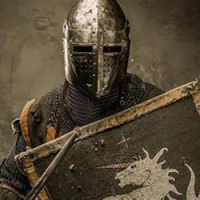




Heraldry is more than just pretty pictures on shields. It's an entire science, art, and language of the Middle Ages that allowed a knight to assert himself on the battlefield even when his helmet's visor was lowered and his face hidden. One glance at the shield, and an experienced warrior knew who he was dealing with: a descendant of an ancient family, a participant in a crusade, a loyal vassal of a king, or a daring seeker of glory.
The Birth of Heraldry.
Heraldry emerged in the 11th and 12th centuries during the Crusades and tournaments. Heavy helmets completely covered the face, while chainmail and cloaks made all warriors look alike. It was necessary to quickly distinguish friend from foe in the dust and chaos of battle. The first heraldic symbols appeared on shields, banners, and clothing.
By the 13th century, heraldry had evolved into a strict system with its own rules, terms, and hierarchy. It was called the "science of heraldry." In France, England, Germany, and Spain, specialized heralds emerged—professional experts in coats of arms who kept genealogies, announced tournaments, and enforced the rules.
Basic Rules of Heraldry.
Heraldry is subject to strict laws to ensure that a coat of arms is clearly visible from afar:
Colors (tinctures) are divided into two groups:
Metals: Gold (Or) and Silver (Argent). They symbolize nobility, purity, and wealth.
Enamels (colors): Red (Gules)—courage and love; Blue (Azure)—loyalty and truth; Green (Vert)—hope and joy; Black (Sable)—constancy or sorrow; Purple—royalty.
Important rule: metal cannot be placed on metal or color on color. This made the coat of arms high-contrast and highly visible.
Division of the shield. The shield could be divided into sections by lines: horizontally, vertically, diagonally, by a cross, a "chevron" (an inverted V), and many other ways.
Heraldic figures.
The most common:
Lion (symbol of courage and royal power).
Eagle (empire, strength, and vision).
Cross (faith, crusades).
Crescent (participation in the crusades or eastern connections).
Roses, lilies, stars, towers, ships, swords, and much more.
Helmet and crest. A helmet with a crest (cross, wings, a hand holding a sword, etc.) was depicted above the shield. The color and shape of the helmet indicated rank: an open helmet for knights, a closed helmet for lower-ranking nobles.
Motto. A short phrase in Latin or the native language expressing the knight's life principle: "Deus vult" ("So God wills"), "Honny soit qui mal y pense" ("Let him be ashamed who thinks ill of this"), or a personal motto.
Heraldry in a Knight's Life.
A coat of arms was personal and family. A knight inherited his father's coat of arms, but could add cadency marks: a small moon, a star, or a stripe to indicate he was a second or third son.
At tournaments, heralds loudly announced the participants by their coats of arms: "Sir John de Montfort, gules shield with a golden lion!" This replaced modern notions.
A coat of arms adorned:
Shield (heater or kite);
Surcoat (cape over armor);
Horse blanket;
Banner and pennant;
Seals on documents;
Tombstones and castle walls.
Heraldic shields from different eras.
11th-12th centuries – large teardrop-shaped (kite) shields with simple figures: a cross, a stripe, a simple beast.
13th-14th centuries – triangular heater shields, more complex divisions and combinations.
15th century – Gothic heraldry with graceful lines, numerous small details, and lush crests.
Late Middle Ages – coats of arms became increasingly complex, including "quarters" from various marriages and inheritances.
Symbolism and meaning.
Each element had a deep meaning:
Golden lion on a red field – royal power and courage (coat of arms of England, Norway, and many knightly families).
Black eagle on gold – Holy Roman Empire.
Silver cross on red – Crusaders and many spiritual and chivalric orders.
Three golden lilies on blue—the French royal dynasty.
Heraldry was an international language. An English knight, seeing the familiar coat of arms of a French baron on the battlefield, could decide whether to attack or try to ransom the knight.
Heraldry Today.
Although the age of knights is long gone, heraldry lives on. State coats of arms, city crests, corporate emblems, university badges, and even modern company logos often use heraldic principles. In Great Britain, Sweden, Spain, and other countries, official Kings of Arms still work to register new coats of arms.
For reenactors and history buffs, heraldry is a way to feel like a true knight. A well-designed coat of arms tells the story of a family better than any book.
Conclusion: a coat of arms as a mirror of a knight's soul.
Heraldry transformed war into a spectacle and honor into a visible sign. A knight riding onto the field with a bright coat of arms on his shield declared to the world: "This is who I am. This is what I fight for. This is my blood and my glory."
In an era when faces were hidden beneath steel, a coat of arms remained the knight's face. It spoke wordlessly of valor, lineage, faith, and ambition. And even today, looking at an ancient shield with faded paint, we hear the echo of those distant tournaments and battles, where colors and figures decided the fates of individuals and entire dynasties.
Heraldry is the eternal language of nobility, which has survived the centuries and continues to remind us: true strength always has its symbol.