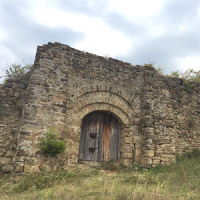

Juan Martinez the Elder, Toledo, Spain.
As with other particularly renowned Spanish swordsmiths, such as Sahagún, Ayala, and Aguirre, the only information we can say about Martínez's life, despite his status as one of the most important masters, is that his work took place at the turn of the 16th century.
Riano mentions in his catalogue a goldsmith named Francisco Martínez, who worked in Seville from 1554 to 1574.
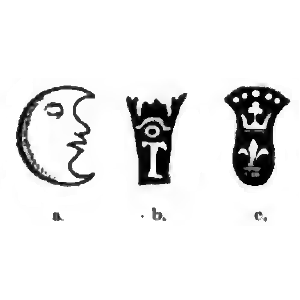
Martínez's importance is evidenced by the widespread distribution of his work, the prestige his brand enjoyed in the early 17th century, and, finally, the beauty and meticulous craftsmanship of his blades. In addition to his own mark, the famous "moon" (a), and the renowned mark of the official inspector (b), Juan the Elder also used the mark "Espadero del Hey," denoting his court position: a heraldic lily surmounted by a crown (c).
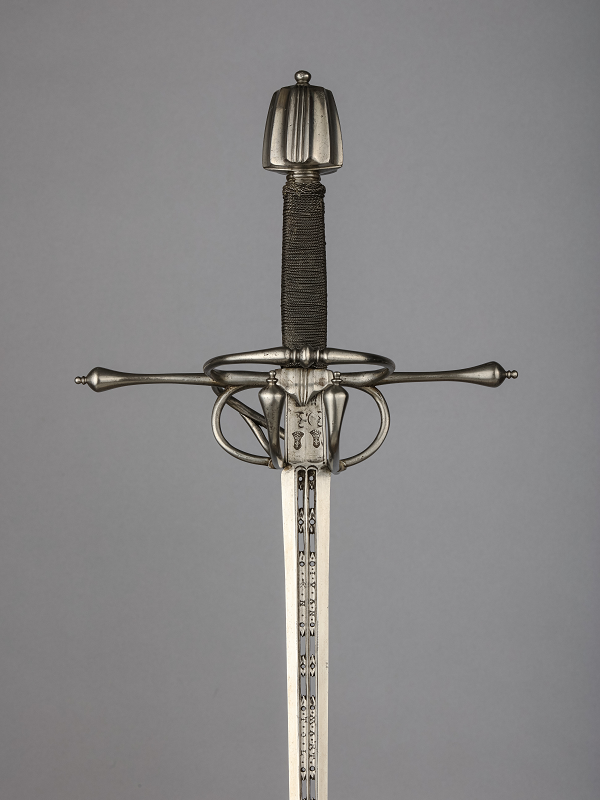
Like almost all Spanish swordsmiths, he engraved his name: IVAN. MARTINEZ. KN. TOLEDO, as well as a motto along the concave part of the blade, executed with a unique, often imperfect, and therefore sometimes difficult to read punch. This motto has given rise to various interpretations. The motto usually reads: "IN. TE. DOMINE. SPERAVI. NON," with the remaining part, CONFVNDAR. IN. AETERNVM, omitted for unknown reasons, perhaps due to space constraints. Blades of his work with the complete motto, incidentally, are in the Royal Historical Museum in Dresden.
His blades can be found in many major collections, where they are valued higher than those of the elder Alonso de Sahagún. In the Royal Museum in Brussels we see three of them (66, 84 and 85h, including one (84) with elegant poison tongues), and in the Royal Collection of Historical Weapons in Copenhagen there are five (Christ. IV. Wall 2. Nos. 4, 10, 14; Fried. III. Wall 4. No. 10a; Fried. IV. Wall 6. No. 13). In the Royal Armoury in Berlin we see four blades by him (490, 1088, 6705 and 6775). Blade No. 1088 also bears the inscription: "VIRTVS . ARMORVM ILLVSTRAT . HOMINEM." Blade No. 6775 is missing the "non."
The Royal Collection of Weapons in Copenhagen holds five blades about which we cannot provide further information. In the Royal Armoury in Madrid, a rapier included in a suit of armor (old catalog no. 2410) bears the name of the maker, Juan Martínez El Viejo. Another fine blade, the sword of a dashing warrior belonging to Don Bernardino Suárez de Mendoza, Count of Comna, bears only his name and the motto "In te Domine speravi" (1719).
Martínez is also represented in the Imperial Armoury of the Hermitage in St. Petersburg.
A blade in the Royal Armoury in Stockholm (71 i.) is of interest because it displays various forms of hallmarks. The rapier in question is dated there somewhat prematurely, to around the mid-16th century, but the blade is certainly one of his early works.
The maker's marks on the blade of a sword in the Royal Historical Museum in Dresden vary even more significantly. There we find the "moon," the symbol of the "Espadero del Rey" (Royal Sword). The coat of arms of Toleda, its name with the motto "In te Domine speravi non," as well as a crowned two-toed eagle and a crowned lion with the brand of Toledo on its talon.
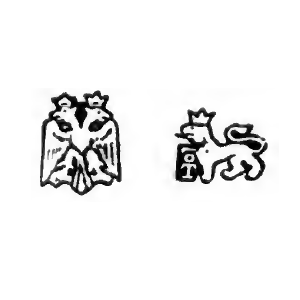
The imperial eagle likely refers, as with Sahagún the Elder (see article), to supplies for the imperial troops, while the lion, according to Ehrenthal, to whom we owe this information, represents the heraldic animal of the city of Toledo.
The blades of Juan the Younger cannot yet be positively identified, except perhaps, based on their age, to suggest that they were his work, as both bear a crescent moon, and both were apparently made by the "Espadero del Rey" (Royal Blacksmiths). According to Don Manuel Rodríguez Paiomin, who, unfortunately, rather hastily copied the marks of Toledo blades from city council documents, Juan Martínez the Younger also worked in Seville. The mark mentioned there is nowhere to be found. However, we point to two blades in the Royal Historical Museum in Dresden, dating from 1587, which, in addition to the name and motto "In te Domine speravi" ("In you, Lord, I trust"), also bear the mark of a "wild man," very similar to that of Sebastián Hernández.
There, it is attributed to the younger Martínez, although the date is very early.
On the other hand, in the Royal Museum in Brussels, one can see a sword belt belonging to another Martínez, Alonso, dating from the turn of the 17th century (mid-11th century), bearing the mark of Al-Martínez. An even younger Alonso of the same name is also known as an 18th-century gunsmith. We see a flintlock pistol of his making in Copenhagen.
Martínez's sword mark, "moon," became so popular in the 17th century that even prominent Spanish and German swordsmiths used it without hesitation.
Among them was Pedro de Velmonte, who used all of Martinez's marks. Hortuno de Aguirre (see entry) used the moon, and Mewes Berns of Solingen, like Clemens Horn, used his Latin motto.
This master should not be confused with another Juan Martínez of the Menchaca family, who worked around the same time, but in Lisbon rather than Toledo. His mark is distinct and easily distinguishable from that of the Toledo smith. The inscription on a blade of his work on a 1st-class rapier in the Royal Arms Museum in Stockholm (71 R) reads: JOAN . MARTINEZ . ME . FES . EN LISVOA. Another blade of his work, on the sword of Philip I in the Royal Armory in Madrid (1716), is engraved with the letters D.M.S. In contrast, the following masters belong to the Zabala family: Juan Martínez de Garata Zabala the Elder and his two sons, Andrea and Gabriel. We list them last because their works cannot be identified by the hastily copied marks of Palomina. We only know that all three worked in Toledo.
Source: Meister der Waffenschmiedekunst vom XIV. bis ins XVIII. Jahrhundert, Wendelin Boeheim, 1897, Berlin, 126
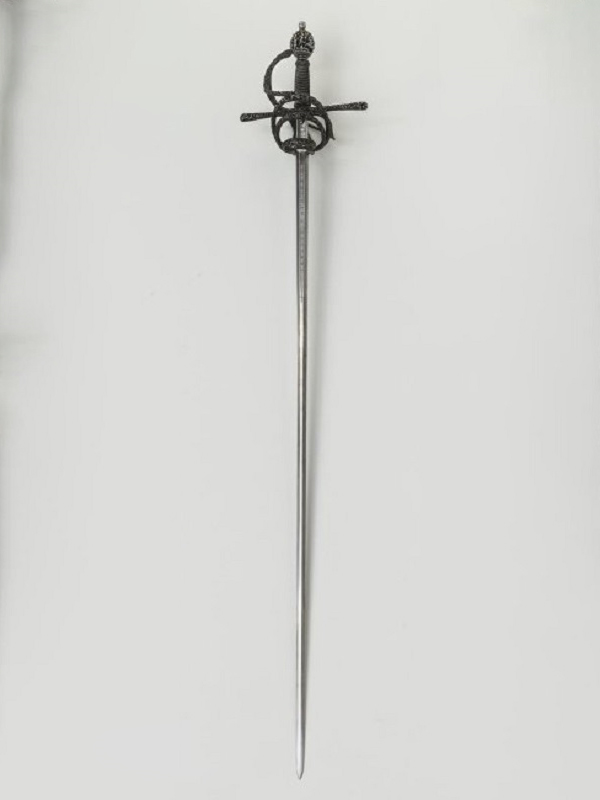
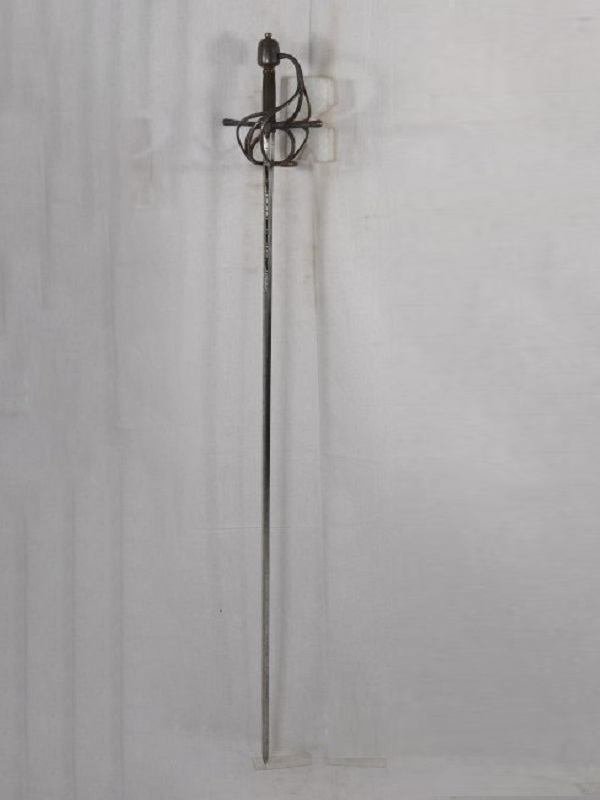
Weapons of the great master you can see:
Hermitage museum, Saint Petersburg, Russian Federation.
The Metropolitan Museum of Art, New York, New York, USA.