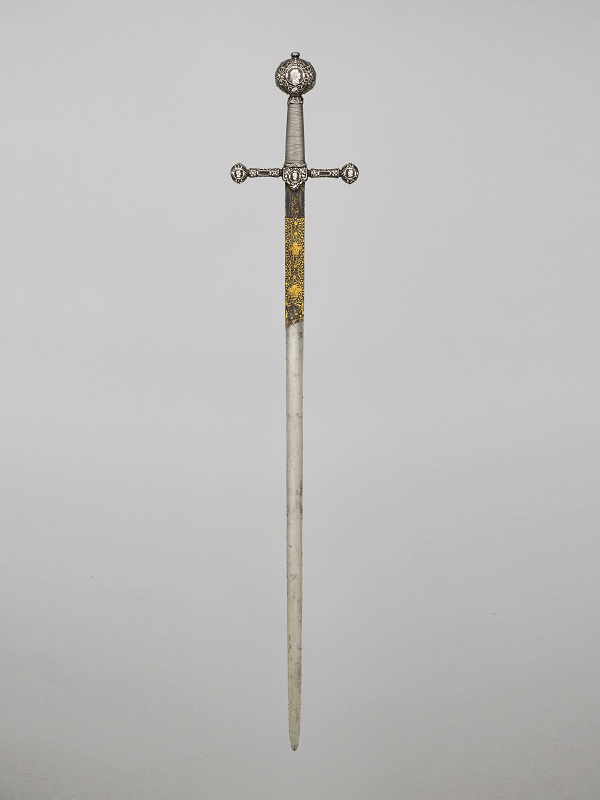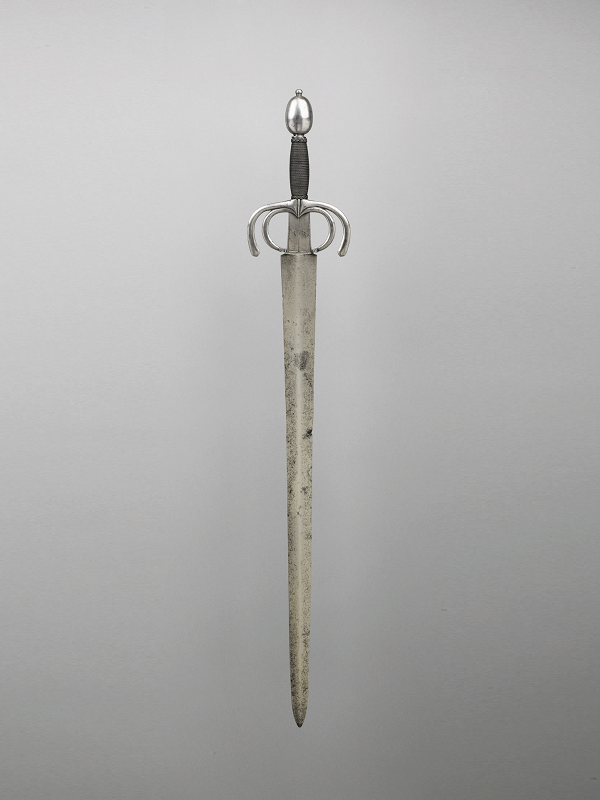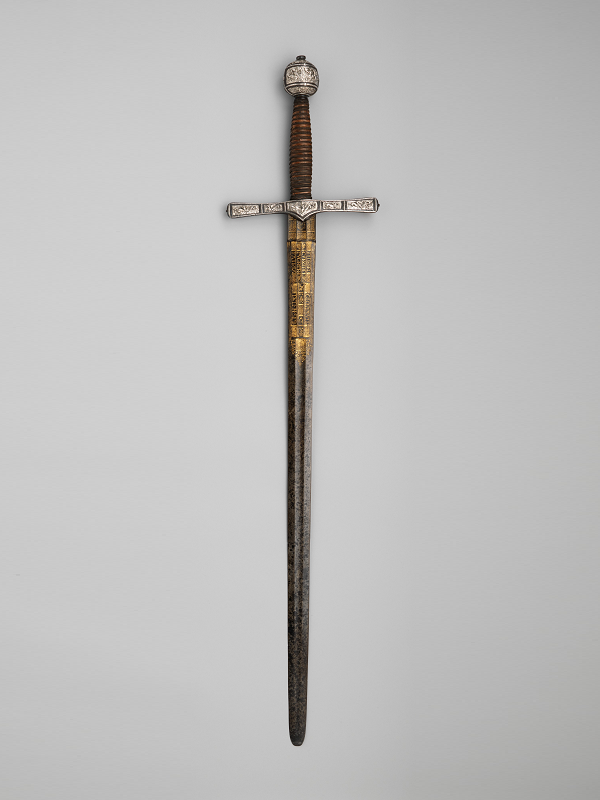
Clement Horn, Solingen, Germany.
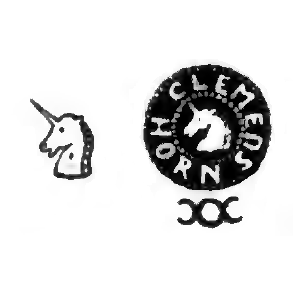
In larger collections of weapons, this name is frequently found on exceptionally well-crafted and beautifully decorated sword blades, which is how it became familiar to connoisseurs. Given this evident skill and productivity, it is surprising that we have learned so little about his life and social circumstances. The name appears only sporadically in the Solingen registers provided by Albert Weyersberg and Cronau, and he does not seem to have originated in Solingen, but rather to have worked there for a considerable time and, exceptionally, to have become a master craftsman. As Mr. Albert Weyersberg informed us at the last minute, in 1616 the "respectable and pious Clemens Horn" was elected churchwarden of the Reformed congregation. In 1618, he submitted an account of his service. Churchwardens were generally chosen from among those in their prime. This date thus indicates the midpoint of his life and career. His activity, as can be seen from his blades, spans between 1580 and 1630. As mentioned, the master's work is much closer to us. We find by him both two-handed swords and sword and swashbuckling blades of good quality, but considerable weight. Many bear only the name etched in, others also the mark of the same, which depicts the head of a "unicorn." It appears in various forms depending on its age.
On the blade of a historically very interesting skinning sword in the forestry armory at Schwarzburg (320), the mark appears quite differently.
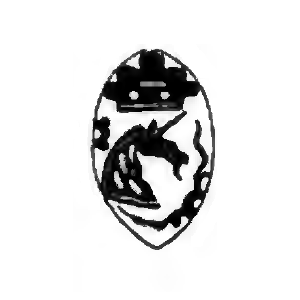
This blade has a blue tarnish, and on one side one sees the equestrian portraits of King Louis XIII, Duke Bernhard of Saxe-Weimar, and Count Axel Oxenstierna; on the other, the equestrian portraits of King Gustavus Adolphus, Duke John George of Saxony, and finally, Duke Gaston of Bourbon. The mounting is made of iron with rich silver plating and traces of gilding. The work dates from c. 1630. It is not uncommon to find blades by this master with inscribed Latin maxims, as on the sword blade in the Royal Armory in Berlin (7096). On it, we read in crudely inscribed letters on one side: “Clemens Horn. — Fide sed evi vide.” On the opposite side: “me fecit Solingen. — Devs providebit.” On a dagger blade (979) in the same armory, on one side is the inscription: “In te Domine speravi non — confvndar in aeternvm,” on the opposite side: “Clemens Horn me fecit. Solingen.” A sword from the same collection bears Horn's name and mark, along with lengthy Latin inscriptions and the year 1621. Of particular historical note is the sword of Elector George William of Brandenburg, dating from around 1610. On the blade, crafted by Clemens Horn, the busts of the aforementioned Elector and Elector John Sigismund of Brandenburg are etched among several Latin inscriptions.
Furthermore, we note a two-handed sword (J. 58) and four swashbuckling sword blades (J. 165, 177, 227, 356) in the Musée d'Artillerie in Paris, and two sword blades in the Royal Historical Arms Collection in Copenhagen, all of which are marked with the name, some also with the unicorn. Fine examples of blades are also preserved in the Royal Historical Museum in Dresden and the Grand Ducal Collection in Karlsruhe.
In the imperial collection of the Hermitage Museum in St. Petersburg, we see a beautifully engraved and gilded blade of a hunting sword. It bears the cipher C. H., followed by the inscriptions "Inter (arma) silent (legesK)," then: "Spe(s) et Patientia," and "Clemens Horn me fecit, Solingen. Anno 1611." The sword was sent by a Russian envoy from Vienna.
Source: Meister der Waffenschmiedekunst vom XIV. bis ins XVIII. Jahrhundert, Wendelin Boeheim, 1897, Berlin, 100
Weapons of the great master you can see:
The Wallace Collection, London, Greater London, United Kingdom.
The Metropolitan Museum of Art, New York, New York, USA.