
Antonio Piccinino, Milan, Italy.
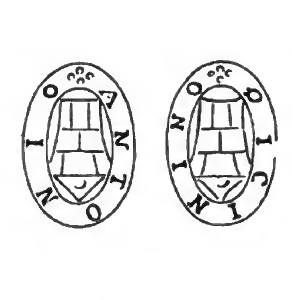
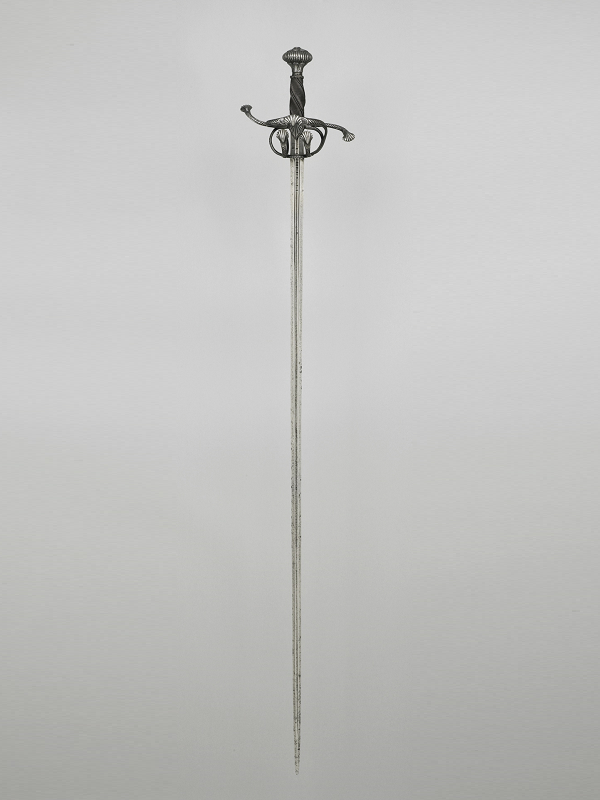
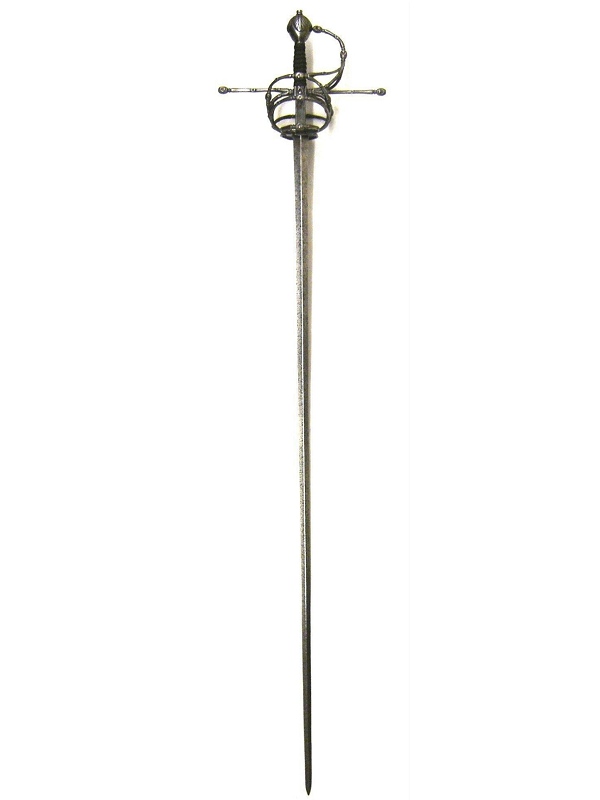
Although contemporary literary sources about this outstanding swordsmith are extremely scarce, his blades, still preserved in many collections, testify to the exceptional beauty and quality of his work and prove to connoisseurs that they can stand on the same level as the finest blades from Toledo and Brescia. The swordsmith Antonio Petrini mentions his blade in a 1642 manuscript, which has been frequently cited, and we present the excerpt here in German translation: “Other blades have a castle or rock fortress (rocca) carved on them; they come from Milan. However, they are not from Castel Vecchio or Castelnuovo. The old ones are better; the new ones are too rough and brittle (troppo crude e frangibili).” Antonio, who supplied both edged weapons for ordinary combat and the finest rapiers with the finest edge and burrs, used two different forms of marks in his career; both depict a castle with two towers. The older mark is much cruder, while the later one, modeled on Spanish examples, depicts a castle surmounted by a wreath of leaves. The maker's name is always present, sometimes accompanied by the renowned Milanese assay mark.
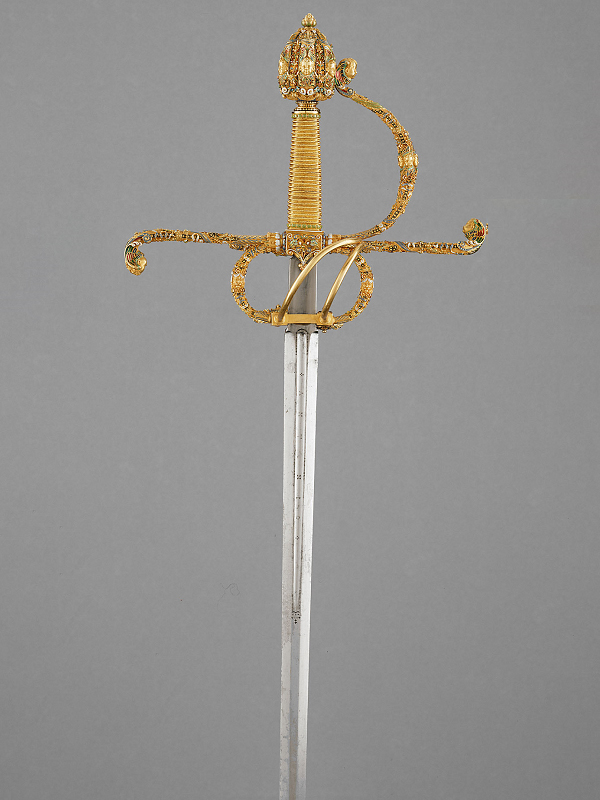
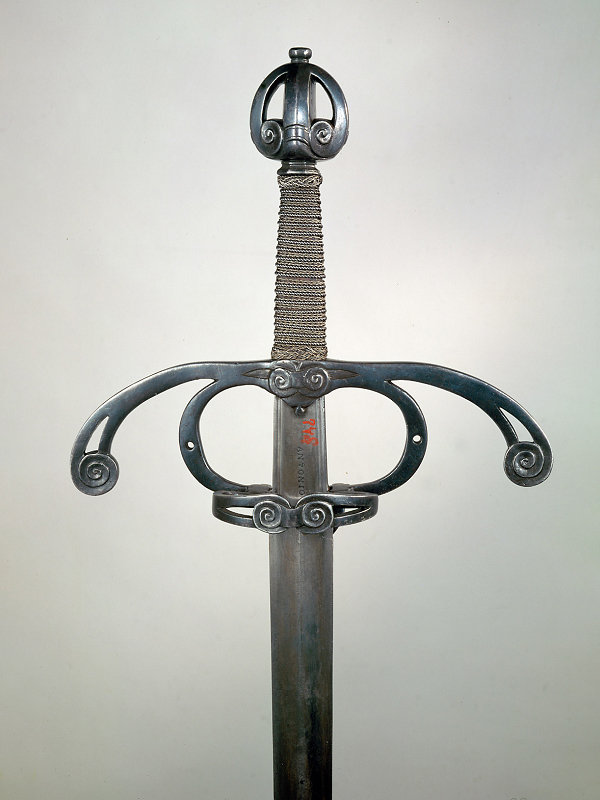
Given the large number of blades by this master still preserved in collections, we will limit ourselves to mentioning only the most notable. Particularly noteworthy, judging by its shape, is the blade of an exceptionally beautiful hunting knife, decorated in Tausia, from the Count's collection at Erbach Castle. It also bears an assay mark. The famous sword of Charles V, a unique masterpiece of jewelry in the art-historical collections of Vienna (379), has a blade by this master, bearing his name and a later hallmark. A magnificent sword from the collection of Baron Nathanael Rothschild in Vienna displays the most beautiful known blade by Antonio: it has four rows of venom tongues of astonishing precision and still bears the old hallmark. Finally, three Piccinino blades from the collection of Archduke Franz d'Este in Vienna are worth mentioning. Two of them retain the old hallmark, one of which reads: MONTE . ANTOLA. The third blade, on an Italian two-handed sword, is interesting in that it bears the date "Antonio Piccinino me fecite in Milan 1584." A close analogue is the two-handed sword from the former collection in Pierrefonds (315), originally from the Soltikov collection and presumably now housed in the Artillery Museum (St. Petersburg).
A large number of blades from common infantry swords made by our master in the collection of the Royal Arsenal in Venice are of great interest. Whether they are modern pieces or Venetian equipment is irrelevant here. It is noteworthy that we find ordinary factory-made products here. All bear a small, later Milanese hallmark and lack the maker's name. Like the blades of famous Spaniards such as del Rey, Sahagún, Tomás de Ayala, and others (see below), Piccinino blades, due to their fame, have also spawned numerous counterfeits, most of which originate in Germany. Blades with the Bicino or Piccinio variants are invariably counterfeits.
Like Antonio, his eldest son, Federigo, according to Moriggia, was primarily a blacksmith, although there are indications that he also made fittings (handles, scabbard fittings). The exact dates of his birth and death are unknown. The oldest dated blade dates back to 1539. Therefore, he must have been born no later than 1519, since Moriggia still indicates that he was working in 1595; thus, he reached an advanced age, like his father.
Of his blades, which are still quite common in collections, we will mention only the most notable. One blade from a ceremonial sword (J. 43) is in the Musée de l'Artillerie in Paris; another, from a ceremonial sword with a magnificently inlaid hilt from the valuable collection of Baron Nathanael de Rothschild, dates to 1539; a third, from an exceptionally richly decorated ceremonial sword from the Royal Museum of Arms in Brussels (Épees 32), bears a maker's mark very similar to those of his father's earlier swords, which we reproduce here. Finally, we will mention the beautiful paired blades of the so-called "dueling set" from the rich collection of Franz Till in Vienna.
Source: Meister der Waffenschmiedekunst vom XIV. bis ins XVIII. Jahrhundert, Wendelin Boeheim, 1897, Berlin, 162
Weapons of the great master you can see:
The Wallace Collection, London, Greater London, United Kingdom.
Victoria and Albert Museum, London, Greater London, United Kingdom.
Hofjagd- und Rüstkammer, Wien, Republik Österreich.