- Articles
- Weapons
- Armor
- Armor for horses
- Emperor Armor
- Chivalry
- Chivalry
- Knights castle
- Knights tournament
- The Crusades
- Knightly Orders
- Knightly saddle
- Knightly motto
- Great Knights
- Price of armor
- Children's armor
- Castles and fortresses
- Museums of armor and weapons
- Coats of arms and heraldry
- Routes and excursions
- Guides


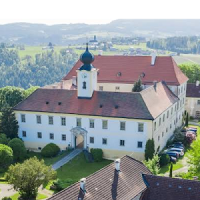
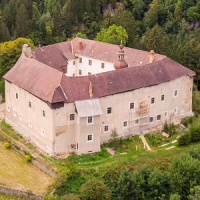
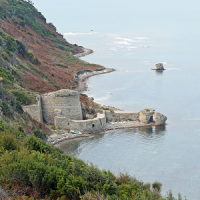
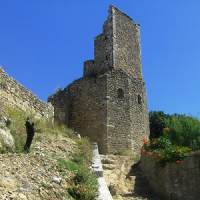
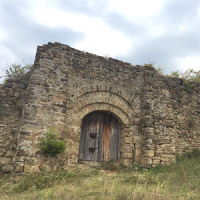
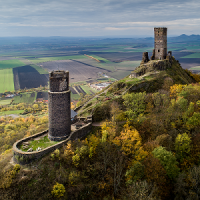
Frydstejn Castle
Zřícenina Hradu Frýdštejn
May - October Tu-Su 10.00-17.00. Weekend: Mo, November - April
Adult - 70CZK, Children's (0-5) - Free, Children's (6-15) - 30CZK, Students - 50CZK, Pensioners - 50CZK
www.frydstejn.cz
Frýdštejn 463 42, Liberecký kraj, Česká republika
50.648603, 15.168868 View map
Frydstejn Castle - Zřícenina Hradu Frýdštejn, Frydstejn, Liberec Region, Czech Republic.
The ruins of Frýdštejn Castle are one of three castles in the Jablonec district. The exact date of its founding is unknown, nor do we know precisely when the Frýdštejn estate was established; however, we do know that it was the property of the Markvartic family. The Lords of Dražice are mentioned in 1363, and Jan of Bibrštejn thirteen years later (in 1376), leading to the theory that the castle's origins are linked to the Bibrštejn family.
The first mention of Frýdštejn dates back to 1385, when ecclesiastical records name Bohuněk, known as Puklice of Frýdštejn.
At the turn of the 14th and 15th centuries, the castle was held by the Kamenec family of Střížovice and Čakovice, but by 1409, the owner of the Frýdštejn estate was Bohuš of Kováň. As a Catholic, he faced a siege by the Hussites in August 1432, led by Ota of Loza and Jan Čapek of Sány. However, Bohuš of Kováň reached an agreement with the Hussites not to take hostile action against them and later even converted to the Hussite cause. In 1448, he assisted George of Poděbrady in the capture of Prague. Following his death in 1460, Jan Zajíc of Hazmburk became the administrator of the estate. Subsequently, the property changed hands several times; in 1540, the Vartenberk family purchased the castle and the estate. However, their ownership was short-lived, as Adam of Vartenberk lost his estates—including Frýdštejn—after participating in the Bohemian Estates' revolt against King Ferdinand I in 1546–1547. The final owner of Frýdštejn was Jan of Oprštorf, who purchased the castle, along with Český Dub, from the king in 1556. Jan gradually sold off parts of the Frýdštejn estate, thereby ending the castle's role as both a manorial seat and a defensive stronghold.
By the time the Oprštorf family sold the castle to Zikmund Smiřický of Smiřice in 1591, it was already uninhabitable.
Frýdštejn was a classic rock castle that commanded views toward Hodkovice and, more importantly, over the Jizera Valley. An old road ran through this valley from Turnov toward the north, passing through the village of Frýdštejn—originally known as Zásada—which housed a manorial farmstead that provided the castle's inhabitants with their basic sustenance.
The exact route used to enter the castle is unknown. Access was likely gained to the right of the tower, through the ground floor of the main palace—the residence of the lord of the castle. Given the limited space within the castle, this entire rock barrier was honeycombed with small chambers and cellars hewn directly into the stone. Of particular interest is a small chamber hewn into the rock south of the main tower; a wall niche and an altar suggest it was once a chapel—a space that, as indicated by the date 1691, remained in use long after the castle was abandoned.
The castle’s dominant feature is its great tower, built atop the highest crag to allow for a wide view of the surrounding area. The tower is the best-preserved part of the castle; it stands approximately 15 meters tall with a diameter of 9 meters and walls two meters thick. Its only entrance was located on the first floor, some 6 to 7 meters above the level of the courtyard.
Frýdštejn Castle was opened to the public in the 1990s, after the Turnov Beautification Society—which had purchased the castle from the Rohan princes of Sychrov in 1892—arranged for the reinforcement of the surviving masonry. Artifacts recovered during archaeological surveys of the site are now held in the collections of the Turnov Museum.
The castle is currently owned by the municipality of Frýdštejn, and extensive, costly preservation work is being carried out with the aim of ensuring the castle survives—at least in its current form—for future generations.
The castle is featured in Karolína Světlá’s book *O Krejčíkovic Anežce* (About Anežka Krejčíková), and it has served as a filming location on several occasions. Among the most famous films shot there is the fairy tale *O princezně Jasněnce a létajícím ševci* (Princess Jasněnka and the Flying Shoemaker). That is a brief overview of the history and present-day status of this significant cultural monument in North Bohemia—Frýdštejn Castle.
9 okt 2026
0
0