- Articles
- Weapons
- Armor
- Armor for horses
- Emperor Armor
- Chivalry
- Chivalry
- Knights castle
- Knights tournament
- The Crusades
- Knightly Orders
- Knightly saddle
- Knightly motto
- Great Knights
- Price of armor
- Children's armor
- Castles and fortresses
- Museums of armor and weapons
- Coats of arms and heraldry
- Routes and excursions
- Guides


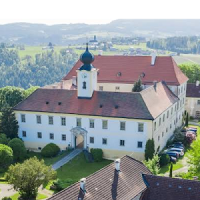
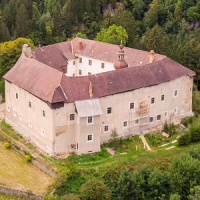
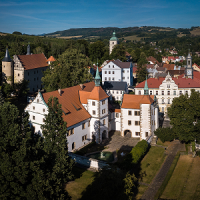
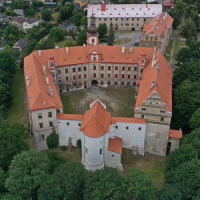

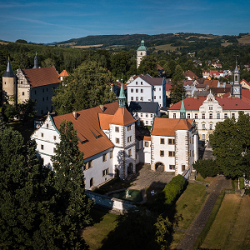
Benesov nad Ploucnici Castle
Státní zámek Benešov nad Ploučnicí
Information on the website. Weekend: Information on the website
Adult - 120CZK, Children's (0-5) - Free, Children's (6-17) - 40CZK, Students - 100CZK, Pensioners - 100CZ
www.zamek-benesov.cz
Zámecká 51 407 22 Benešov nad Ploučnicí, Ústecký kraj, Česká republika
50.742426, 14.310999 View map
Benesov nad Ploucnici Castle - Státní zámek Benešov nad Ploučnicí, Benesov nad Ploucnici, Usti nad Labem Region, Czech Republic.
Benešov nad Ploučnicí preserves a highly significant complex comprising two separate chateau structures—the Upper Chateau and the Lower Chateau—along with a third example of unique Renaissance architecture: the adjacent parish Church of the Nativity of the Virgin Mary. All three buildings are linked by the Salhausen noble family, originally from Meissen. They arrived in Bohemia in the early 16th century and undertook extensive construction projects in the style of the Saxon Renaissance.
The Salhausen noble family—who arrived from Meissen in 1515 and were granted Bohemian noble status that same year—is inextricably linked to the phenomenon of the "Saxon Renaissance" in the regions of Benešov, Česká Kamenice, Děčín, and Ústí. The sons of Jiří of Salhausen—Bedřich, Jan, and Volf—initially lived together but parted ways in 1522; only Bedřich remained in Benešov nad Ploučnicí, where he built his own residence—the structure now known as the Upper Chateau—within three years. He continued his building activities from 1540 onwards, constructing the Lower Chateau for his son Jan alongside his own new residence; this building featured side Renaissance gables in the shape of "donkey-back" arches and a three-story prismatic tower in front of the southern façade. Later, his brother Bedřich the Younger resided in the Upper Chateau, while Jan’s sons, Antonín and Volf, lived in the Lower Chateau. Around 1578, Volf had his own Renaissance palace—known as the Volf Wing—added to the Lower Chateau complex. This marked the end of the Salhausen family's building activities in Benešov nad Ploučnicí. Although both chateaux in the town passed to new owners in the years that followed, neither ever served as the seat of an estate again; consequently, they were spared the fashionable, functional alterations that often compromised such buildings.
The Lower Chateau was opened to the public in 1961; fortunately, it escaped serious damage during a fire in December 1969 that severely affected the National Museum's ethnographic exhibition. Thanks to the systematic efforts of heritage preservationists, the Upper Chateau was opened to the public in 1999 following a comprehensive restoration.
The unique Renaissance character of both chateau buildings is sensitively complemented by exhibitions of period furniture, porcelain, weaponry, paintings, prints, and decorative arts, all evoking the lifestyle of the minor nobility at a country estate during the 16th and 17th centuries. A replica of the Triton statue by the Dutch master Adriaen de Vries stands in the chateau courtyard.
Sourse: www.zamek-benesov.cz/cs/o-zamku
15 sen 2026
0
0