- Articles
- Weapons
- Armor
- Armor for horses
- Emperor Armor
- Chivalry
- Chivalry
- Knights castle
- Knights tournament
- The Crusades
- Knightly Orders
- Knightly saddle
- Knightly motto
- Great Knights
- Price of armor
- Children's armor
- Castles and fortresses
- Museums of armor and weapons
- Coats of arms and heraldry
- Routes and excursions
- Guides



Frankopan Nova Kraljevica Castle
Kaštel Frankopanski Nova Kraljevica
Rovina ul. 6, 51262, Kraljevica, Primorsko-goranska županija, Republika Hrvatska
45.275548, 14.564780 View map
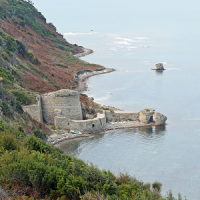
Frankopan Nova Kraljevica Castle - Kaštel Frankopanski Nova Kraljevica - Dvorac Nova Kraljevica, Kraljevica, Primorje-Gorski Kotar County, Republic of Croatia.
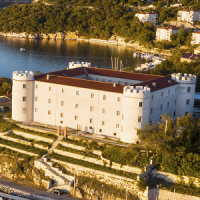
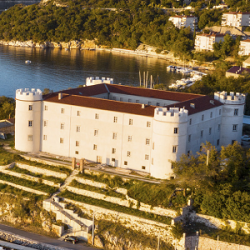
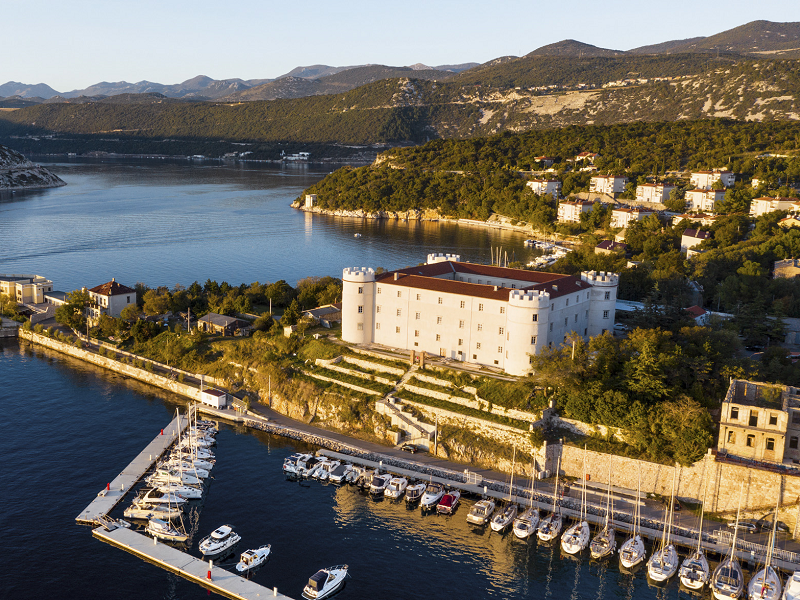
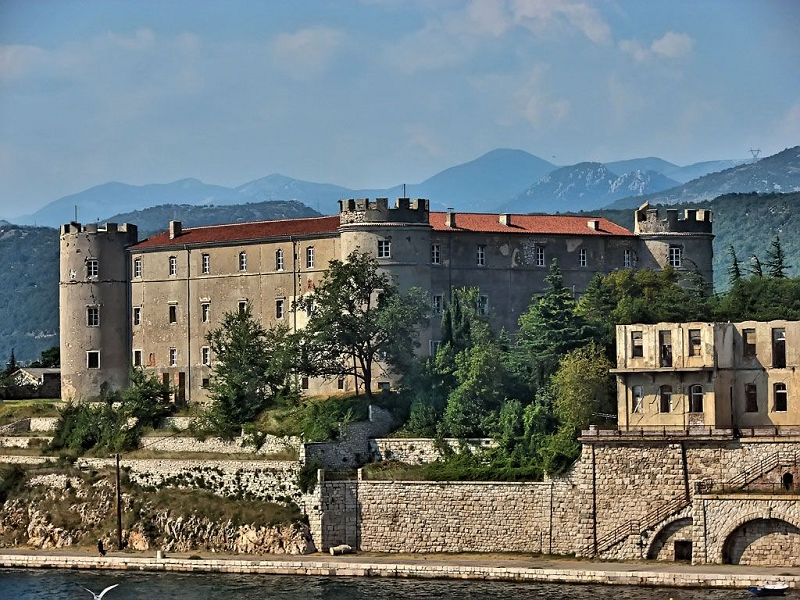
Kraljevica Castle is located on a hill on a peninsula, at the very entrance to Bakar Bay. Petar Zrinski began building it in 1651 for his wife, Katarina of the Frankopan family. The castle was built not as a defensive structure, but as a residence for a powerful dynasty, a testament to the social status of its owner.
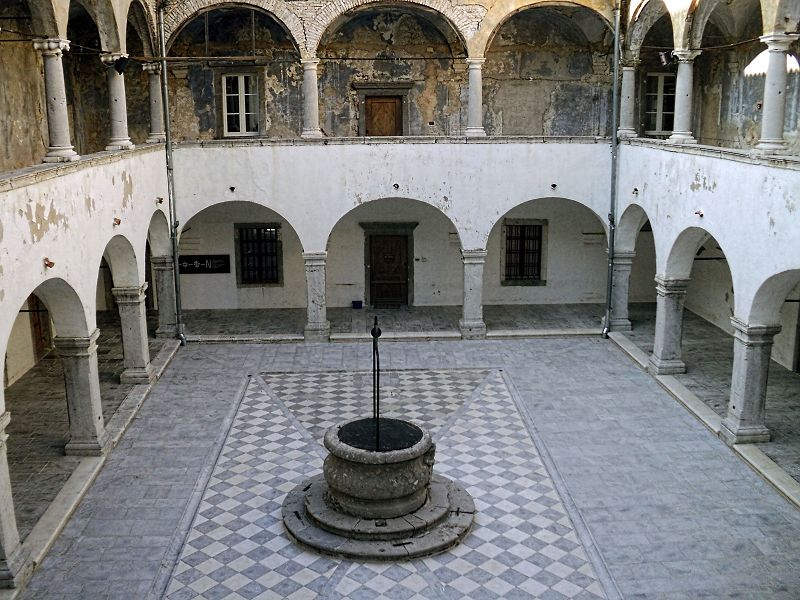
The builders, most likely Venetians, created a large rectangular complex (44 by 36 meters) in the late Renaissance style, but with numerous Baroque details. Four large towers were positioned at the corners. The castle consists of a basement, which housed storage, a ground floor, and a first floor surrounding a beautiful atrium (the second floor was added later). Although the castle looks like a fortress from the outside, the interior was built like a private residence. It had magnificent interior decoration, of which only two doorframes and a magnificent black marble fireplace on the ground floor remain. The walls were decorated with gilded leather and numerous paintings and sculptures. A 17th-century painting shows that the castle also had a special hall called the museum, intended to house the family's rich heritage. At the time, it was one of the first museums in Croatia. Rumor has it that this castle was intended to serve as Croatia's capital after the capture of Vienna. This story, of course, is unconfirmed, but it may explain why it was built in such an opulent form, next to the earlier Zrinski Castle in the center of Kraljevica. There is also a legend that the conspiracy was hatched in this castle, but the fact is that it was planned much earlier.
After the conspiracy was uncovered and the heads of the Frankopan and Zrinski families were executed, the castle was plundered and passed under Austrian control, where it was used for various, mostly inappropriate, purposes. In the 17th and 18th centuries, it served as a dungeon and barracks. Later, a hospital was established here, where, in addition to typhus, cholera, and other illnesses, syphilis was also treated. After the hospital's closure, the castle remained empty until 1882, when it was purchased by the Sisters of Mercy, who then sold it to the Jesuits, who had come to the region after fleeing Italy. The Jesuits added a second floor, added a crown to the towers, in keeping with the fashion of the time (the castle previously had a conical tower), and covered the first floor with colorful stained-glass windows (these windows would later be transported to Bosiljevo Castle). Young monks were educated in the castle, studying theology and philosophy, logic, dialectic, metaphysics, cosmology, psychology and ethics, Latin, Greek, Italian, and the national Croatian language and literature, as well as mathematics, algebra, geometry, mechanics, chemistry, physics, and history. But by 1894, they had abandoned the castle and returned to Italy. The castle was abandoned again, and at the beginning of the century, a school was established there. During World War I, the castle was once again used as a hospital. During World War II, it served as barracks for the Yugoslav, and later, the Italian and German armies.
Now, Kraljevica Castle is recognized as having immense significance and importance in Croatian history and is being actively restored. The restored premises house art galleries, and a series of cultural events, known as "letov Frankopane," are organized to attract public attention. Speakers emphasize the exceptional acoustic properties of the atrium, considering it the best open space in Croatia, as well as the unique atmosphere of the gallery.
10 sen 2026
0
0