- Articles
- Weapons
- Armor
- Armor for horses
- Emperor Armor
- Chivalry
- Chivalry
- Knights castle
- Knights tournament
- The Crusades
- Knightly Orders
- Knightly saddle
- Knightly motto
- Great Knights
- Price of armor
- Children's armor
- Castles and fortresses
- Museums of armor and weapons
- Coats of arms and heraldry
- Routes and excursions
- Guides


Trosky Castle
Hrad Trosky
Information on the website. Weekend: Information on the website
Adult - 180CZK, Children's (0-5) - Free, Children's (6-17) - 50CZK, Students - 140CZK, Pensioners - 140CZK
www.hrad-trosky.cz
Troskovice, Liberecký kraj, Česká republika
50.516559, 15.230851 View map
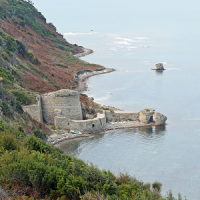
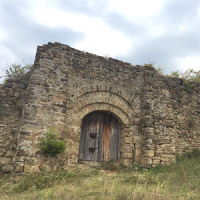
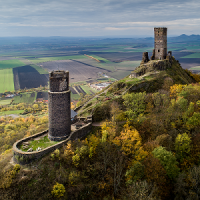
Trosky Castle - Hrad Trosky, Troskovice, Liberec Region, Czech Republic.
Trosky Castle stands on a unique rock formation of volcanic origin. Two lava plugs erupted from the earth's interior during the Tertiary period. Subsequent erosion washed away the overlying soil, sand, and other soft rock, exposing the basalt crags in their current form.
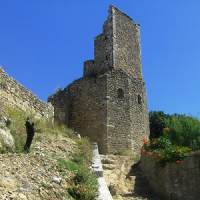
The castle was established on these rocks much later—in the late 14th century (specifically between 1380 and 1390)—by Čeněk of Vartenberk. Čeněk took advantage of the natural benefits offered by the basalt formations. He built the inner castle, featuring residential palaces, between the crags and erected defensive-residential towers atop the peaks; the lower, pentagonal tower originally had two stories and was likely accessible from the palace on the northern side. The taller, four-sided tower had three stories and reportedly housed the castle chapel. The demanding construction project exhausted Čeněk’s resources and funds; consequently, in 1394—while still alive—he handed Trosky over to the Czech King Wenceslaus IV, to whom he owed a significant portion of the money spent on building the castle. Four years later, the king sold the castle to the powerful Berg family.
During the Hussite Wars—a time when the castle was held by Ota the Elder and Ota the Younger of Berg—Trosky served as a key stronghold for the Catholic side. During this period, it was besieged several times (in 1424 and 1428), including by the armies of Jan Žižka. The Berg family managed the Trosky estate until 1455, when the last of the line, Jan, sold the property to Jan Zajíc of Házmburk, the owner of the nearby Kost Castle.
The second half of the 15th century marked the beginning of a period of rapid turnover in the castle's ownership; it passed in quick succession through the hands of the Zajíc of Házmburk, Šelmberk, Bibrštejn, and Lobkowicz families. Finally, in 1559, it was acquired by the Smiřický family. They no longer resided in the castle itself; at the turn of the 16th and 17th centuries, they moved to a more comfortable seat, Hrubá Skála, which they had converted from a medieval castle into a Renaissance chateau. Under their rule, the region experienced significant economic prosperity, characterized by the establishment of fishponds, sheep farms, breweries, and hop gardens.
In the first half of the 17th century—while Trosky remained part of the Skála estate—the castle passed by inheritance to the Wallenstein (Valdštejn) family. Its most famous owner from this lineage was Albrecht von Wallenstein. During his tenure, the castle was looted by Swedish troops and subsequently occupied by Imperial forces. Under the Wallensteins, Trosky declined in importance, and over time, the landmark fell into disrepair.
The last noble family to own Trosky Castle—by which time one could truly speak of the ruins of the original structure—was the Aehrenthal family, who took possession in 1821. From a global perspective, this is not a particularly prominent noble family; nevertheless, it is said that without the Aerenthals, the Bohemian Paradise (*Český ráj*) would not be the Bohemian Paradise. The Aerenthals tended to the local wealth of forests, meadows, and the ponds beneath Trosky Castle. They fostered fruit growing, established an arboretum, built hiking trails, and generally contributed to the development of tourism in the region. Linked to this were their efforts to preserve the ruins of Trosky Castle and open the site to the public.
In the early 20th century, the Aerenthals transferred Trosky to the Bohemian Paradise Tourist District, and the castle was managed by the Czech Tourists Club. Since 1925, Trosky Castle has been state-owned.
9 okt 2026
0
0