- Articles
- Weapons
- Armor
- Armor for horses
- Emperor Armor
- Chivalry
- Chivalry
- Knights castle
- Knights tournament
- The Crusades
- Knightly Orders
- Knightly saddle
- Knightly motto
- Great Knights
- Price of armor
- Children's armor
- Castles and fortresses
- Museums of armor and weapons
- Coats of arms and heraldry
- Routes and excursions
- Guides


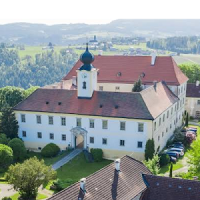
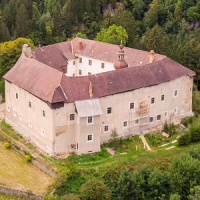
Lukov Castle
Hrad Lukov
Information on the website. Weekend: Information on the website
Adult - 70CZK, Children's (0-6) - Free, Children's (7-15) - 60CZK, Students - 60CZK, Pensioners - 60CZK, Family (2+2) - 220CZK
www.hradlukov.cz
Lukov 38, 763 17 Lukov, Zlínský kraj, Česká republika
49.303111, 17.739873 View map
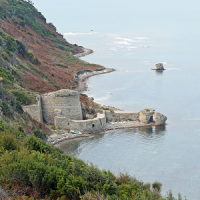
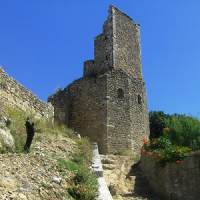
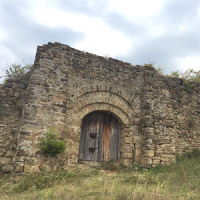
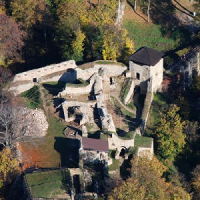
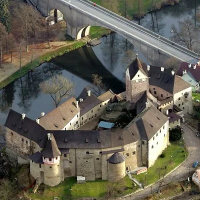
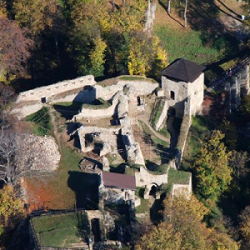
Lukov Castle - Hrad Lukov,Lukov, Zlin Region, Czech Republic.
The origins of Lukov Castle date back to the first third of the 13th century. Fragments of stonework from this period attest to the work of stonemasons from the prominent Velehrad construction workshop. While the castle was undoubtedly held by the Crown at that time, a record from 1332 shows it in the possession of the powerful Šternberk family by the early 14th century. However, the very next year, the castle reverted to royal control—an event described by the Czech King and Holy Roman Emperor Charles IV in his autobiography. Yet, it did not remain in royal hands for long; by 1342, it once again belonged to the Šternberks, remaining under their administration for nearly two hundred years. In 1392, Pope Boniface IX mentioned the existence of the castle church of St. John, which housed relics of the Holy Cross. Tangible evidence of this unique architectural feature includes discovered fragments of richly decorated Gothic pinnacles, tracery windows, and a rose window.
During the Bohemian-Hungarian wars, the castle was captured and burned by the troops of the Hungarian King Matthias Corvinus. The extensive damage to the fortifications likely prompted a major reconstruction and expansion of the castle. It was probably during this period that the so-called Lower Castle, featuring the St. John Tower, was built.
In 1511, the Lukov estate was purchased by the House of Kunštát. The most prominent holder of the castle from this family was Jan Kuna of Kunštát, the Moravian Landeshauptmann (provincial governor). In 1548, the Nekš family of Landek became the new owners of Lukov Castle and its estate; under their tenure, the castle underwent extensive Renaissance-style reconstruction to meet the era's standards for comfortable living. The Nekš family were capable administrators, and their estate grew significantly in both size and wealth. It is hardly surprising, then, that the family's last heiress, Lukrecie, became the object of interest for many noble suitors. Her second husband was Albrecht Václav Eusebius of Wallenstein—a nobleman who was slightly her junior and exceptionally ambitious (and who would later become a renowned military commander); upon her death in 1614, he inherited her vast estate.
In 1619, during the Bohemian Revolt against the Austrian Emperor, Lukov Castle was confiscated from Albrecht by the Moravian Directory government because he had shown himself to be a loyal supporter of Ferdinand II. After the Battle of White Mountain, Albrecht of Wallenstein returned to Lukov, but he soon parted with the estate to acquire Frýdlant instead. During the Thirty Years' War, Lukov repeatedly became a focal point for uprisings by the local population—known as the *Valaši* (Wallachians)—against the Habsburgs. Efforts to pacify the resistance in the Wallachia region, which had been progressing promisingly, were derailed in the spring of 1642 by the Swedish invasion of Moravia and the occupation of Olomouc. The Swedes captured Lukov Castle without a fight; they maintained a garrison there for nearly three months before looting and setting fire to the structure upon their departure. At the time, the castle was held by the Minkwitz family (Minkwitz von Minkwitzburg), who had long struggled with massive debts and foreclosure proceedings. Jan Josef of Rottal acquired the Lukov estate from the indebted Minkwitz family but soon sold it to the Seilern family. As members of the Viennese court nobility, the Seilerns rarely spent time at the Lukov estate. The castle gradually lost its importance; administrative offices were relocated to the village below, and by the end of the 18th century, the site was completely abandoned and became a source of cheap building material.
Efforts to save the castle complex began in the final quarter of the 20th century. Archaeological research has been conducted there almost continuously since 1983, and a gradual restoration project began in 1987. Members of the Brontosaurus Movement and the Association of Friends of Lukov Castle have been involved in this work. Thanks to years of volunteer effort, the castle has been transformed from a neglected ruin into a popular tourist destination that hosts educational programs aimed primarily at children and young people.
3 okt 2026
0
0