- Articles
- Weapons
- Armor
- Armor for horses
- Emperor Armor
- Chivalry
- Chivalry
- Knights castle
- Knights tournament
- The Crusades
- Knightly Orders
- Knightly saddle
- Knightly motto
- Great Knights
- Price of armor
- Children's armor
- Castles and fortresses
- Museums of armor and weapons
- Coats of arms and heraldry
- Routes and excursions
- Guides


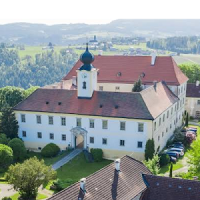
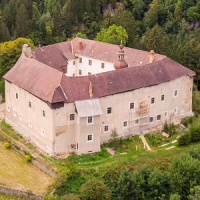
Klenova Castle
Hrad Klenová
Information on the website. Weekend: Information on the website
Adult - 100CZK
www.gkk.cz/cs/pro-navstevniky/hrad-a-zamek/
Klenová 1, 340 21 Klenová, Plzeňský kraj, Česká republika
49.331759, 13.229047 View map
Klenova Castle - Hrad Klenová, Klenova, Plzen Region, Czech Republic.
Klenová Castle in the Middle Ages.
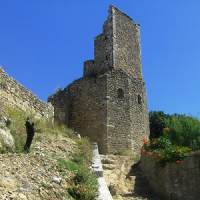
The first mention of the Lords of Klenová dates back to 1287; consequently, the origins of the local castle are traced to the second half of the 13th century. Surviving from that period are the lower section of the palace's northern wall and a prismatic tower located in the westernmost part of the complex. Its lower, circular section—now partially buried underground and accessible via an opening in the vault—served as the castle dungeon. The tower was accessed at the first-floor level via a small bridge leading from the wall of the adjacent palace. The castle was encircled by a moat, which remains preserved around almost the entire perimeter, except for the area in front of the later château; there, it was filled in during the château's construction in the 1830s. Over the course of the 14th and 15th centuries, several generations of the Lords of Klenová and Janovice held the estate. Intensive construction activity is assumed to have taken place during the reign of the House of Luxembourg, particularly in the northeastern section of the Upper Castle, above the surviving cellars. The outer ward walkway (parkán) encircling the entire castle likely dates to this period; on the northern side, it had to be supported by vaulted arches, which remain visible today when viewed from the castle moat. Based on surviving architectural elements, the current form of the palace's southeastern section—now the best-preserved part of the castle ruins—was created during the reign of Wenceslaus IV. A new hall featuring a so-called "Hussite Chapel" was built on the first floor, adjoining a terrace that was added in the 19th century. A stonemason's mark is still visible today on the boss of its rib vault—now protected by a modern roof that stands out prominently in the castle's silhouette. It was also during this period that a polygonal upper section was added to what was likely an older round tower; this addition housed the castle chapel. After the structure collapsed, the space was converted into an observation terrace in the 19th century. From 1420 to 1465, the family seat was owned by Přibík of Klenová, a renowned warrior and one of the most significant figures in the political life of the era. During the Hussite Wars, he succeeded in capturing the town of Stříbro; he held it for some time, and in exchange for relinquishing it, he later acquired substantial estates, most notably Volyně and Protivín. This feat went down in the annals of the Hussite Wars as one of the most important events of that turbulent period. He also took part in the siege of Plzeň, though he is said to have simultaneously supplied the besieged town in secret. In addition to various diplomatic services rendered to Czech kings, a notable episode in his career was a raid into Bavaria in 1450, during which he seized 600 head of cattle and horses. A legend recorded by Václav Hájek of Libočany is also associated with him; according to the story, in 1447 he captured two Polish monks traveling to Bavaria, suspecting them of carrying messages to Rome directed against the Utraquist bishop Jan Rokycana. He tortured them cruelly and subsequently—to prevent the torture from coming to light—had them starved to death in the aforementioned castle prison located in the prismatic tower. Přibík of Klenová’s most significant construction achievement was the further strengthening of the fortifications. On the most vulnerable side—facing east—the slope of the older rampart was faced with a massive wall, and a second ditch was excavated and an additional rampart raised in front of it. This system has been preserved to this day north of the castle; however, along the access road and in the so-called southern garden, the ditch was filled in and the rampart leveled. The new fortifications were innovative, particularly because the ramparts' crest—accessible from the castle proper via ramps—allowed for the maneuvering of cannons. Bastions were added later, during the Late Gothic period, and they evidently projected slightly beyond the facing wall. In addition to their military function, they served as structural supports for masonry that was gradually leaning outward. The northern section collapsed and was not rebuilt until the nineteenth century, taking on a somewhat atypical shape. Utility buildings were situated along the southern section, which is now concealed within the structure of the chateau.
The Renaissance and Kryštof Harant of Polžice and Bezdružice.
In the first half of the 16th century, the Klenovský family's tenure of the Klenová estate came to an end; after passing through the hands of several other owners, the castle was acquired in 1553 by Jiří Harant of Polžice and Bezdružice—a nobleman of modest means who nevertheless served as a high-ranking imperial official. He renovated the lord's residence at Klenová. Construction work focused primarily on the upper section of the castle palace. The only part preserved to this day is the building known as the Burgrave's House (*purkrabství*), which was converted from a Late Gothic kitchen during that period. In the mid-20th century, a fresco frieze featuring the coats of arms of the estate's owners and allied noble families was discovered in the upper-floor hall. Tradition holds that some of Jiří Harant's many children were born at Klenová, including Kryštof Harant of Polžice and Bezdružice—a prominent Renaissance statesman, traveler, composer, and writer. He took over the estate after 1584 together with his brother Adam. Adam's share remained in the Harant family, while Kryštof's portion passed to his brother-in-law—once again a member of the Klenovský family, Přibík of Klenová. In 1646, both shares were united under the ownership of the Count of Martinic. The castle's decline into ruin dates roughly from this time; by 1737, it was recorded as a ruin. Kryštof Harant of Polžice and Bezdružice (1564–1621) is the most significant figure associated with Klenová. In all likelihood, he was born right here, as Klenová was his father's seat at the time. He received a careful education, partly from a private tutor and partly at a school in Plzeň. He acquired extensive knowledge and skills within the cultured environment of the Innsbruck court of Archduke Ferdinand II of Tyrol, where he arrived in 1576 at his father's behest. He learned Latin, Greek, Italian, and German, and studied history, geography, political science, politics, theology, music, mathematics, and the natural sciences. The social bustle, contacts with foreign guests, and accompanying Ferdinand on a journey to Italy laid the foundations for his passion for travel. Following his father's death in 1584, he took over the management of the family estates. From 1594 to 1597, he participated in a military campaign against the Turks, during which he demonstrated both military talent and loyalty to the Emperor. After his return, his wife died; influenced by this event—and driven by an ambition to gain firsthand knowledge of the lands inhabited by the Turks—he decided to undertake a pilgrimage to the Holy Land. He set out in the spring of 1598, accompanied by his brother-in-law, the knight Heřman Černín of Chudenice. He described the journey—which led through Bavaria and Tyrol to Italy, and onward to Crete, Cyprus, Jaffa (in present-day Tel Aviv), Jerusalem, and Egypt—in his travelogue *Journey, or a Trip from the Kingdom of Bohemia to the City of Venice*, one of the most celebrated works of Czech literature. From the autumn of 1599, Kryštof Harant resided alternately at the Bělá stronghold and in Plzeň, where he personally met Emperor Rudolf II; by 1600, he had become a member of the Emperor's inner circle. In 1603, he was elevated to the rank of baron. Following the death of Rudolf II, he briefly served Matthias. In 1614–15, he was sent on a diplomatic mission to Spain; he reportedly described this journey across Western Europe in a German-language travelogue, though the manuscript has not survived. Upon his return, he left Habsburg service and lived at Pecka Castle—which he had acquired in 1603 through his second marriage—devoting himself to estate management, literature, and, above all, music as a composer and the founder of a castle ensemble. Several of Harant's compositions have been preserved to this day. In 1618, for reasons not entirely clear, he converted to the Utraquist faith and actively joined the Estates Revolt. In 1619, he even commanded the artillery during the siege of Vienna. During the reign of Frederick of the Palatinate, he held various court positions, including royal court and chamber councilor and president of the Bohemian Chamber. Following the defeat of the uprising, he was arrested in February 1621 for his participation in the resistance and sentenced to death by beheading. The execution took place on June 21 in Prague's Old Town Square. He was buried in the church crypt at Pecka Castle.
Klenová Castle and Chateau in the 19th Century.
In the 19th century, apart from a few farm buildings in the outer bailey, Klenová was completely dilapidated. In 1832, the estate was purchased by Count Josef Filip Eduard Stadion-Warthausen und Thannhausen. His family owned the nearby Trhanov estate, while he personally held the Chlum u Třeboně estate. Count Stadion initiated the restoration of Klenová in the spirit of the Romanticism of the era. He built a chateau within the southern fortifications, incorporating older structures; this determined the building's layout, which consists of three distinct sections. The most remarkable of these is the western section—housing the owner's formal residence—which was decorated in the Neo-Gothic style, representing one of the earliest examples of this style's use in Bohemia. The castle ruins served as a romantic backdrop. Count Stadion laid out viewing terraces and repaired the large prismatic tower, topping it with a roof featuring a gallery. By filling in the moat and leveling the terrain, the space between the castle and the chateau—where a park was subsequently established—was created. Furthermore, Count Stadion built the lower gate, installed a chapel on the upper floor of the upper gate, and constructed a Neo-Gothic carriage house in the area in front of the large tower. However, the demanding construction work likely exhausted him, forcing him to cede Klenová to his brother Franz in 1836—who briefly served as the Austrian Minister of the Interior in 1848—and the estate was sold to František Václav Veith in 1838. Veith completed the château's interiors, commissioning the decorative work—specifically the illusionistic wall paneling—likely from the renowned Czech painter Josef Navrátil, who also worked for him and his relatives at other locations in Bohemia, such as the châteaux of Jirny and Liběchov. A detailed description of the château in its finalized form comes from František Antonín Heber’s famous 1848 publication on Bohemian castles and fortresses. Under the next owner, Heliodor Heidl—who acquired the property sometime after 1849 and held it until 1880—the western Neo-Gothic wing was remodeled in the Neo-Renaissance style to harmonize with the rest of the building. The interiors were similarly updated, featuring rich stucco ornamentation and wallpaper, while doors and windows were framed with woodwork incorporating cornices and broken pediments. During Heidl's tenure in the 1860s, the moat on the southern side was filled in, and a garden was established on the reclaimed land. Minor modifications continued under the next owner, Felix von Heintscheln, Knight of Heinegg, who built the so-called Villa Paula—later renamed the Kotrba Villa—in the area below the castle. After his death, his wife commissioned the construction of a Neo-Gothic Chapel of St. Felix in his memory on a nearby rise, the site of a former outlying fortification. The estate remained in private hands until 1951, when the castle and chateau were placed under the administration of the National Cultural Commission. The painter Vilma Vrbová-Kotrbová is recorded as the final private owner. An art gallery was established at Klenová in 1963.
Sourse: www.gkk.cz/cs/pro-navstevniky/hrad-a-zamek/historie/
28 sen 2026
0
0