- Articles
- Weapons
- Armor
- Armor for horses
- Emperor Armor
- Chivalry
- Chivalry
- Knights castle
- Knights tournament
- The Crusades
- Knightly Orders
- Knightly saddle
- Knightly motto
- Great Knights
- Price of armor
- Children's armor
- Castles and fortresses
- Museums of armor and weapons
- Coats of arms and heraldry
- Routes and excursions
- Guides


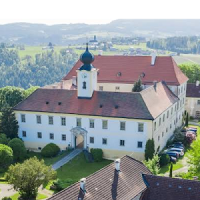
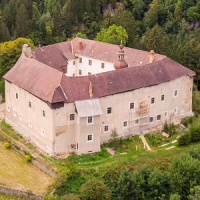
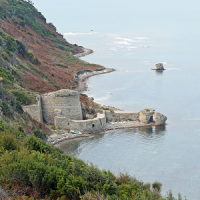
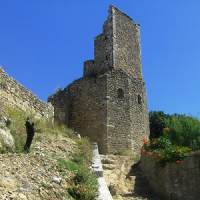
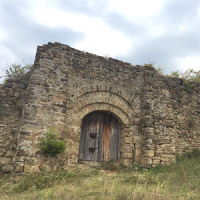
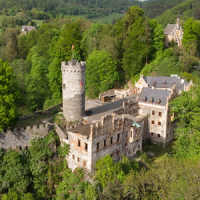
Hasistejn Castle
Hrad Hasistejn
April - May, October Fr-Su 10.00-18.00, June - September Mo-Su 10.00-18.00. Weekend: November - March
Adult - 80CZK, Children's (0-6) - Free, Children's (7-15) - 50CZK, Students - 50CZK, Pensioners - 50CZ
www.hasistejn.cz
431 58 Místo, Ústecký kraj, Česká republika
50.445238, 13.257103 View map
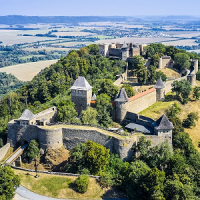
Hasistejn Castle - Hrad Hasistejn, Misto, Usti nad Labem Region, Czech Republic.
The history of Hasištejn Castle is closely intertwined with the evolution of Czech history and architecture. Established in the early 14th century on a strategic site—a narrow promontory bordered to the west by the deep valley of the Prunéřov Stream and to the east by the ravine of a mountain tributary—its origins, though undocumented in writing, are clearly evident in its architectural layout and form, which reveal its vital strategic and defensive role. Shielded by natural features, Hasištejn Castle became a key stronghold for guarding the mountain passes and important routes leading from Germany into Bohemia.
The castle's founder, Bohuslav II of Rýzmburk, married Agáta—the daughter of Fridrich I of Šumburk—marking the beginning of a long history linked to the Šumburk family. Fridrich I, credited with the castle's construction, built it in this strategic location to protect the realm and control key mountain passes. The castle remained in the possession of the Šumburk family until 1418, when, following a three-month siege, it passed into the hands of Mikuláš Chudý of Lobkowicz. Mikuláš had acquired the castle as a pledge from King Wenceslaus IV in recognition of the assistance and services he had rendered to the Crown.
Following the death of Wenceslaus IV, the castle became the property of the Lobkowicz family. Having sustained significant damage during the siege, the structure required extensive repairs and reconstruction. New fortifications were constructed, including a semicircular bastion and a square gate tower accessible via a drawbridge. Mikuláš Chudý died in 1435, but work on the castle continued under his son, Mikuláš II—a man renowned for his wealth who was elevated to the rank of baron in 1459.
Mikuláš II laid the foundations for the Franciscan monastery in Kadaň, where he was later buried. After his death, his brother Jan Popel managed the castle until the eldest son came of age to take over its administration. The castle subsequently remained under the joint ownership of the brothers, with the exception of Bohuslav Hasištejnský of Lobkowicz; upon returning from his travels, he became the castle's chief administrator and patron. However, his efforts to remodel and modernize the site were cut short by his death without an heir in 1510.
From that time on, the castle gradually fell into disrepair and became a source of building materials for local residents. This continued until the late 19th century, when the castle came into the possession of Emanuel Karsch, who initiated a partial restoration. The former palace building was converted into a restaurant, and the tallest tower became an observation tower. Unfortunately, the restaurant burned down in the 1970s, dealing another blow to the already beleaguered castle.
The history of Hasištejn Castle is a tale of rise and fall, of wealth and loss, but above all, of an indomitable spirit that endures within walls that have withstood the test of time. Today, the castle is a prized historical monument that attracts visitors with its unique atmosphere and the stories it has to tell.
19 sen 2026
0
0