- Articles
- Weapons
- Armor
- Armor for horses
- Emperor Armor
- Chivalry
- Chivalry
- Knights castle
- Knights tournament
- The Crusades
- Knightly Orders
- Knightly saddle
- Knightly motto
- Great Knights
- Price of armor
- Children's armor
- Castles and fortresses
- Museums of armor and weapons
- Coats of arms and heraldry
- Routes and excursions
- Guides


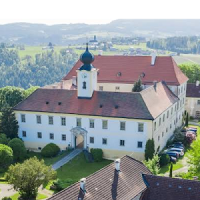
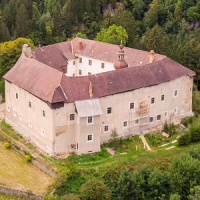
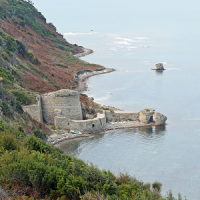
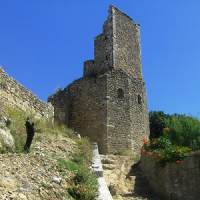
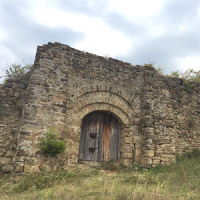
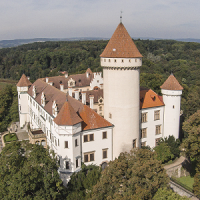
Cornstejn Castle
Hrad Cornštein
Information on the website. Weekend: Information on the website
Adult - 120CZK, Children's (0-5) - Free, Children's (6-17) - CZK, Students - 70CZK, Pensioners - 70CZK, Family (2+3) - 350CZK
www.muzeumznojmo.cz
671 10 Bítov, Jihomoravský kraj, Česká republika
48.934167, 15.715235 View map
Cornstejn Castle - Hrad Cornštein, Bitov, South Moravian Region, Czech Republic.
Cornštejn Castle is one of the most remarkable examples of medieval fortification architecture in southwestern Moravia. Originally a small castle with a courtyard and a palace, protected from the south by a high gable wall, it was built during the reign of King John of Luxembourg between about 1320 and 1330. The builder, Raimund of Lichtenburg, as a leading nobleman of the kingdom, had acquired the nearby royal castle of Bítov into fief a little earlier. By building Cornštejn, which guarded an important path from Vranov, Raimund not only strengthened the defense of Bítov, but also acquired another fortified residence worthy of the members of his growing family. Its name is derived from the German Zorn (anger) and Stein (stone, rock). In the 14th century, the castle was supplemented with a palisade, during the reign of Jan of Cornštejn in the first third of the 15th century, a second, more comfortable palace with a residential tower was built, the castle was expanded with a lower forecourt with farm buildings and other gates. The defense even included a dangerous hill south of the castle. In the 1440s of the 15th century, the Cornštejn lords were so strong that they were able to wage an independent fight with the neighboring Austrians, and even resist the Holy Roman Emperor Frederick III.
In the mid-15th century, Cornštejn was held by Lord Hynek Bítovský of Lichtenburg, who refused to swear allegiance to the Kališnice king Jiří of Poděbrady and led an open rebellion against him in 1463–1464. The Moravian Diet declared Hynek a disturber of the peace and sent troops to Cornštejn. The eleven-month siege of Cornštejn became a political event of European importance, as the Pope of Rome himself was behind the rebellious Lichtenburg. Cornštejn was not conquered by force, but was starved.
King George then took it away from the treacherous Hynek and entrusted it to the lords of Krajíř of Krajku in a new fief. Wolfgang Krajíř of Krajku and his sons repaired and expanded the castle at the turn of the 15th and 16th centuries. An advanced fortification with advanced cannon bastions grew up in the saddle south of the castle. However, due to constant legal disputes and squabbles with the lords of Bítov, the Krajířs sold Cornštejn back to the Lichtenburgs after 1526. In 1542, in connection with the Turkish threat, the fortifications of Cornštejn were last modernized. After the extinction of the Lichtenburgs, the next owners of Bítov no longer cared for the castle and let it fall into disrepair. The last owners, the Haas of Hasenfels, had the castle nationalized as a ruin based on Beneš's decrees.
The current appearance of the castle is largely the result of an extensive, but unfinished reconstruction from the 1970s. In 1987, the castle was transferred to the administration of the South Moravian Museum in Znojmo, which has been open to the public since 1998 during the summer season. In 2011, with the financial support of the European Union, further reconstruction work was carried out, new observation decks were opened and the palace cellars were made accessible, which were subsequently equipped with exhibits of the torture chamber and the cenotaph for the castle garrison. The surroundings of the castle are notable as a recreational and naturally valuable area. It is surrounded by the Cornštejn Nature Reserve, which protects preserved forests, rocks and scree with many valuable plant species. Among the animals, there are, for example, the rare blue butterfly and the giant beetle. Common swifts nest directly on the castle, and other bird species can also be observed here. In autumn and winter, Cornštejn is a popular location for several species of bats.
1 okt 2026
0
0