Pietro Caino, Milan, Italy.
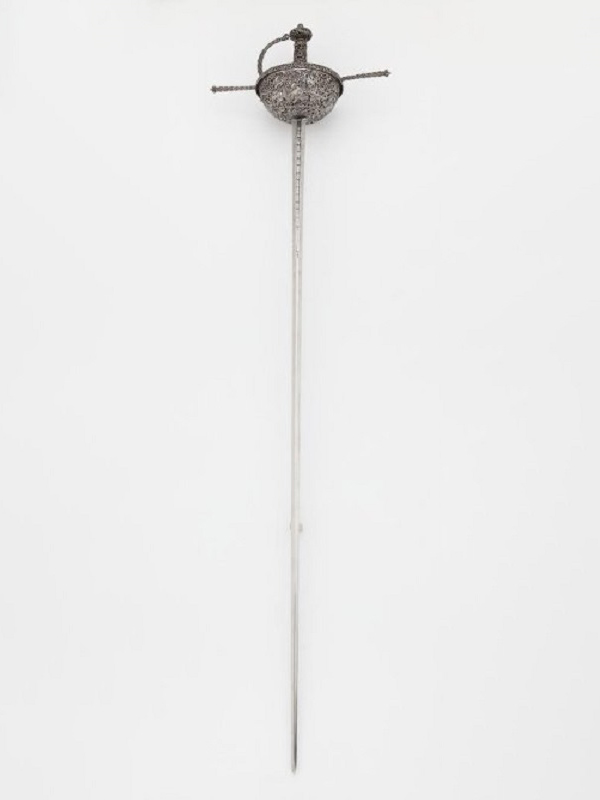
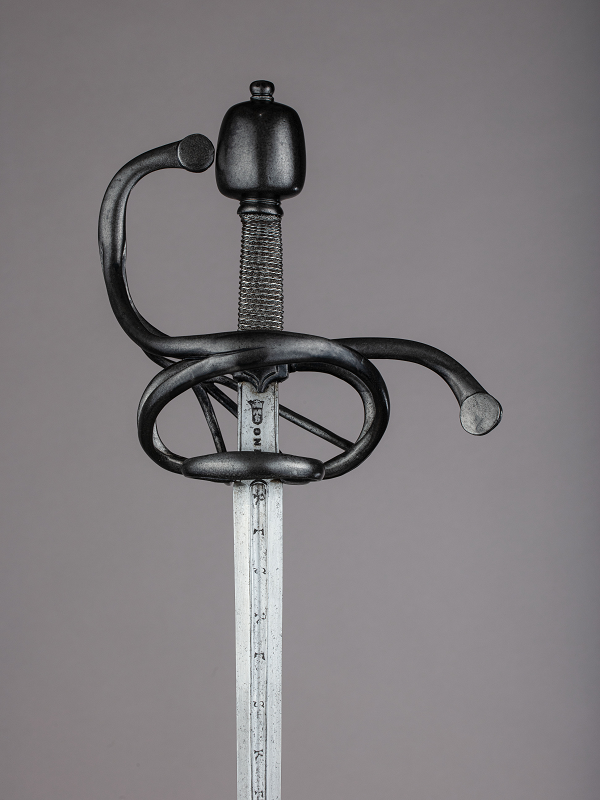
Rapiers with blades bearing, among other hallmarks, the name "Caino" are often found in large arms collections. These are among the finest and most valuable Italian blades, and so we have made considerable efforts to obtain more detailed information about this important maker. Unfortunately, we have only partially succeeded, and we must reserve this famous name for further research.
Caino is already mentioned with praise in a 1642 manuscript by the armourer Antonio Petrini, and I will quote the relevant passage here in German translation: Petrini, discussing Milanese smiths, says: "Some blades are engraved with the image of the moon, and on it is the name Caino; they are very long, with a comb without a concave edge. They are highly prized if they are not counterfeits: I have often examined such blades and have found both good and bad ones among them. Therefore, caution is very important here, because counterfeits are common."
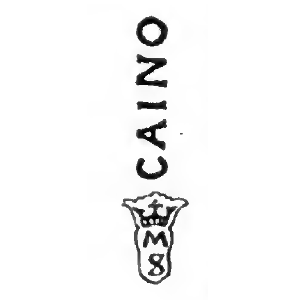
Nothing further can be learned about this master from older sources, as even the Annals of the Fabrics of the Duomo of Milan do not mention him among its smiths. The influence of Caino is evident in the style of his blades. The sword was undoubtedly made in the town of Caino on the Harza River above Brescia, where blade making had been successfully practiced for centuries, around 1550. At the same time as Pietro, a certain Francesco de Caimo, son of the late Andrea, was working in Rome; he is mentioned as a smith living on Mount Giordano in 1555. His works can be found in almost all the major public and private collections. The Artillery Museum holds a rapier with a hilt decorated with the finest gold leaf (J. 115), on the blade of which one can read the following inscription: "Petro Caimo (sic!) - al seo de Lio." On the second (J. 171) the inscription is engraved on the blade: "Petro Caino in Milan — el Segno del lioni doro." From these words we deduce the master's mark: a golden lion, and assume that his workshop was on Via degli Spadari, where most blacksmiths were located. On another, somewhat younger, blade with a coat of arms (J. 148) a crowned letter S is engraved in the partition, similar to the one Sahagún had (see there), with the name "Caino." The blade of rapier J. 156, with the hallmark A, F below it and the name Caino, does not belong to our master. A rapier with the same toponym as (J. 115) is kept in the Royal Historical Museum in Dresden. Other works by his hand are in the art collections of Vienna, the Royal Armoury in Berlin, the Royal Armoury in Turin, and the Royal Private Armoury in Stockholm. Kaino used various hallmarks, including the one shown here, as well as the letters P.S.M., which appeared several times in a row. We have not yet encountered the "moon" on any of his blades, but this in no way calls into question the accuracy of Petrini's credible statements. The letters IHS (Jesus) also appear on a blade in Paris (J. 698). On a blade in Turin, his name even appears alongside those of Sebastian Hernandez. This is, of course, a fake.
Source: Meister der Waffenschmiedekunst vom XIV. bis ins XVIII. Jahrhundert, Wendelin Boeheim, 1897, Berlin, 27
Weapons of the great master you can see:
Hermitage museum, Saint Petersburg, Russian Federation.
The Metropolitan Museum of Art, New York, New York, USA.