Peter Munsten, (1591-1627), Solingen, Germany.
Albert Weyersberg, a leading scholar of Solingen's industrial history, whose advice we also consult here, unfortunately has less information about the life of this important master than we would like. The family appears to have been established and active in Solingen since ancient times, but the name first appears in connection with Peter in the late 16th century.
The family name apparently derives from a small village near Solingen; at least as early as 1594, an Andreas Müngsten was working in Müngsten, near Solingen. This Andreas, Peter's brother, left for Spain in the early 17th century and worked in Toledo and also in Calatayel. We will add his hallmarks at the end. Weyersberg later also mentions Peter working in London; this is confirmed by blades from Copenhagen and Stockholm, which we will discuss later. From 1597 to 1598, Peter Müngsten was mayor of Solingen. We may well recognize him as our master.
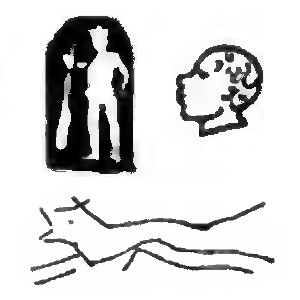
Peter's blades are rarely found in large weapon collections; those we have seen are distinguished by the fineness of the material and meticulous craftsmanship, and they strike us as strikingly similar to Spanish blades, leading us to suspect that Peter also worked for some time in Toledo. The shape of his hallmarks already hints at this: a wild man and a Moor's head. The former is borrowed from Sebastian Hernandez, while the latter—a Moor's head—can already be seen on the blades of Emperor Charles V's swords around 1530. Incidentally, Johannes Hoppe also used the image of a wild man in a similar form. Kronau presents hallmarks of both Andreas and Peter, undoubtedly accurately drawn. We reproduce Peter's hallmarks here as an illustration.
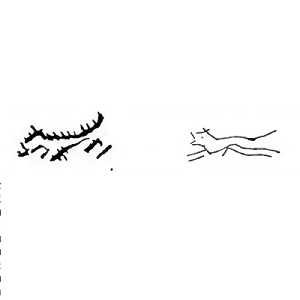
He also sometimes uses a "wolf" in the long, elongated form characteristic of Solingen's work. Weyersberg adds a question mark to the quotation from a passing remark in our "Weapon Studies" section about how the Passau "Wolf" is easily distinguished from later imitations. This prompts us to answer it: the original Passau "Wolf" is carved, always inlaid with brass, and all the lines are covered by short, roughly chiseled cross-lines, which in their crude execution are intended to represent volcanic craters.
Thus, on the left we see the Passau Wolf, and on the right, the Solingen Wolf.
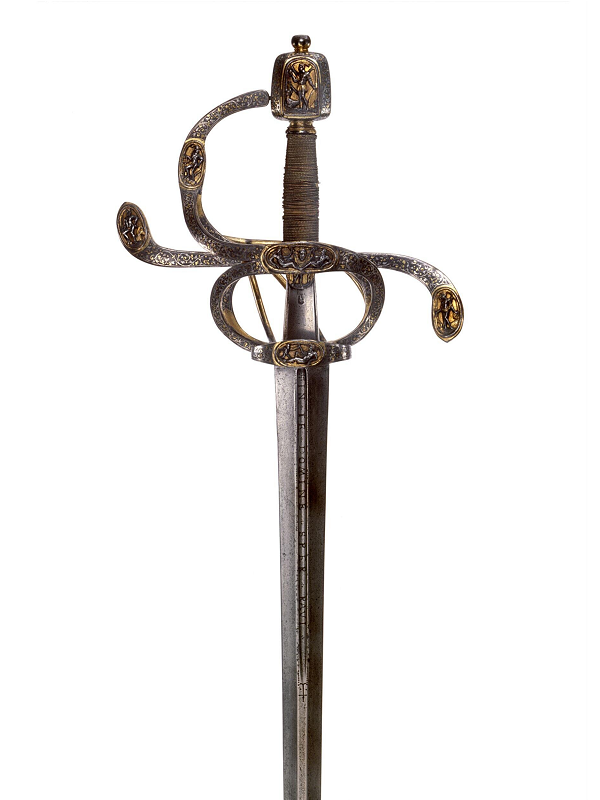
Swords by Peter are in the Imperial House Armory in Vienna and the Royal Armory in Berlin. A magnificent sword, richly inlaid with silver, from the Hohenzollern princely collection in Sigmaringen, bears the "Wolf" and the maker's name: "Peter Munsten me fecit, Solingen." A sword from the Stockholm and Copenhagen collections, dating to the late 16th century, bears the inscription: "Peter Munsten me fecit, London." It remains unclear whether this presence in London should be attributed to the period before or after his accession to the mayoral office. We lean toward the former. In the Royal Armory in Stockholm, we find another magnificent sword, the blade of which (73 h) bears the maker's name and the date Solingen. The deeply incised stamp depicts a savage, but in a different form:
Such variations should not be surprising; they are explained by the fact that the stamps wore out quickly. Here, the stamp indicates that we are dealing with a later work by the master.
The blade created by the master clearly demonstrates his importance and the scale of his work. We see it on a magnificent sword in the Artillery Museum (I. 379), which King Henry IV received as a gift from Pope Alexander VI on the occasion of his wedding to Marie de' Medici in 1599. In his catalogue, Robert calls it "la lame de Solingen d'unc grandc beaute" (a Solingen blade of extraordinary beauty). It is engraved with the name Peter Munstein. The stamp is unclear. The blade of the city sword from the aforementioned museum (J. 205) depicts only a "savage man." On the blade of a sword inscribed "Peter Münsten" in the weapons collection in Sigmaringen, the "Wolf" is also visible.
We know of only one blade belonging to Peter the Younger, undoubtedly the master's son; it is housed in the Royal Historical Museum in Dresden. Its hallmark, which Gronau also correctly identifies, depicts a female figure with a bird's head. This young master's career began around 1600, and with him, his name disappears among Solingen smiths. Finally, we turn to our master's brother, Andreas, who also appears to  have some significance. We find his name in a list of Toledo smiths provided to us by Don José Rodríguez Palomina. His hallmark, listed there—two letters A and M, surmounted by a crown and joined together—is clearly distorted. The author writes: "Andrés Münsten. Also active in Calatayel." Gronau, on the other hand, presents us with master's marks, which he undoubtedly developed more precisely: he dates them all to 1597, and from them we can see that he also used the mark with the Moor's head. The author identifies a third mark as depicting a monk. The following blades made by him are described here: a city sword in the historical collection of weapons in Copenhagen (p. 185), with the inscription "Andrejs Münsten"; in the Royal Armoury in Stockholm (76), with the same inscription; and finally, in the Royal Armoury in Berlin.
Source: Meister der Waffenschmiedekunst vom XIV. bis ins XVIII. Jahrhundert, Wendelin Boeheim, 1897, Berlin, 151
Weapons of the great master you can see:
Victoria and Albert Museum, London, Greater London, United Kingdom.