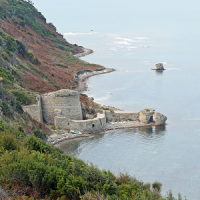
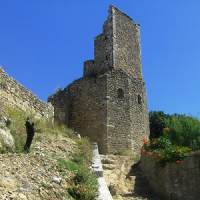
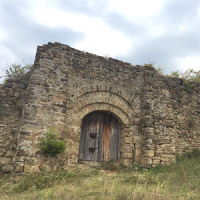

Gabriel and Francesco da Merate, activ Milan 1480-1495, Arbois 1495-1509, Milan, Italy. Arbois, Burgund.
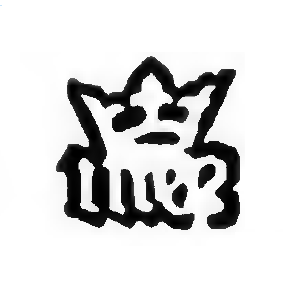
Upon his accession to the throne, King Maximilian I, faced with the decline of armor production in his Burgundian lands, was forced to call upon skilled and experienced armorers from Milan.
On April 17, 1494, the king, in his own name and that of his son Philip I, concluded a three-year contract in Worms with Gabriel de Mérate and his brother Francesco. In exchange for an immediate payment of 1,000 francs and 1,000 Rhenish gold guilders, payable in three annual installments, they agreed to build and fully equip a forge and mill on a site assigned to them in the town of Arbois, Burgundy. Furthermore, Gabriel was to receive an annual salary of 100 francs and be exempt from taxes for his work. In return, Master Gabriel was obligated to annually produce 50 suits of Burgundian armor, marked with a special master's hallmark: each suit of armor was guaranteed to cost 40 francs. He also required 100 helmets "with lattice guards" at 10 francs each. Additionally, he required 100 pairs of large guards' armor at 5 francs each and 100 pairs of guards' armor at 40 francs each. Gabriel was obligated to work exclusively for the king, who, in turn, was obligated to accept his work and pay in two installments, one on the summer solstice and the other on Christmas.
On the Monday before St. Matthew's Day in 1496, the king of Vigenin ordered his quartermaster, André, to collect the archers' armor from Master Gabriel, load it, and transport it to Genoa. Documents in the Innsbruck governor's archives indicate that King Maximilian placed large orders with the Merat family in preparation for the planned 1507 campaign to Rome.
On December 24, 1507, Georg Kirchmüllner complained to the king in a letter from Trent that Gabriel de Merat had still not delivered his cuirassier and was causing him further inconvenience.
On December 30, 1508, Paul von Liechtenstein wrote to the emperor that, by order of the emperor, he had written to the Fugger factor and Macrath regarding negotiations regarding the ships "Geliger" and "Harnasch," which had been detained by the Venetians at the border.
On the same matter, Jakob Fugger wrote to the emperor from Augsburg on March 14, 1509, stating that Gabriel de Mora (she!) had been unable to achieve anything in Venice. "They told him there: 'What business is it of his?'" Documents concerning the imperial arsenal in Arbois and the Mératet brothers are valid until 1509; after that point, all further information ceases. Apparently, the emperor terminated the contract, as the effective work in Nuremberg made the expensive institution superfluous, and even in the Netherlands, a more than equal figure emerged in the person of Jacques Voys.
Mératet's relationship with Maximilian I certainly existed before 1494. The armor for the old German infantry, used by Claude de Vaudreuil, adviser and chamberlain to Duke Charles the Bold of Burgundy, when he fought Emperor Maximilian I at the Diet of Worms and was defeated, bears the hallmark:
This is a Milanese hallmark and is undoubtedly an earlier hallmark of the Mératet brothers (Collection of Coats of Arms of the Imperial House in Vienna, 917).Another suit of German foot cavalry armor from the same collection (948), entirely covered in gold leaf and unnamed, is found in old inventories. Named after the "Kingsfelder," but undoubtedly belonging to the emperor, it bears the mark of the imperial armory in Arbois, the only known example to date, already bearing this mark. Gabriel's seal in the documents depicts an ancient head turned to the left.
Source: Meister der Waffenschmiedekunst vom XIV. bis ins XVIII. Jahrhundert, Wendelin Boeheim, 1897, Berlin, 133
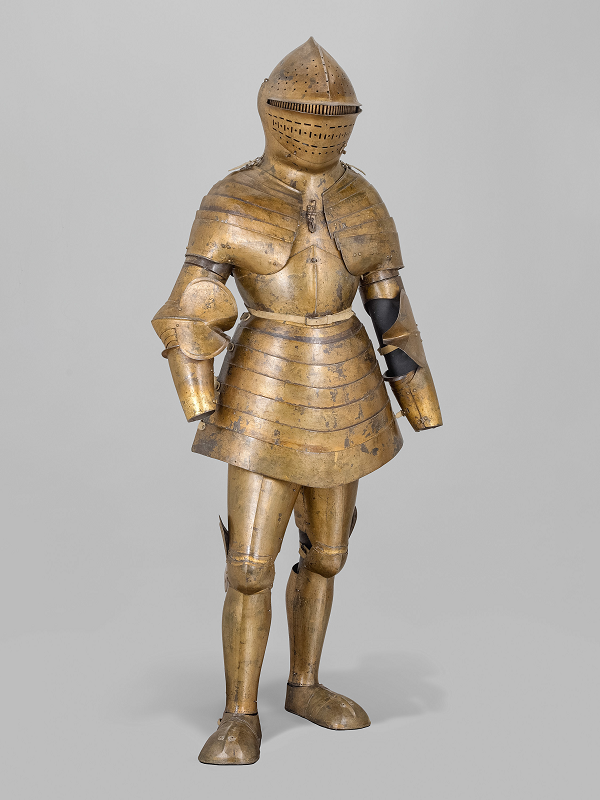
Famous customers of the master:
Emperor Maximilian I
Armor of the great master you can see:
Hofjagd- und Rüstkammer, Wien, Republik Österreich.