

Wilhelm von Worms the Elder - Wilhelm von Worms d.Ä.. (activ 1497 - died 1537), Nuremberg, Germany.
Wilhelm the Elder was the son of Hans von Worms, a Nuremberg gunsmith living in modest circumstances, mentioned as alive in 1501; his mother was Anna. Wilhelm's brother, Heinrich, was a citizen and gunsmith in Würzburg. Wilhelm presumably worked in the workshop of Hans Grünewalt, whose daughter, Elsbeth, he also married in 1501. He apparently improved his position through this marriage, as his wife brought him a house next to the corner house (Zum geharnischten Mann) in Nuremberg as a dowry, as well as 100 Rhenish florins. From his father, he received 50 Rhenish florins. However, Wilhelm worked not in the aforementioned house, but in the house of the late Grünewalt. Elsbeth, who died around 1518, does not appear in the death register of St. Sebald's Church, the parish to which her house belonged. In 1526, he appears again in the register as married to a certain Anna, from a wealthy family, whose name is unknown. The marriage was short-lived, as she also died in 1529 and appears in the death register as living in the gunsmiths' market. Whether William married a third time is unknown; for reasons discussed later, we may doubt this.
William had four children, all likely descended from Elsbeth. The eldest was William, later court armorer to Charles V, followed by Sebald, also an armorer. Wilhelm died in 1567, along with two daughters: Barbara, married to the gunsmith Hendrik Kolb, and Anna, married to the gunsmith Valentin Siebenbürger, who died in 1547 and is buried in St. John's Cemetery. After the marriage of his daughter Anna around 1531, Wilhelm moved in with her and his son-in-law, leaving him with all his clients and working in his workshop as he pleased. At the height of his career, Wilhelm achieved great fame in Nuremberg; at one point, in 1529, we also find him among those mentioned by the Elder Council. His family coat of arms can be found in the armorial of the library of the Germanisches Nationalmuseum among those created after 1506. The coat of arms is divided into four quarters. The first and fourth quarters depict two crossed boxes in the form of a ladder, similar to those used for transporting barrels on wagons. In the second and third quadrants, a stag leaping to the right. This last figure suggests that the "leaping stag" mark, which we previously attributed to Grünewald, belongs not to this city, but to the older Worms. We find it on three inscriptions in the Germanisches Nationalmuseum, two of which are dated 1498.
Documents concerning William the Elder's activities, which likely began around 1497, provide only scant evidence. Baader mentions Finen in the Annals of Zahn. He made various suits of armor for the bailiff of Kitzingen, the knight Ludwig von Hutten, but was unable to receive payment, so in 1528 the council issued him a stern warning.
According to the death records of Saint Sebald, William the Elder died in his house on Schmidgasse in 1537.
Source: Meister der Waffenschmiedekunst vom XIV. bis ins XVIII. Jahrhundert, Wendelin Boeheim, 1897, Berlin, 234
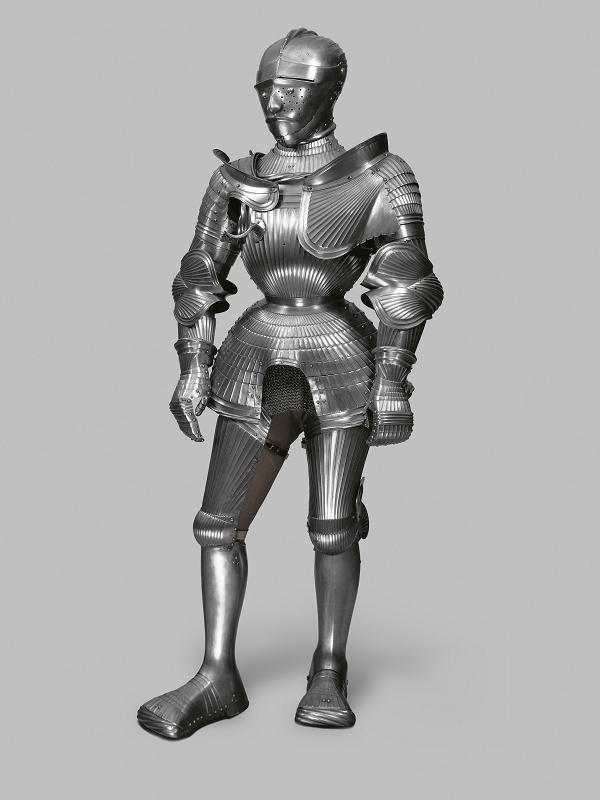


Famous customers of the master:
Duke Ulrich of Württemberg
Armor of the great master you can see:
Hofjagd- und Rüstkammer, Vienna, Austria.
Saint Louis Art Museum, Saint Louis, Missouri, USA.
Philadelphia Museum of Art, Philadelphia, Pennsylvania, USA.