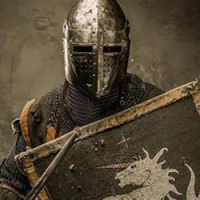

The Spangenhelm (de: Spangenhelm) is one of the most durable and widespread helmet types in European history. It dominated from Late Antiquity (3rd–4th centuries) until the early 11th century, surviving the fall of the Roman Empire, the Great Migration Period, the Viking Age, and the Early Middle Ages. The name comes from the German word "spange," meaning "strip, fastener," which accurately reflects the helmet's main design feature.
Design: Ingenious simplicity.
Unlike later, solid-forged helmets, the spangenhelm was assembled from several parts, like a construction set. The core consisted of:
A frame made of metal strips (usually 4–6 vertical "spangs" and a horizontal rim).
The crown segments are triangular or trapezoidal plates of iron or bronze, inserted between the strips and secured with rivets. The lower rim (brow band), often reinforced, served as a base for attaching additional elements.
The crown of the helmet was often crowned with a brow band or decorative finial. Many examples had a nasal and cheek plates, and an aventail—a chainmail mesh that protected the neck and lower face—was attached to the lower rim.
This segmented design had enormous advantages:
Easy to repair in the field—replacing just one damaged plate was sufficient.
Relatively inexpensive and quick to manufacture, even in small workshops.
Good durability: impacts were distributed across the frame rather than concentrated in one spot.
Historical Path.
The spangenhelm emerged in the late Roman era as a development of earlier frame helmets. Roman legionaries and especially their barbarian allies (Goths, Franks, Alemanni) actively used such helmets as early as the 4th and 5th centuries. After the fall of the Western Roman Empire, the technology spread throughout Europe and Asia—from Merovingian France to Byzantium, the Avar Khaganate, and even to the territory of what would become Rus'.
In the 6th and 7th centuries, luxurious "princely" versions with rich decoration appeared. One of the most famous is the Morken helmet (6th–7th centuries), covered in gold leaf with embossed patterns and cheek pieces.
During the Viking and Anglo-Saxon eras, the spangenhelm evolved into simpler forms but retained its framed design. The famous Sutton Hoo helmet (7th century) is a striking example of a "face" spangenhelm with a mask covered in silver and gold.
In combat: a balance of protection and mobility.
The spangenhelm provided excellent protection against overhead slashes thanks to its convex shape and frame, which deflected blows to the side. However, the eyes, cheeks, and mouth remained relatively uncovered—this provided good visibility and ventilation, but required skill and courage from the warrior.
The helmet was worn over a quilted liner or felt cap. It typically weighed 1.5–2.5 kg, allowing for long periods of combat without severe neck fatigue. By the 10th–11th centuries, the spangenhelm gradually gave way to more protective Norman conical helmets with a solid crown, but remained in use for a long time in remote regions of Europe.
Varieties.
The simple bandhelm—a minimalist frame with 2–4 segments.
The kreuzbandhelm—with cross-shaped bands on top for greater rigidity.
With a face mask—luxurious options for the nobility (Sutton Hoo, Merken).
With a nasal guard and cheek plates—transitional forms to the Norman type.
Heritage.
The spangenhelm is a true symbol of the Dark Ages and the early Middle Ages. It combined Roman engineering with barbarian practicality. Even after the advent of solid-forged helmets, its design ideas continued to live on in later armor.
Today, the spangenhelm is one of the most popular helmets among historical reenactors due to its relative ease of manufacture and authentic appearance. Original artifacts are housed in museums across Europe (the British Museum, the Bonn Museum, Byzantine collections, and others).
This helmet has seen hundreds of battles, from the battlefields of the Catalaunian Wars to Viking battles, and has proven that sometimes the most reliable protection is not a monolith, but a skillfully assembled system of strips and plates, where each component contributes to the overall strength. The spangenhelm remains a shining example of how ancient craftsmen were able to create effective and beautiful weapons from limited resources.