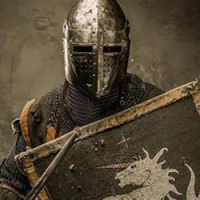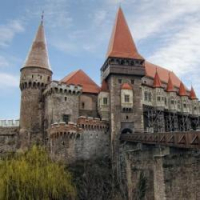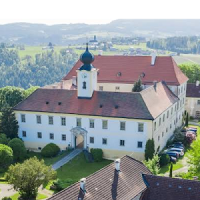
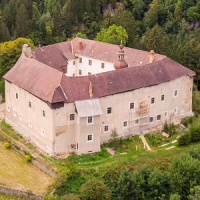
Military and Hospitaller Order of Saint Lazarus of Jerusalem.
Before the Crusades, there was, outside the walls of the Holy City, a leper hospital under the patronage of Saint Lazarus. It was under the jurisdiction of the Greek-Melkite Patriarchs of Jerusalem and served by Armenian monks. It was from this hospital that the Order of Saint Lazarus emerged.
In contrast to the other military and religious orders that established themselves in the Holy Land, which were dependent on the Latin Church, the Order of St Lazarus was under the jurisdiction of the Eastern Church.
After the Crusaders took Jerusalem in 1099, those knights who had contracted leprosy came to be cared for at the Hospital of Saint Lazarus, some of them remaining within the monastic community and taking vows while not abandoning their chivalric commitment. It was thus that the Order of St Lazarus acquired its final identity.
The Hospitallers of St Lazarus cared for lepers and were required to welcome into their number knights from other Orders who had been stricken by this disease. Together they constituted an army and fought for those values that are essential to life.
The Order of St Lazarus is a Christian Order, welcoming into its ranks without partiality Catholics, Protestants, Orthodox and Anglicans.
The coming of the Second World War saw the Order of St Lazarus organising, from 1940 onwards, an ambulance corps for the French front. During the occupation, it set up a corps of volunteer aid workers under the name "Volontaires de l’Ordre de Saint-Lazare", which saved many lives during the bombardments, particularly in Normandy and around Paris.
In 1945, its humanitarian and patriotic efforts were acknowledged by the French government, which conferred the Croix de Guerre on the Order’s Grand Capitular in recognition of the bravery of the Order of St Lazarus’ volunteers during the war.
Once war was over, the Knights of St Lazarus resumed their hospitaller work and their efforts to bring about unity among Christians. To this end, agreements were entered into with Raoul Follereau in order to resume the fight against leprosy, with, inter alia, dispensaries set up in Africa and a village for lepers built in Senegal.
The Order’s conferment of knighthood on Albert Schweitzer was an expression of its twin vocations of humanitarianism and Christian unity, and the Doctor and Pastor of Lambaréné became involved in the Order’s African projects.
As a consequence of all these endeavours, the Order of St Lazarus has been accorded official recognition by a number of states, among them Bolivia, Canada, Austria, Croatia and Hungary.
The Order gained new dynamism when, in September 2004, the Chapter General elected its 49th Grand Master in the person of His Royal Highness Prince Charles-Philippe d’Orléans, Duc d’Anjou.
Source: https://www.saint-lazare.org/index.php?id=orderhistory&L=1%2F
The Charter of the Knightly Order of Saint Lazarus.
The Charter of the Knightly Order of Saint Lazarus (Military and Hospitaller Order of Saint Lazarus of Jerusalem, Ordo Militaris et Hospitalaris Sancti Lazari Hierosolymitani) differs significantly from the statutes of the Knights Templar or Hospitaller.
Charter Basics.
The Order arose in the first half of the 12th century (approximately 1130) on the premises of a leper colony (hospital for lepers) outside the walls of Jerusalem. Initially, it was a Hospitaller brotherhood that cared for those afflicted with leprosy. Later, it acquired a military-chivalric character: knights from other orders (Templars, Hospitallers) who had contracted leprosy were accepted into its ranks.
The Order followed the Augustinian Rule of Saint Augustine, the same as the Order of the Hospitallers (St. John). This statute was typical of Western Hospitaller and canonical communities. Pope Alexander IV officially recognized the order as a military-monastic and Hospitaller order in the bull Cum a Nobis Petitur in 1255.
Key provisions of the medieval statute.
Since the full original text of the early statute has not survived in its entirety (only fragments of cartularies and references are known), the main features are reconstructed from indirect sources and analogy with the Augustinian statute:
Three monastic vows:
Obedience (especially important in a military structure).
Poverty (community of goods).
Chastity.
Hospital mission (primary initially): care for lepers, the sick, and the poor. Those afflicted with leprosy were considered "living dead" and often became full brothers of the order. In some leper colonies, even the master could be elected from among the sick. Military function: Healthy and sick knights fought together. Lazarite knights (lepers) were considered particularly desperate warriors—they often chose death in battle rather than surrender.
Clothing and symbols: White cloak with a green cross (eight-pointed or simple). Green symbolized hope and a connection with the illness of Lazarus (from the Gospel).
Structure:
Grand Master.
Knights (military elite, often of noble birth).
Serving brothers and chaplains.
Sick brothers (lepers), who had a special status.
Discipline and daily life: Asceticism, communal prayer, caring for the sick, fasting, silence during meals, reading during meals. Prohibitions on luxury, hunting (except for special occasions), and personal property.
A distinctive feature of the order: it accepted leper knights, whom other orders (for example, the Templars) were obliged to exclude according to their own rules. This made the Order of Saint Lazarus a unique "order of the living dead."
Later Statutes and Changes.
In the 13th century, the order received numerous papal privileges and immunities (Popes Urban IV, Clement IV, and others).
After the loss of the Holy Land (the fall of Acre in 1291), the order survived in Europe, primarily in France, Italy, and Spain. Its military role gradually diminished, while its Hospitaller role remained.
The modern order (which has several branches and obediences) is governed by the Constitution and Statutes of the 20th and 21st centuries. They retain a Christian (ecumenical) character, vows of mercy and assistance to the sick (especially those suffering from leprosy and other diseases), but the military function is symbolic. The order emphasizes charity, support for Christianity, and assistance to those in need. The Order of Saint Lazarus was one of the smallest and most specialized military monastic orders. Its knights fought in battles (including the defense of Acre in 1291), but were renowned primarily as the "leper knights," who fought with exceptional courage.
Major Battles of the Knightly Order of Saint Lazarus.
The major battles of the Knightly Order of Saint Lazarus (the Military and Hospitaller Order of Saint Lazarus of Jerusalem) are relatively few in number compared to larger orders like the Hospitallers or the Templars. The order was small and specialized: it united knights afflicted with leprosy (leprosy), who were expelled from other orders. These "living dead" (as they called themselves) fought with particular ferocity, often with their visors open, to terrify their enemies, who feared the contagion.
The order's military role manifested itself primarily in the 13th century in the Holy Land. The Knights of Lazarus participated in the campaigns of the Kingdom of Jerusalem, but almost never acted independently.
Key Battles and Campaigns Involving the Order.
The Battle of Montgisard (1177).
One of the earliest and most successful battles. A small detachment (according to some sources, around 300 Knights of Saint Lazarus) fought in the forefront of the army of the leper king Baldwin IV against Saladin's forces. The crusaders achieved an unexpected victory, routing Saladin's guard. This is a striking example of the Lazarites' participation.
Third Crusade (1189–1192).
The Lazarites participated in several battles and sieges, including:
The Siege and Capture of Acre (1191) was a significant victory for the crusaders led by Richard the Lionheart and Philip II Augustus.
The Battle of Arsuf (1191) and the Battle of Jaffa (1192) were successful actions against Saladin's forces.
The Battle of La Forbie (Hiribya / Gaza, October 17–18, 1244) was the most tragic and famous battle of the Order.
The Crusaders' greatest defeat since Hattin. The combined army (Templars, Hospitallers, Teutons, Lazarites, and local barons) clashed with Egyptian Ayyubids and Khwarezmian mercenaries.
The Order of Saint Lazarus lost its entire contingent: all the knights (both healthy and lepers) perished, along with the Master. This was a catastrophe for the Order—the almost complete destruction of its military branch in the Holy Land. The battle is sometimes called "the second Hattin."
The Seventh Crusade of Saint Louis IX (1248–1254).
The Lazarites participated in the Egyptian campaign, including the battles of Damietta and, most notably, the crushing defeat at Mansura (1250) and subsequent skirmishes. In 1253, they also participated in the attack on Ramla (Ramla).
The Siege and Fall of Acre (1291) – the end of the order's military history in the Holy Land
The last stronghold of the Crusaders. All the military brothers of the Order of Saint Lazarus stationed in Acre perished defending the city from the Mamluks under the command of Sultan Khalil. This marked the end of the order's presence in the Levant.
After 1291, the order virtually lost its military role and survived in Europe (primarily in France, in Boigny) as a Hospitaller organization.
A distinctive feature of the order: the Lazarites rarely formed large independent units (their numbers were small). They became famous not for the number of victories, but for their desperate bravery and the psychological impact they had on their enemies. After heavy losses in 1244, Pope Innocent IV even permitted able-bodied knights to hold leadership positions in the order.
In later centuries (for example, at the Battle of Lepanto in 1571), individual branches or related orders (the Savoy Order of Saints Maurice and Lazarus) participated in naval battles, but that's another story.
Castles and fortifications of the Knights of Saint Lazarus.
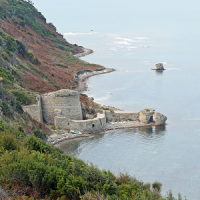
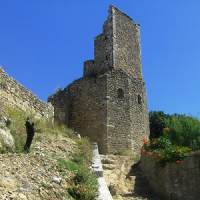
The castles and fortifications of the Knights of Saint Lazarus (the Military and Hospitaller Order of Saint Lazarus of Jerusalem) differ markedly from the extensive network of Hospitaller or Templar fortresses.
The Order originally arose as a leper hospital outside the walls of Jerusalem (c. 1098–1130), and only assumed a military role in the 13th century. It was small in size, specialized in caring for those afflicted with leprosy, and did not build large independent castles. Knights of Lazarus (including lepers) more often fought as part of general Christian armies or defended existing fortifications.
In the Holy Land (12th–13th centuries)
The Order had a leper colony (a hospital for lepers) and several dependent hospitals, but it owned almost no large castles of its own. It is known that the Lazarites sometimes received control of individual fortifications for their defense:
The leper colony outside the walls of Jerusalem was the central location of the order. It was not a full-fledged castle, but had defensive elements.
Fortifications in Acre (Acra) - after the loss of Jerusalem, the order maintained a quarter and hospital in Acre. It participated in the defense of the city in 1291 (all the military brothers stationed there perished).
Individual forts and commanderies: sources mention that the order was entrusted with the defense of small fortifications, such as Kharbet el Zeitha and Madjel el Djemeriah (the exact location and condition are poorly documented today; these were more likely small outposts than large castles).
After the fall of Acre in 1291, the order evacuated to Cyprus, then to Sicily and Europe. It did not maintain a large network of castles in the Holy Land.
Main European Residences.
After the loss of the Holy Land, the order's center moved to France:
Château de Boigny-sur-Bionne (near Orleans, France) is the main residence and most significant castle of the order. King Louis VII gave it to the order in 1154 after the Second Crusade. In 1288, it was elevated to a barony. After 1291, it became the de facto headquarters of the order in Europe. It housed the commandery, church, and lands. The castle remained important until the 16th and 17th centuries. It still exists today (though not in full possession of the order), and modern ceremonies of some branches of the order are occasionally held there.
Other European commanderies and hospitals (mostly leper colonies, not military castles):
Burton Lazars (England) is an important center in England with a hospital and commandery. Capua (Capua, Southern Italy) is the main center in the Kingdom of Sicily.
Commanderies in Hungary, Switzerland, and other regions of Europe were mostly hospitals and small houses, sometimes with fortified elements.
Modern period (20th–21st centuries).
The modern branches of the order (there are several obediences) use or have owned the following buildings:
Castello Lanzun (Torri Ta Lanzun, Malta, San Gwann) – a fortified tower (15th–17th century fortified tower), restored and transferred to one of the branches of the order in the 1970s. It is used as an administrative center and meeting place (Grand Commandery of the Castello). It previously served as a defense against pirates and as a hunting lodge.
Some branches of the order mention other historic buildings, but they are more symbolic or administrative in nature.
Conclusion: The Order of Saint Lazarus was never a large "castle" order. Its strength lay not in its fortifications, but in its unique mission—caring for lepers and the willingness of the "living dead" (knights with leprosy) to fight to the bitter end. The main "castle" in European history became the Château de Boigny, and in modern times, Castello Lanzun in Malta.
Grand Master of the Order of Saint Lazarus:
Gérard le Fondateur (1099–1120)
Boyant Roger (1120–1131)
Jean (1131–1153)
Barthélémy or Bartholomeo (1153–1154)
Hitier or Hector (1154–1155)
Hughes de Saint-Paul (1155–1157)
Raymond du Puy (1157–1159)
Rainier or Lambertus (1164–1168)
Raymond (1168–1169)
Gérard de Montclar (1169–1185)
Bernard (1185–1186)
Gauthier de Châteauneuf or Walter de Novo Castro (1228–1234)
Rainaldus de Floriaco or Reynald de Fleury (1234–1254)
Miles (1256–1267)
Jean de Meaux (1267–1277)
Thomas de Sainville (1277–1312)
Sir Adam de Veau (1313–1330)
Jean de Paris (1332–1348)
Jean de Couraze (1349–1354)
Jean le Comte (1355–1361)
Jacques de Besnes or Jacques de Baynes (1382–1384)
Pierre des Ruaux (1413–1454)
Guillaume des Mares (1454–1469)
François d'Amboise (1493–1500)
Agnan de Mareul (1500–1519)
François de Bourbon, Comte de Saint-Paul (1519–1521)
Claude de Mareul (1521–1554)
Jean de Conti (1554–1557)
Jean de Lévis (1557–1564)
Michel de Seure de Lumigny (1564–1571)
François de Salviati (1578–1586)
Michel de Seure de Lumigny (1586–1593)
Aymard de Clermont de Chastes (1593–1599)
Hughes Catelan de Castelmore (1599–1603)
Jean-Charles de Gayand de Monterolles (1603–1604)
Philibert, Marquis de Nérestang (1604–1620)
Claude, Marquis de Nérestang (1620–1639)
Charles, Marquis de Nérestang (1639–1644)
Charles-Achilles, Marquis de Nérestang (1645–1673)
François-Michel le Tellier, Marquis de Louvois (1673–1691)
Philippe de Courcillon, Marquis de Dangeau (1691–1720)
Prince Louis de Bourbon, Duc d'Orléans, Chartres, Valois, Nemours et Montpensier (1720–1752)
Prince Louis de France, Duc de Berry (1757–1773)
Prince Louis Stanislas Xavier de France, Comte de Provence, Duc d’Anjou (1773–1814)