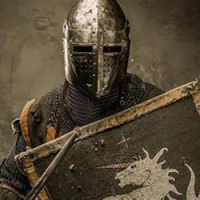


The Cervelliere (fr: Cervellière, de: Hirnhaube, it: Cervelliera, from Latin: cerebrarium — "brain protection") is one of the most modest, yet important, knightly helmets of the Early and High Middle Ages (late 12th – 14th centuries). It is a simple, hemispherical steel cap, tightly fitting to the head, which became the basis for many more complex helmets, including the bascinet.
The cervelliere was not luxurious and did not cover the face, but it laid the foundation for the transition from early medieval helmets to full-fledged Gothic armor. It was practical, inexpensive, and versatile—the ideal solution for a warrior who needed skull protection without excess weight or overheating.
Origin and Historical Context.
The cervellier appeared in the late 12th century as a response to the growing threat of attacks from above during the Crusades and civil wars. Before this, the standard helmets were the Norman nasal-plate helmet or the spangenhelm. The new helmet was a simple iron or steel hemisphere, forged from a single piece of metal (or assembled from plates).
At first, the cervellier was often worn under a mail hood (coif) or a great helm. It protected the top of the skull from slashing blows, arrows, and falls, while mail covered the neck and face. By the 13th century, the cervellier had become a standalone helmet, especially popular among infantrymen, urban militiamen, and lightly armored knights.
The name comes from the French cervelle, meaning "brain," emphasizing its primary function: protecting the most vulnerable part of the head.
Cervellier Construction.
The cervellier was extremely simple:
A hemispherical or slightly conical crown sat snugly on the head, following the shape of the skull.
A small protrusion or curved edge along the lower rim provided a better fit and protection for the temples.
No facial protection—no nasal guards, visors, or cheek pieces in the basic version.
The metal thickness was typically 1.5–3 mm, sufficient to protect against slashing blows, but not against direct thrusts.
Weight was only 0.8–1.5 kg, making it one of the lightest metal helmets.
The helmet was often worn with a felt or leather liner for cushioning and support. Sometimes holes were made along the lower edge for attaching straps or an additional aventail.
Over time, the cervellier evolved: the crown became more elongated, the back portion lengthened to protect the back of the head, and the brim sloped downwards. These changes gradually transformed it into the early bascinet, one of the most successful helmets of the 14th century.
The early cervellier with its characteristic hemispherical shape and simple design.
A later variant, already close to the bascinet, with a more pronounced fit.
Use and advantages.
The cervellier was a true "people's" helmet:
Knights wore it as an inner layer under their helm for additional protection and better support of the heavy "pot."
On its own, infantrymen, archers, and light cavalry prized it for its lightness, ventilation, and good visibility.
With a chainmail hood — a classic combination, the cervellier protected the crown of the head, and the chainmail protected the neck and lower face.
Advantages:
Lightweight and comfortable for extended wear.
Excellent ventilation (unlike closed helmets).
Ease of manufacture and low cost.
Good protection against overhead blows and arrows.
Disadvantages:
Completely open face – vulnerable to thrusts and slashes from the front.
Weak neck protection without an additional aventail.
The cervellier was widely used in the Crusades, in the wars for the English throne, and in the French and Italian campaigns of the 13th century. It was especially popular among crusaders and urban militias.
Evolution and Legacy.
The cervellier was the direct ancestor of the bascinet. By the mid-14th century, many cervelliers already had an elongated nape and sometimes a simple visor – this was the early bascinet. Over time, the open "cervellier" gave way to more protective models, but its concept of a "tight-fitting helmet" influenced many later helmets.
In the early modern period, similar simple steel caps (secrets) were sometimes worn under hats or as hidden protection. Today, original cervelliers are rare museum exhibits (at the Metropolitan Museum of Art, the Paris Army Museum, and British collections). Among reenactors, they are prized for their 13th-century authenticity and comfort in hot weather.
The cervellier is a modest but fundamental helmet of the Middle Ages. It wasn't the most formidable or beautiful, but it marked the beginning of the development of true knightly armor. This simple iron cap on a warrior's head reminded him that sometimes the best protection is a reasonable minimum that doesn't interfere with seeing the enemy, breathing, or fighting. In an era when armor was becoming increasingly heavy, the cervellier preserved the human face of war—open, practical, and ready for battle.