- Articles
- Weapons
- Armor
- Armor for horses
- Emperor Armor
- Chivalry
- Chivalry
- Knights castle
- Knights tournament
- The Crusades
- Knightly Orders
- Knightly saddle
- Knightly motto
- Great Knights
- Price of armor
- Children's armor
- Castles and fortresses
- Museums of armor and weapons
- Coats of arms and heraldry
- Routes and excursions
- Guides


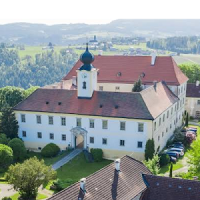
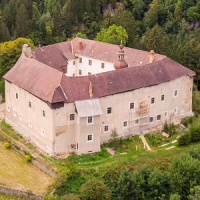
Wallsee Castle - Schloss Wallsee
Schloss Wallsee
External inspection. Weekend: Private property
www.schloss-wallsee.at
Schloss Wallsee 1, 3313 Wallsee, Niederösterreich, Republik Österreich
48.169703, 14.714840 View map
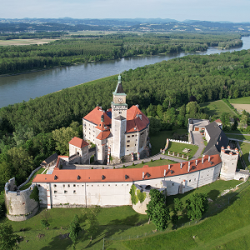
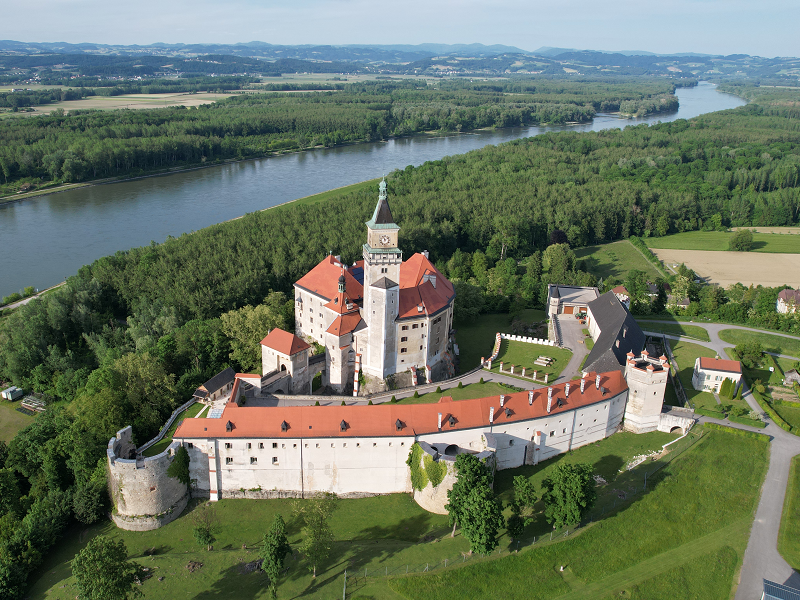
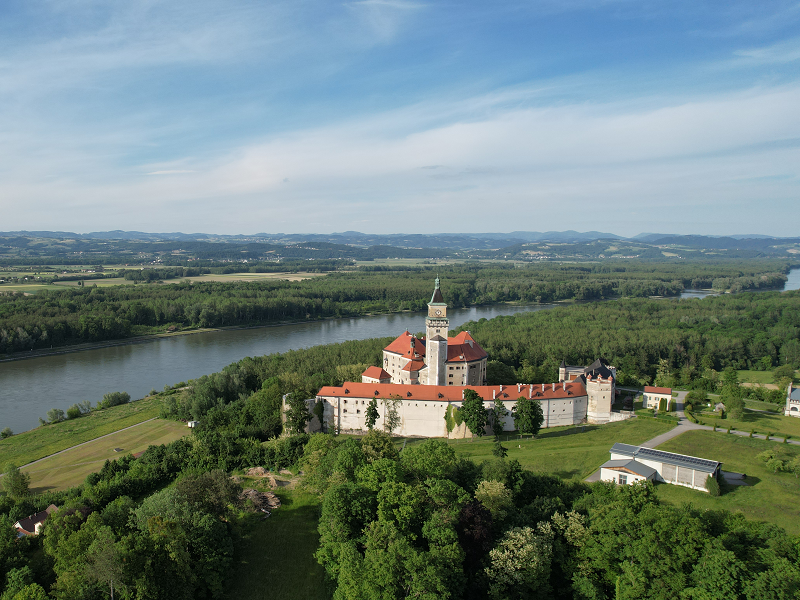
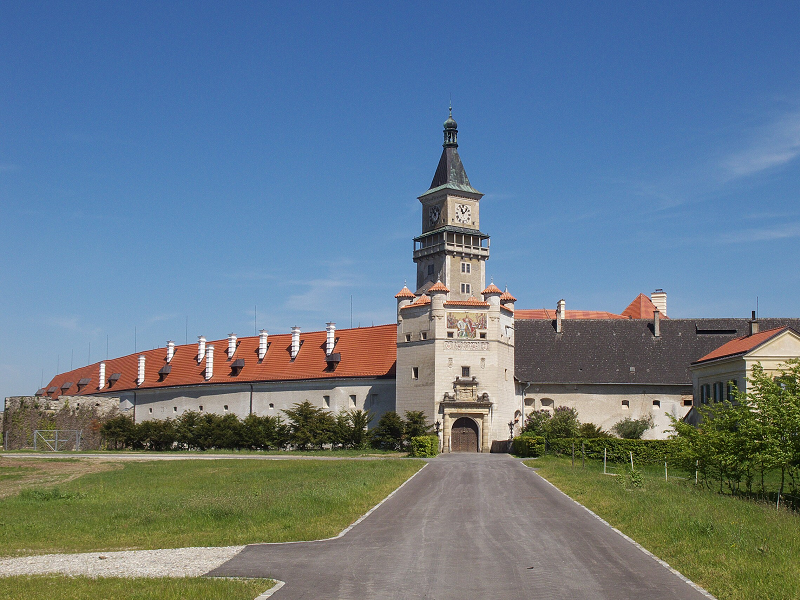
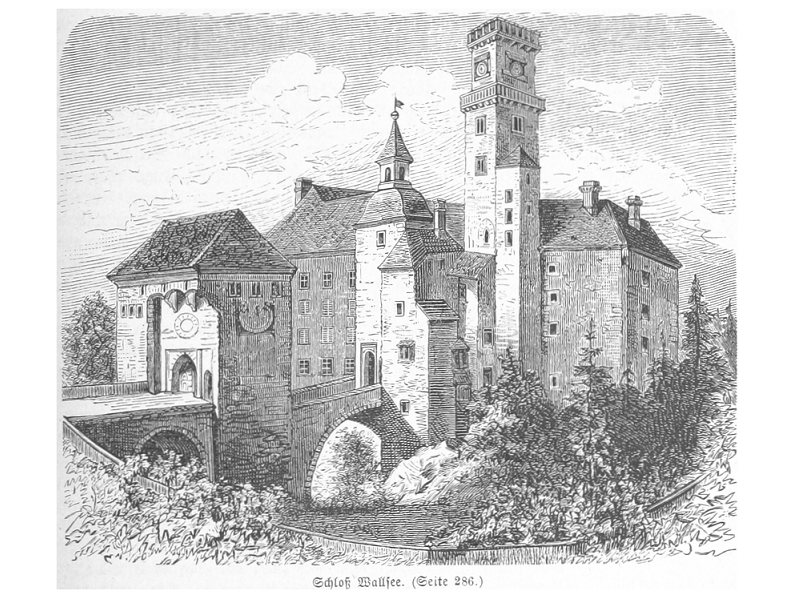
Wallsee Castle - Schloss Wallsee, Wallsee, Lower Austria, Republic of Austria.
The settlement around Wallsee Castle dates back a long way: Archaeological finds from the Roman Imperial period (1st to 4th centuries) have been discovered in the castle park. These suggest that a fort or watchtower once stood on the present-day castle hill. However, due to a lack of written sources from this early period, the history up to the Middle Ages is only partially documented. More reliable records only emerged after the stabilization of the area following the victory over the Hungarians in 955.
The name "Neue Walse" was first documented towards the end of the 14th century. At this time, construction also began on a fortress, which changed hands several times over the centuries.
In 1895, Archduchess Marie Valerie and Archduke Franz Salvator of Austria acquired the property. They initiated extensive construction work and adapted the complex to contemporary tastes. Since 1897, Wallsee Castle has largely presented itself in its present form: The striking Gothic pointed arches and rib vaults were combined with the elegant lines and decorative elements of Art Nouveau – an architectural fusion that gives the castle its distinctive character.
The Lords of the Manor.
Lords of Sunilbur.
In 1071, the parish of Sunilburg, which surrounds the castle, was first mentioned in a document. The church was under the protection of the Lords of Sunilburg, who built and maintained the castle using their own funds.
Lords of Sleunz and Zakkin.
After the decline of the Sunilburg family, the Lords of Sleunz and later the Lords of Zakking took over the castle. They resided at Sommerau Castle and shaped the period after the extinction of the Sunilburg line.
Konrad von Sommerau.
One of the prominent figures associated with Wallsee Castle. As the castellan of Enns, he played a crucial role in the conflicts between King Rudolf of Habsburg and King Ottokar of Bohemia. Konrad von Sommerau opened the gates of Enns to the imperial army and joined it with his own forces. This contributed to the imperial army arriving before Vienna in full force and more quickly than expected. He also played a decisive role in the Battle of Marchfeld, which led to King Rudolf's victory over Ottokar of Bohemia. Konrad von Sommerau was also one of the leading figures in the noble revolt against Albrecht I. However, after the revolt was suppressed, he lost all his fiefs and disappeared from history.
Lords of Wallsee.
After the failure of the noble revolt against Albrecht I, the Waldsee family, an important Hohenstaufen ministerial family from Swabia, came to Austria in 1296 at the instigation of Rudolf of Habsburg.
In 1362, they received market rights for the town of Sindelburg on the Danube, which is now part of the market town of Wallsee-Sindelburg. Just a few years later, in 1368, the name "Neuen Walse" appears for the first time in a document. The first recorded mention of the fortress of the same name followed in 1388, thus also documenting the beginning of construction of the outer bailey under Henry VI of Waldsee.
This medieval construction phase significantly shaped the castle's exterior appearance – particularly through its Gothic pointed arches and rib vaults. These elements were preserved and, centuries later, were stylishly enhanced by Art Nouveau architectural additions under Archduke Franz Salvator and Archduchess Marie Valerie of Austria.
The Saxe-Coburg and Gotha Family.
In 1862, Wallsee Castle came into the possession of the Saxe-Coburg and Gotha family. Duke Ernst of Saxe-Coburg acquired the property. Since he had no children of his own, his nephew Alfred, Duke of Saxe-Coburg and Gotha and Duke of Edinburgh, inherited the castle. In 1895, Alfred decided to sell the castle to Archduke Franz Salvator and Archduchess Marie Valerie of Austria.
The Saxe-Coburg and Gotha family contributed to the preservation and further development of the castle, which by that time had already suffered some neglect. Their decision to acquire the castle in 1862 was an important step in the long history of its ownership. The connection between the Saxe-Coburg and Gotha family and Wallsee Castle added another dimension to the building, which was later further shaped by subsequent owners, Archduke Franz Salvator and Archduchess Marie Valerie of Austria. This transition marked a significant point in the preservation and transformation of the castle before it eventually passed into the possession of the Habsburg-Lorraine family.
Archduchess Marie Valerie and Archduke Franz Salvator of Austria
In 1895, Wallsee Castle became the property of Archduchess Marie Valerie of Austria, the youngest daughter of Emperor Franz Joseph I and Empress Elisabeth ("Sisi"), and her husband, Archduke Franz Salvator.
Since the castle had been barely inhabited in the preceding years, it was in a neglected state. Under the direction of the Archduchess and his wife, extensive renovations and restoration work were carried out to restore the building.
In addition to the necessary structural measures, a stylistic redesign was also undertaken: Particularly in 1901, extensive alterations were made that continue to shape the castle's appearance today. The existing Gothic elements were carefully combined with the flowing lines and decorative details of Art Nouveau – a combination that makes Wallsee Castle architecturally unique to this day.
Margaretha and Andreas Habsburg-Lothringen
In 2001, Margaretha and Andreas Habsburg-Lothringen acquired Wallsee Castle with the aim of preserving its historical fabric and adapting it for contemporary use.
Since 2007, the castle has been open to the public. Since then, its historic rooms have served as a venue for weddings, receptions, exhibitions, Christmas markets, and other cultural events.
Thanks to the owners' ongoing commitment, not only has the listed building been preserved, but a place has also been created where history and the present are intertwined in a modern way.
31 jan 2026
0
0