- Articles
- Weapons
- Armor
- Armor for horses
- Emperor Armor
- Chivalry
- Chivalry
- Knights castle
- Knights tournament
- The Crusades
- Knightly Orders
- Knightly saddle
- Knightly motto
- Great Knights
- Price of armor
- Children's armor
- Castles and fortresses
- Museums of armor and weapons
- Coats of arms and heraldry
- Routes and excursions
- Guides


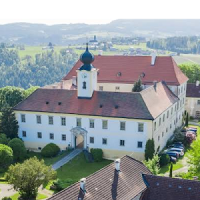
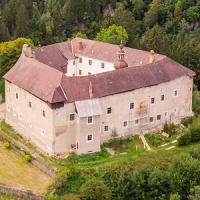

Trsatski Castle
Kaštel Trsatski
Partizanski put 9a, 51000, Rijeka, Primorsko-goranska županija, Republika Hrvatska
45.332398, 14.455342 View map
Trsatski Castle - Kaštel Trsatski, Rijeka, Primorje-Gorski Kotar County, Republic of Croatia.
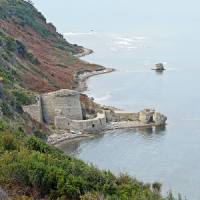
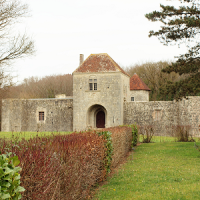
This small fortress, located 138 meters above sea level, occupies a strategic position above the port city of Rijeka. Trsat Castle is built over a deep canyon through which the Riječina River flows. This prime location has been used since prehistoric times as a watchtower for movement along the coast and inland.
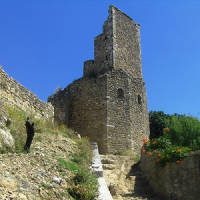
The castle is located in a very strategically important location; the Romans began constructing fortifications here, calling them the Liburnian Limes. Today, only the Roman tower (a typical donjon) remains of the ancient settlement. The main buildings of Trsat Castle were erected around the 13th century. Some buildings and massive walls, some reaching a height of 25 meters, have survived to this day.
In the early 15th century, the city of Rijeka, including the fortress, came into the possession of the prominent Frankopan family. Later, at the end of the 15th century, these lands were bequeathed to his cousin, the Hungarian King Matthias Corvinus. Trsat Castle was then recaptured by Frederick III of Habsburg. At the dawn of the 16th century, a royal captain of the fortress was sent to Trsat Castle by personal decree of the emperor. The establishment of this position increased the rank and importance of the fortification itself. Later, the castle lost its strategic and military significance, as the threat of attack from the Venetian Republic and the Ottoman Empire disappeared. The fortress began to gradually fall into disrepair and cause losses to its owners, especially after 1750, when an earthquake further devastated Trsat.
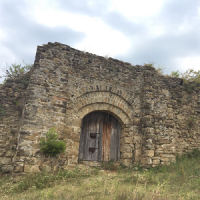
In 1778, Empress Maria Theresa transferred Trsat to the jurisdiction of the municipality of Bakar, where a royal shipyard was built. Trsat remained on the brink of collapse. But in 1826, the castle was purchased by Austrian Field Marshal Laval Nugent, who decided to create an archaeological museum there. He commissioned the Venetian architect Giacomo Paronuzzi to restore the fortress, who refurbished the tower with the main gate. He also added a neo-Gothic rose window and ornamentation. He decorated the Roman tower with railings, and in the center of the fortress, he erected the Nugent family mausoleum, with a classical façade in the style of a Roman temple. After the Field Marshal's death, his descendants brought their ancestor's ashes from Great Britain and placed them in a side niche of the mausoleum. The castle remained in family ownership until almost the end of World War II, when the Field Marshal's great-granddaughter, Countess Anna Nugent, died at the age of 82.
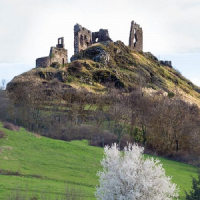
After the two world wars of the 20th century, Trsat again fell into ruins. In 1960, the local government acquired the fortress, and restoration work began. Today, the ancient tower and some of the buildings on the castle grounds have been restored, but the west wing remains in ruins. The castle hosts exhibitions, summer concerts, and theatrical performances, and a restaurant open in the courtyard is open during the summer. The castle is a fine example of medieval architecture and is very popular with tourists. The main tower is visible from virtually anywhere in the city, and there is an observation deck here offering stunning views of the surrounding area.


10 sen 2026
0
0