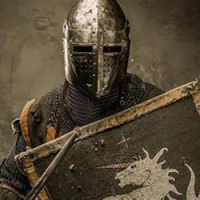





The Norman helmet (also known as the conical helmet or nasal helmet) is one of the most recognizable symbols of the early Middle Ages. It has become an icon of the Viking Age, the Norman Conquests, and the transition from the "Dark Ages" to the classical chivalry of the 11th and 12th centuries. This helmet is primarily associated with the Norman knights of William the Conqueror and is vividly depicted in the Bayeux Tapestry, created shortly after the Battle of Hastings in 1066.
Origin and Construction.
The Norman helmet emerged in the late 9th and early 10th centuries as a development of earlier framed spangenhelm helmets. Unlike their segmented predecessors, many 11th-century examples were made from a single sheet of iron or steel, forged into a distinctive conical or slightly rounded shape. This made the helmet lighter, stronger, and more effective at deflecting blows—the sharp tip prevented weapons from slipping. The main distinguishing feature is the nasal, or nasal plate: a wide metal strip descending from the edge of the crown directly down the center of the face, protecting the nose and upper face from slashing blows. The nasal was often integral with the crown or attached with rivets. Along the lower edge of the helmet was a reinforcing rim (brow band), to which an aventail—a chainmail mesh covering the neck, ears, and back of the head—was sometimes attached.
Typical dimensions:
Crown height: 20–30 cm.
Weight: 1.5 to 2.5 kg (relatively light by the standards of later armor).
The helmet was worn over a quilted liner or directly on the head, and the aventail was often attached to a chainmail hood (coif).
Normans in the Bayeux Tapestry.
The Bayeux Tapestry is the primary visual source for Norman helmets. It depicts both Norman horsemen and Anglo-Saxon warriors wearing nearly identical conical helmets with nasal guards. Helmets were often decorated with decorative bands, bronze or gilded elements, and sometimes colored inlays, emphasizing the warrior's status. William the Conqueror in the tapestry lifts his helmet to show his knights that he is alive—a striking moment emphasizing the practicality of the open design.
Advantages and Disadvantages in Combat.
The conical shape was excellent at resisting slashing blows from swords, axes, and even arrows—the blow glided across the surface without penetrating the skull. The nasal guard protected against direct blows to the face without significantly restricting vision (unlike the fully enclosed helmets of later designs). Its lightness allowed for quick head turns, which was critical for mounted knights. However, the protection was partial: the eyes, cheeks, and mouth remained exposed. In close combat, this left the warrior vulnerable to thrusts or arrows. Therefore, the Normans often combined the helmet with a large almond-shaped shield. By the 12th century, such helmets were gradually replaced by more protective models—the great helm and early bascinets.
Evolution and Regional Characteristics.
Although the helmet is called "Norman," it was widespread throughout Western Europe: among the Vikings, Franks, Anglo-Saxons, and even in Rus' (where similar forms were called "helmets"). By the 12th century, the crown had become taller and sharper, and the nasal sometimes lengthened or acquired decorative forms. Some examples had small brims or additional plates.
Few original archaeological finds have survived—most are known from museums (for example, in Vienna, Brescia, or reconstructions based on finds in Normandy and England). Craftsmen forged them from iron, sometimes with bronze embellishments. Both simple single-plate versions and framed spangenhelms with nasal guards are popular in reenactment circles today.
The Legacy of the Norman Helmet.
The Norman helmet became a transitional link between Viking helmets and full-fledged knightly armor. It symbolized an era when warfare was still relatively "open"—a warrior could see the enemy's face, and battles were often decided by personal valor and skill. It was wearing such a helmet that the Norman heavy cavalry changed the course of European history, conquering England and laying the foundations of feudal chivalry.
Today, the Norman helmet is a favorite among historical reenactors, artists, and medieval enthusiasts. Its simple yet ingenious form inspires the creation of authentic armor and reminds us that sometimes the best protection is not complete coverage, but a clever balance between safety, mobility, and visibility. This humble conical helm with nasal guard has seen action in hundreds of battles, from Hastings to the Crusades, and is still admired for its simple efficiency – a true embodiment of the spirit of the early knights.